Derivative of ln(2x): Why It Is 1/x, With Examples
The derivative of ln(2x) is 1/x, the same as ln x. See two proofs, a graph of why the slopes match, and how ln(2x + 1) is different.
Exponential and log derivatives Updated 2 min read
At a glance
- Derivative
- \dfrac{1}{x} for x > 0
- General form
- \dfrac{d}{dx}\ln(kx) = \dfrac{1}{x} for any constant k > 0
- Key log rule
- \ln(2x) = \ln 2 + \ln x
- Domain of ln(2x)
- x > 0
- Compare
- \dfrac{d}{dx}\ln(2x + 1) = \dfrac{2}{2x + 1}
On this page
The derivative of \ln(2x) is \dfrac{1}{x}. This surprises many students: the 2 disappears, and the answer matches the derivative of ln x.
Proof 1: the chain rule
Let u = 2x, so u' = 2. The chain rule for logs says "derivative of the inside over the inside":
The 2 on top cancels the 2 on the bottom.
Proof 2: split the log first
The product rule for logarithms says \ln(ab) = \ln a + \ln b. So
Now \ln 2 \approx 0.693 is just a number, and the derivative of a constant is 0:
This second proof explains why the answer is the same as for \ln x.
Graph: two curves, same slopes
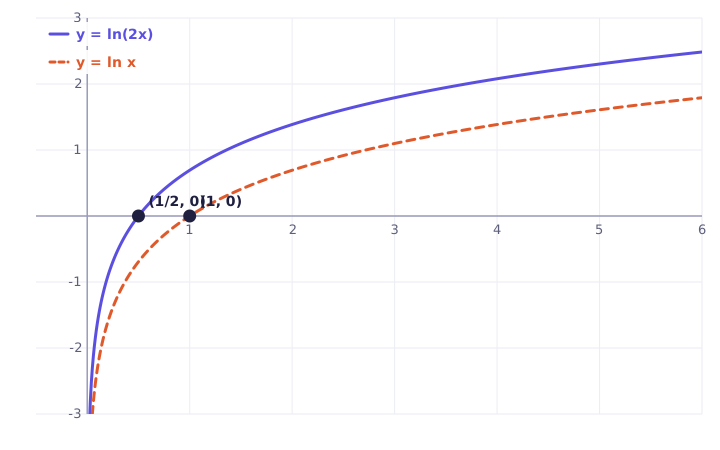
At any x, the two curves are the same vertical distance apart, so their tangent lines are parallel. At x = 2, for example, both have slope \frac{1}{2}.
When the constant does not cancel
The trick only works when the inside is a constant times x. Compare:
| Function | Derivative | Does the constant cancel? |
|---|---|---|
| \ln(2x) | \frac{2}{2x} = \frac{1}{x} | yes |
| \ln(5x) | \frac{5}{5x} = \frac{1}{x} | yes |
| \ln(2x + 1) | \frac{2}{2x + 1} | no |
| \ln(x + 2) | \frac{1}{x + 2} | no |
| \ln(2x^3) | \frac{6x^2}{2x^3} = \frac{3}{x} | the 2 cancels, the power stays |
The last row works because \ln(2x^3) = \ln 2 + 3\ln x.
Worked examples
Example 1: a tangent line. At x = \frac{1}{2}, \ln(2x) = \ln 1 = 0 and the slope is \frac{1}{1/2} = 2. The tangent line is
Example 2: product rule. For f(x) = x\ln(2x), the product rule gives
Example 3: a square. For g(x) = \left[\ln(2x)\right]^2, the outer function is a square:
Common mistakes
- Writing \frac{1}{2x}. You divided by the inside but forgot to multiply by its derivative, 2.
- Writing \frac{2}{x}. You multiplied by 2 but did not keep the 2 in the denominator.
- Cancelling in \ln(2x + 1). The 2 only cancels when the inside is exactly 2x.
See also the derivative of ln(x²), where a power instead of a multiple sits inside the log, and practise more with derivatives of exponential and logarithmic functions.
Practice it now
Chain rule: any function
Solve real problems on this topic with instant feedback, hints and a step-by-step walkthrough for every answer. Free, no sign-up needed to start.
Practice this lesson