Derivative of log x: Base 10 and Base b, With Examples
The derivative of log₁₀ x is 1/(x ln 10), and of log_b x is 1/(x ln b). See the change of base proof, chain rule examples and a graph.
Exponential and log derivatives Updated 2 min read
At a glance
- Derivative of log₁₀ x
- \dfrac{1}{x\ln 10} \approx \dfrac{0.4343}{x}
- General base
- \dfrac{d}{dx}\log_b x = \dfrac{1}{x\ln b}
- Chain rule form
- \dfrac{d}{dx}\log_b u = \dfrac{u'}{u\ln b}
- Change of base
- \log_b x = \dfrac{\ln x}{\ln b}
- Domain
- x > 0
On this page
The derivative of \log_{10} x is \dfrac{1}{x\ln 10}. For a log with any base b:
It is the derivative of ln x, \frac{1}{x}, divided by the constant \ln b.
Which log is "log x"?
The notation depends on where you are:
- On calculators, in chemistry and in most high school courses, \log x means \log_{10} x.
- In many calculus books, in higher math and in most programming languages, \log x means \ln x.
- In computer science, \log x often means \log_2 x.
If you are not sure, look at the answer key: an answer with \ln 10 in it means base 10.
Proof with the change of base formula
The change of base formula turns any log into a natural log:
Since \frac{1}{\ln b} is a constant, the constant multiple rule gives
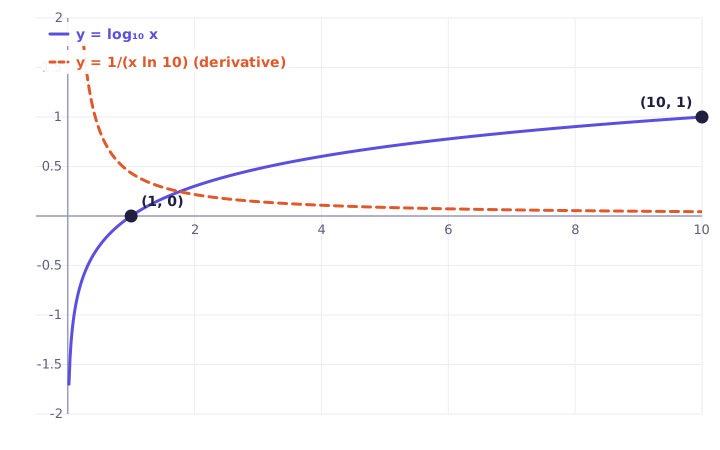
For base 10, \frac{1}{\ln 10} \approx 0.4343. So a base 10 log grows at about 43\% of the rate of the natural log.
Graph of log₁₀ x and its derivative
Derivatives for common bases
| Function | Derivative | Approximate |
|---|---|---|
| \ln x | \frac{1}{x} | \frac{1}{x} |
| \log_{10} x | \frac{1}{x\ln 10} | \frac{0.4343}{x} |
| \log_2 x | \frac{1}{x\ln 2} | \frac{1.4427}{x} |
| \log_3 x | \frac{1}{x\ln 3} | \frac{0.9102}{x} |
Chain rule version and examples
Example 1. \frac{d}{dx}\log_{10}(x^2 + 1) = \frac{2x}{(x^2 + 1)\ln 10}.
Example 2. \frac{d}{dx}\log_2(3x) = \frac{3}{3x\ln 2} = \frac{1}{x\ln 2}. The 3 cancels, just like in the derivative of ln(2x).
Example 3: product rule. For f(x) = x\log_{10} x,
Example 4: decibels. Sound level is L = 10\log_{10}\frac{I}{I_0}. Then \frac{dL}{dI} = \frac{10}{I\ln 10}, so each extra unit of intensity matters less as I grows.
Inverse of aˣ
\log_b x is the inverse of b^x, whose derivative is b^x\ln b (see the derivative of 2ˣ and aˣ). One has \ln b on top and the other has it on the bottom, as the inverse function rule predicts.
Common mistakes
- Writing \frac{1}{x} for base 10. That is only right for the natural log.
- Putting \log 10 instead of \ln 10. The factor is always a natural log. (\log_{10} 10 = 1, which would wrongly cancel it.)
- Writing \frac{\ln 10}{x}. The \ln b goes in the denominator.
For more, see logarithmic functions and derivatives of exponential and logarithmic functions.
Practice it now
Exponentials and logarithms
Solve real problems on this topic with instant feedback, hints and a step-by-step walkthrough for every answer. Free, no sign-up needed to start.
Practice this lesson