Derivative of sec x: Formula, Proof and Examples
The derivative of sec x is sec x tan x. See the proof from 1/cos x, the chain rule for sec(u), a graph and worked examples like sec(2x) and x sec x.
Trigonometric derivatives Updated 2 min read
At a glance
- Derivative
- \sec x\tan x for x \ne \frac{\pi}{2} + k\pi
- In sin and cos
- \dfrac{\sin x}{\cos^2 x}
- Chain rule form
- \dfrac{d}{dx}\sec u = \sec u\tan u \cdot u'
- Slope at x = 0
- \sec 0\tan 0 = 0
- Integral version
- \int \sec x\tan x\,dx = \sec x + C
On this page
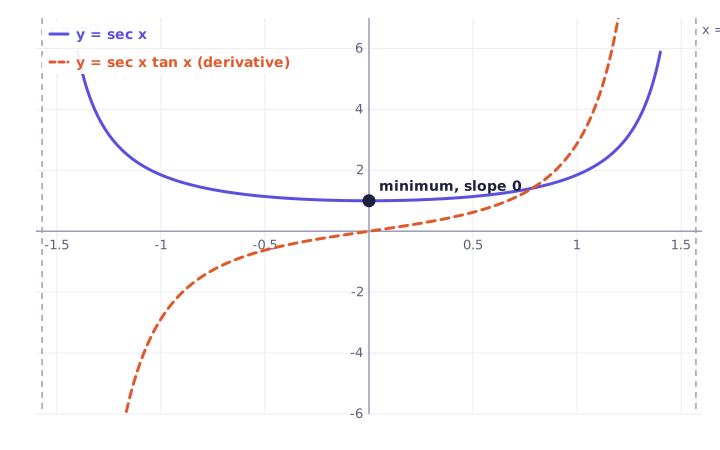
The derivative of \sec x is \sec x\tan x. Secant is the reciprocal of cosine, so its derivative comes straight from the derivative of cos x.
Graph of sec x and its derivative
Proof with the chain rule
Write \sec x = (\cos x)^{-1}. The chain rule with the power -1 outside and \cos x inside gives
Split the fraction into two familiar pieces:
The quotient rule on \frac{1}{\cos x} gives the same thing: \frac{0\cdot\cos x - 1\cdot(-\sin x)}{\cos^2 x} = \frac{\sin x}{\cos^2 x}.
The chain rule version: derivative of sec(u)
Both \sec and \tan keep the same inside.
| Function | Inside u | Derivative |
|---|---|---|
| \sec(2x) | 2x | 2\sec(2x)\tan(2x) |
| \sec(x^2) | x^2 | 2x\sec(x^2)\tan(x^2) |
| \sec(3x + 1) | 3x + 1 | 3\sec(3x + 1)\tan(3x + 1) |
| \sec\left(\frac{1}{x}\right) | \frac{1}{x} | -\frac{1}{x^2}\sec\frac{1}{x}\tan\frac{1}{x} |
Worked examples
Example 1: a product. \frac{d}{dx}(x\sec x) = \sec x + x\sec x\tan x = \sec x(1 + x\tan x).
Example 2: a power. \frac{d}{dx}\sec^3 x = 3\sec^2 x\cdot\sec x\tan x = 3\sec^3 x\tan x.
Example 3: a sum that simplifies. \frac{d}{dx}(\sec x + \tan x) = \sec x\tan x + \sec^2 x = \sec x(\tan x + \sec x). This neat result is the trick behind the integral of sec x, \ln\lvert\sec x + \tan x\rvert + C.
Example 4: a value. At x = \frac{\pi}{3}, \sec\frac{\pi}{3} = 2 and \tan\frac{\pi}{3} = \sqrt{3}, so the slope is 2\sqrt{3} \approx 3.46.
How to remember it
Secant and tangent always travel together in calculus. The derivative of \tan x is \sec^2 x, and the derivative of \sec x is \sec x\tan x. One way to keep them straight: tangent's derivative has no tangent in it, while secant's derivative contains both functions once each. Checking a value also helps. At x = 0 secant has its minimum, so the slope must be zero, and indeed \tan 0 = 0.
Common mistakes
- Writing \tan^2 x or \sec^2 x. The derivative of \sec x is \sec x\tan x. \sec^2 x is the derivative of \tan x.
- Adding a minus sign. Secant is not a "co" function, so its derivative is positive. Compare with the derivative of csc x, -\csc x\cot x.
- Changing only one inside. \frac{d}{dx}\sec(5x) = 5\sec(5x)\tan(5x). Both factors keep 5x.
Reading the result backward gives the integral of sec x tan x. The reciprocal trig functions page covers the graph of secant.
Practice it now
Sine, cosine and tangent
Solve real problems on this topic with instant feedback, hints and a step-by-step walkthrough for every answer. Free, no sign-up needed to start.
Practice this lesson