Derivative of sec²x: Formula, Proof and Examples
The derivative of sec²x is 2sec²x tan x. See two proofs, one with the chain rule and one with 1 + tan²x, plus examples like sec²(3x).
Trigonometric derivatives Updated 2 min read
At a glance
- Derivative
- 2\sec^2 x\tan x for x \ne \frac{\pi}{2} + k\pi
- In sin and cos
- \dfrac{2\sin x}{\cos^3 x}
- Chain rule form
- \dfrac{d}{dx}\sec^2 u = 2\sec^2 u\tan u\cdot u'
- Relation to tan x
- \sec^2 x is the derivative of \tan x, so this is \frac{d^2}{dx^2}\tan x
- Integral of sec²x
- \int \sec^2 x\,dx = \tan x + C
On this page
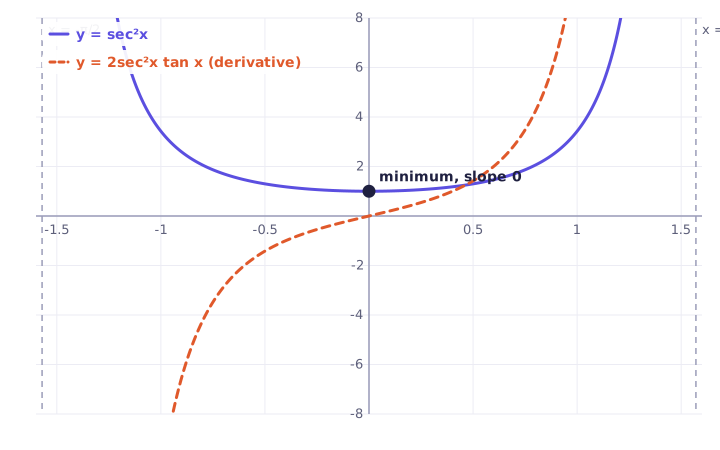
The derivative of \sec^2 x is 2\sec^2 x\tan x. Read \sec^2 x as (\sec x)^2, then apply the chain rule once.
Graph of sec²x and its derivative
Proof 1: chain rule on (sec x)²
The outer function is the square, the inner function is \sec x. Using the chain rule and the derivative of sec x:
Proof 2: using 1 + tan²x
The identity \sec^2 x = 1 + \tan^2 x gives a second route. The 1 drops out, and \tan^2 x is a square of \tan x:
Both routes agree, which is a good check on the identity.
Proof 3: in terms of cos x
\sec^2 x = (\cos x)^{-2}, so
Split it as 2\cdot\frac{1}{\cos^2 x}\cdot\frac{\sin x}{\cos x} = 2\sec^2 x\tan x.
Why this is the second derivative of tan x
The derivative of tan x is \sec^2 x. So differentiating \sec^2 x is the same as differentiating \tan x twice:
The sign of this tells you the concavity of \tan x: concave down for -\frac{\pi}{2} < x < 0 and concave up for 0 < x < \frac{\pi}{2}.
Chain rule variants
Example 1. \frac{d}{dx}\sec^2(3x) = 6\sec^2(3x)\tan(3x).
Example 2. \frac{d}{dx}\sec^2(x^2) = 4x\sec^2(x^2)\tan(x^2).
Example 3: a value. At x = \frac{\pi}{4}, \sec^2\frac{\pi}{4} = 2 and \tan\frac{\pi}{4} = 1, so the slope is 2\cdot 2\cdot 1 = 4.
Example 4: a product. \frac{d}{dx}(x\sec^2 x) = \sec^2 x + 2x\sec^2 x\tan x.
Where you will meet it
The derivative of \sec^2 x comes up most often in two places. The first is finding the concavity and inflection points of \tan x, since \sec^2 x is its first derivative. The second is in integration, where recognizing 2\sec^2 x\tan x as a derivative lets you undo it quickly with u-substitution: setting u = \tan x turns \int 2\tan x\sec^2 x\,dx into \int 2u\,du = \tan^2 x + C. Since \tan^2 x and \sec^2 x differ only by 1, that is the same family of antiderivatives.
Common mistakes
- Stopping at 2\sec x. That is only the outer derivative. Multiply by \sec x\tan x.
- Answering \tan x. \tan x is the integral of \sec^2 x, not its derivative. See the integral of sec²x.
- Treating \sec^2 x as \sec(x^2). \frac{d}{dx}\sec(x^2) = 2x\sec(x^2)\tan(x^2), which is different.
Squares of sine and cosine follow the same pattern: see the derivative of sin²x and derivative of cos²x.
Practice it now
Chain rule: trig
Solve real problems on this topic with instant feedback, hints and a step-by-step walkthrough for every answer. Free, no sign-up needed to start.
Practice this lesson