Derivative of sin 2x: Formula, Proof and Examples
The derivative of sin 2x is 2cos 2x. See the chain rule proof, a check with 2 sin x cos x, the general sin(ax) rule and worked examples.
Trigonometric derivatives Updated 2 min read
At a glance
- Derivative
- 2\cos 2x
- General rule
- \dfrac{d}{dx}\sin(ax) = a\cos(ax)
- Second derivative
- -4\sin 2x
- Period
- \pi, half the period of \sin x
- Integral of sin 2x
- \int\sin 2x\,dx = -\frac{1}{2}\cos 2x + C
On this page
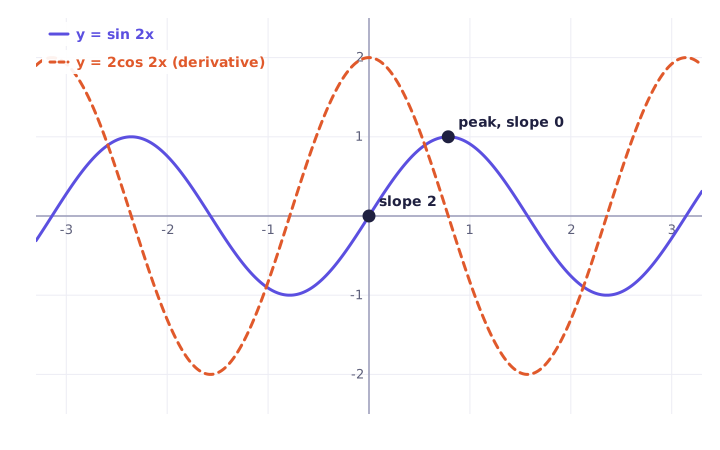
The derivative of \sin 2x is 2\cos 2x. The chain rule pulls the inner factor 2 out front, and the inside 2x stays the same.
Graph of sin 2x and its derivative
Proof with the chain rule
Outer function \sin u, inner function u = 2x, so u' = 2. With the chain rule and the derivative of sin x:
A check with the double angle formula
Rewrite \sin 2x = 2\sin x\cos x and use the product rule:
The double angle formula \cos^2 x - \sin^2 x = \cos 2x turns this into 2\cos 2x. Two methods, one answer.
Why the 2 comes out
Squeezing the graph horizontally by a factor of 2 makes it twice as steep everywhere. That is what the factor 2 in front of \cos 2x records. In general:
| Function | Derivative |
|---|---|
| \sin 3x | 3\cos 3x |
| \sin\frac{x}{2} | \frac{1}{2}\cos\frac{x}{2} |
| \sin(2x + 1) | 2\cos(2x + 1) |
| \sin(\pi x) | \pi\cos(\pi x) |
| 5\sin 2x | 10\cos 2x |
Worked examples
Example 1: a value. At x = \frac{\pi}{6}, the slope is 2\cos\frac{\pi}{3} = 2\cdot\frac{1}{2} = 1.
Example 2: a product. \frac{d}{dx}(x\sin 2x) = \sin 2x + 2x\cos 2x.
Example 3: higher derivatives. Each derivative brings out another 2: \frac{d^2}{dx^2}\sin 2x = -4\sin 2x, \frac{d^3}{dx^3}\sin 2x = -8\cos 2x, and \frac{d^4}{dx^4}\sin 2x = 16\sin 2x.
Example 4: a link to sin²x. The derivative of sin²x is \sin 2x. So \sin^2 x is an antiderivative of \sin 2x, and so is -\frac{1}{2}\cos 2x. They differ by a constant, since \sin^2 x = \frac{1}{2} - \frac{1}{2}\cos 2x.
Where you will meet it
The function \sin 2x appears whenever a wave repeats twice as often as \sin x. It also shows up as a simplified answer, for example as the derivative of \sin^2 x, so knowing its own derivative saves time on second derivatives. In physics, \sin 2\theta appears in the range of a projectile, and its derivative tells you how the range changes as you tilt the launch angle.
Common mistakes
- Forgetting the 2. \frac{d}{dx}\sin 2x is not \cos 2x.
- Changing the inside. The answer is 2\cos 2x, not 2\cos x.
- Dividing instead of multiplying. \frac{1}{2} shows up when you integrate, not when you differentiate. See the integral of sin 2x.
- Confusing \sin 2x with 2\sin x. \frac{d}{dx}(2\sin x) = 2\cos x. The graphs are different.
For more chain rule drills, try the chain rule practice problems.
Practice it now
Chain rule: trig
Solve real problems on this topic with instant feedback, hints and a step-by-step walkthrough for every answer. Free, no sign-up needed to start.
Practice this lesson