Derivative of sin²x: Formula, Proof and Examples
The derivative of sin²x is 2 sin x cos x, which equals sin 2x. See the chain rule proof, a check with a double angle identity and examples.
Trigonometric derivatives Updated 2 min read
At a glance
- Derivative
- 2\sin x\cos x
- Simplified
- \sin 2x
- Chain rule form
- \dfrac{d}{dx}\sin^2 u = 2\sin u\cos u\cdot u'
- Not the same as
- \sin(x^2), whose derivative is 2x\cos(x^2)
- Integral of sin²x
- \int\sin^2 x\,dx = \frac{x}{2} - \frac{\sin 2x}{4} + C
On this page
The derivative of \sin^2 x is 2\sin x\cos x, which the double angle formula shortens to \sin 2x.
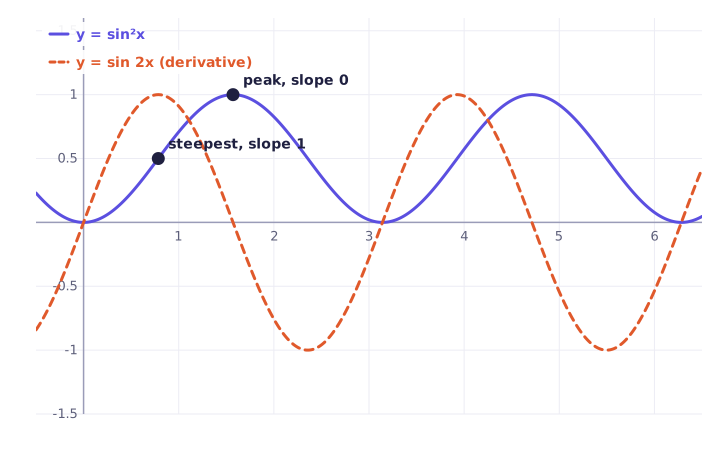
Graph of sin²x and its derivative
Proof with the chain rule
The notation \sin^2 x means (\sin x)^2. Outside is the square, inside is \sin x. The chain rule gives
The double angle identity \sin 2x = 2\sin x\cos x tidies it up to \sin 2x.
A check with a double angle identity
Rewrite first with \sin^2 x = \frac{1 - \cos 2x}{2}:
Same answer, no chain rule on a square needed. This power-reducing identity is also how you integrate it, see the integral of sin²x.
A check with the product rule
Write \sin^2 x = \sin x\cdot\sin x and use the product rule: \cos x\sin x + \sin x\cos x = 2\sin x\cos x.
Chain rule variants
| Function | Derivative | Simplified |
|---|---|---|
| \sin^2(3x) | 6\sin 3x\cos 3x | 3\sin 6x |
| \sin^2(x^2) | 4x\sin(x^2)\cos(x^2) | 2x\sin(2x^2) |
| \sin^2\left(\frac{x}{2}\right) | \sin\frac{x}{2}\cos\frac{x}{2} | \frac{1}{2}\sin x |
Worked examples
Example 1: a higher power. \frac{d}{dx}\sin^3 x = 3\sin^2 x\cos x.
Example 2: a value. At x = \frac{\pi}{4}, the slope is \sin\frac{\pi}{2} = 1. That is the steepest point of \sin^2 x.
Example 3: maximum slope. The derivative \sin 2x is at most 1, so \sin^2 x never climbs faster than slope 1, the same top speed as \sin x.
Example 4: second derivative. \frac{d}{dx}\sin 2x = 2\cos 2x, so \sin^2 x is concave up where \cos 2x > 0, for example on \left(-\frac{\pi}{4}, \frac{\pi}{4}\right).
Why the answer has period π
The function \sin^2 x never goes negative, so its graph repeats every \pi instead of every 2\pi. The derivative \sin 2x also has period \pi, which is a good consistency check: a function and its derivative should repeat together. If your answer had period 2\pi, such as 2\cos x, something went wrong. Matching the period is a quick way to catch errors without redoing the algebra.
Common mistakes
- Answering \cos^2 x. Squaring the derivative is not the chain rule.
- Answering 2\cos x. The square's derivative is 2\sin x, and then you multiply by \cos x.
- Mixing up \sin^2 x and \sin(x^2). See the derivative of sin(x²): 2x\cos(x^2).
The cosine version is on the derivative of cos²x page, and the result \sin 2x has its own derivative of sin 2x page.
Practice it now
Chain rule: trig
Solve real problems on this topic with instant feedback, hints and a step-by-step walkthrough for every answer. Free, no sign-up needed to start.
Practice this lesson