Integral of sin 2x: Formula, Derivation and Examples
The integral of sin 2x is -cos(2x)/2 + C. See the u-substitution, why sin² x + C and -cos² x + C are also correct, and worked definite integral examples.
Trigonometric integrals Updated 2 min read
At a glance
- Antiderivative
- -\dfrac{1}{2}\cos 2x + C
- Also correct
- \sin^2 x + C or -\cos^2 x + C
- Method
- u = 2x, du = 2\,dx
- From 0 to π/2
- 1
- General form
- \int\sin(kx)\,dx = -\dfrac{1}{k}\cos(kx) + C
On this page
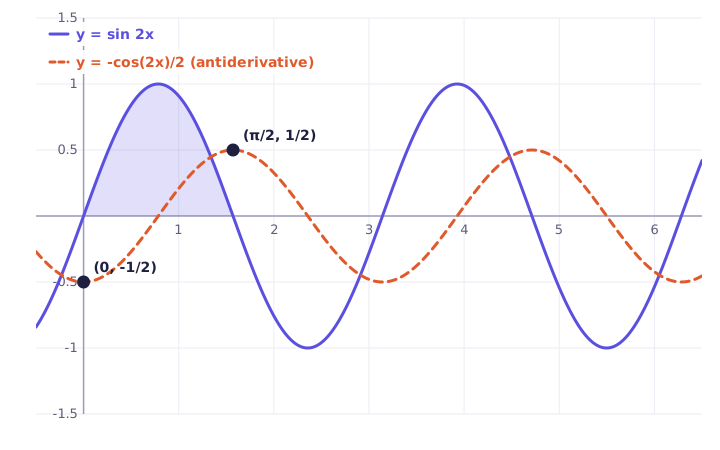
The integral of \sin 2x is -\dfrac{1}{2}\cos 2x + C. It is the integral of sin x with one extra step to handle the 2 inside.
Graph of sin 2x and its antiderivative
Derivation with u-substitution
- Let u = 2x. Then du = 2\,dx, so dx = \frac{1}{2}du.
- Substitute: \displaystyle\int\sin 2x\,dx = \frac{1}{2}\int\sin u\,du.
- Integrate: \frac{1}{2}(-\cos u) + C.
- Put u = 2x back: -\frac{1}{2}\cos 2x + C.
The same steps give the general rule \int\sin(kx)\,dx = -\frac{1}{k}\cos(kx) + C. See the u-substitution rule.
Check by differentiating
The chain rule factor 2 cancels the \frac{1}{2}. The forward direction is on the derivative of sin 2x page.
Three correct answers
Using the double-angle identity \sin 2x = 2\sin x\cos x:
- With u = \sin x, du = \cos x\,dx: \int 2u\,du = \sin^2 x + C.
- With u = \cos x, du = -\sin x\,dx: \int -2u\,du = -\cos^2 x + C.
These look different from -\frac{1}{2}\cos 2x, but they are not. Since \cos 2x = 1 - 2\sin^2 x = 2\cos^2 x - 1:
So the three answers differ only by constants. That is allowed: the +C absorbs the difference. This also explains why the derivative of sin² x is \sin 2x.
Definite integrals
For a definite integral, all three forms of the antiderivative give the same number, because the constant cancels when you subtract.
Worked examples
Example 1. \int(\sin 2x + \cos 2x)\,dx = -\frac{1}{2}\cos 2x + \frac{1}{2}\sin 2x + C.
Example 2. \int 6\sin 3x\,dx = 6\cdot\left(-\frac{1}{3}\cos 3x\right) + C = -2\cos 3x + C.
Example 3: sin 2x cos x. Rewrite as 2\sin x\cos^2 x and let u = \cos x:
Check: \frac{d}{dx}\left(-\frac{2}{3}\cos^3 x\right) = 2\cos^2 x\sin x = \sin 2x\cos x.
Example 4: sin 2x cos 2x. Use \sin 2x\cos 2x = \frac{1}{2}\sin 4x, so the integral is -\frac{1}{8}\cos 4x + C.
Common mistakes
- Answering -\cos 2x + C. You forgot the \frac{1}{2}. Its derivative is 2\sin 2x.
- Answering -2\cos 2x + C. That multiplies by 2, which is what differentiating would do.
- Thinking \sin^2 x is wrong because it differs from the book. Differentiate it: you get \sin 2x, so it is right.
- Writing 2\sin x for \sin 2x. \sin 2x = 2\sin x\cos x, not 2\sin x.
Practise on u-substitution problems.
Practice it now
U-substitution
Solve real problems on this topic with instant feedback, hints and a step-by-step walkthrough for every answer. Free, no sign-up needed to start.
Practice this lesson