Rational Functions: Asymptotes, Holes, Derivatives and Integrals
Rational functions P(x)/Q(x): domain, vertical and horizontal asymptotes, holes, derivatives with the quotient rule and integrals by partial fractions.
Algebraic functions Updated 3 min read
At a glance
- Domain
- All x with Q(x) \ne 0
- Derivative
- \frac{P'(x)Q(x) - P(x)Q'(x)}{Q(x)^2}
- Integral
- \int \frac{A}{x - r}\,dx = A\ln|x - r| + C
- Vertical asymptotes
- Zeros of Q that do not cancel
- Horizontal asymptote
- Compare the degrees of P and Q
- Integration method
- Long division, then partial fractions
On this page
A rational function is one polynomial divided by another. They are defined everywhere except where the denominator is zero, and the behavior near those points, asymptotes and holes, is what makes them central to limits, curve sketching and integration.
Definition and formula
P and Q are polynomials and Q is not the zero polynomial. The simplest example is the reciprocal function \frac{1}{x}. Others include \frac{2x + 1}{x - 1} and \frac{x^2 - 4}{x - 2}.
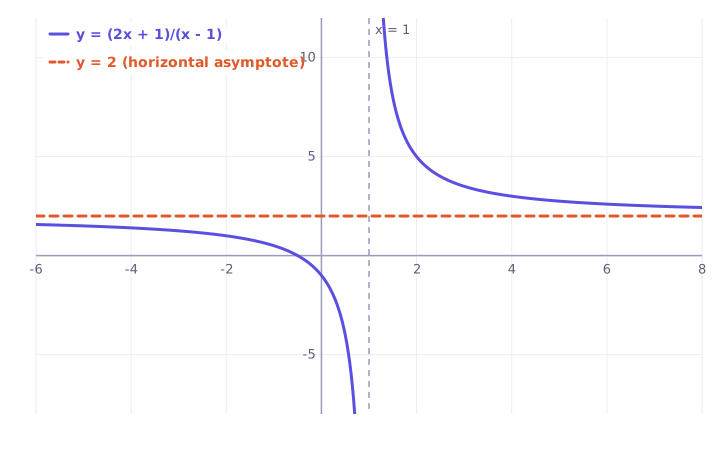
Graph of a rational function
Asymptotes and holes
Factor P and Q completely first.
- Hole. A factor (x - a) that cancels from top and bottom leaves a removable discontinuity at x = a. Example: \frac{x^2 - 4}{x - 2} = x + 2 for x \ne 2, a line with a hole at (2, 4).
- Vertical asymptote. A zero a of the denominator that remains after cancelling. Near x = a the function heads to \pm\infty, so the one-sided limits are infinite.
- Horizontal asymptote. From limits at infinity, with \deg P = m and \deg Q = n:
| Degrees | Behavior as x \to \pm\infty |
|---|---|
| m < n | asymptote y = 0 |
| m = n | asymptote y = \frac{\text{leading coeff of } P}{\text{leading coeff of } Q} |
| m = n + 1 | slant asymptote from long division |
| m > n + 1 | no line asymptote |
Derivative of a rational function
Use the quotient rule:
The derivative is again a rational function with the same points excluded from its domain.
Integrating rational functions
There is no single formula. The standard method is:
- If \deg P \ge \deg Q, divide to get a polynomial plus a proper fraction.
- Factor Q and split the proper fraction with partial fractions.
- Integrate each piece. Linear factors give logarithms, \int \frac{A}{x - r}\,dx = A\ln|x - r| + C; irreducible quadratics give arctangents.
Worked examples
Example 1: asymptotes. For f(x) = \frac{2x + 1}{x - 1}, nothing cancels, so x = 1 is a vertical asymptote. Degrees are equal, so y = \frac{2}{1} = 2 is the horizontal asymptote.
Example 2: derivative. With P = 2x + 1 and Q = x - 1:
The derivative is always negative, so f decreases on each side of the asymptote.
Example 3: a limit with a hole. \lim_{x \to 2} \frac{x^2 - 4}{x - 2} = \lim_{x \to 2} (x + 2) = 4.
Example 4: integral by partial fractions. Since \frac{1}{x^2 - 1} = \frac{1/2}{x - 1} - \frac{1/2}{x + 1},
Common mistakes
- Declaring every denominator zero an asymptote. Cancel common factors first; cancelled factors give holes.
- Cancelling terms instead of factors. \frac{x + 4}{x + 2} \ne \frac{4}{2}. Only common factors cancel.
- Mixing up the quotient rule order. The numerator is P'Q - PQ'; reversing it flips the sign.
- Using partial fractions on an improper fraction. Divide first when \deg P \ge \deg Q.
How it connects
Rational functions are the standard source of \frac{0}{0} limits, the test case for L'Hôpital's rule, and the main application of partial fractions in Calculus 2. Their sketches use every tool from curve sketching.
Practice it now
The quotient rule
Solve real problems on this topic with instant feedback, hints and a step-by-step walkthrough for every answer. Free, no sign-up needed to start.
Practice this lesson