Power Functions f(x) = xⁿ: Graphs, Derivative, Integral and Rules
Power functions f(x) = xⁿ for whole, negative and fractional n: graphs, domains, the derivative nxⁿ⁻¹, the integral and the n = -1 exception.
Algebraic functions Updated 2 min read
At a glance
- Domain
- All reals for whole n \ge 0; x \ne 0 for negative n
- Derivative
- nx^{n-1}
- Integral
- \frac{x^{n+1}}{n+1} + C
- Exception
- \int x^{-1}\,dx = \ln|x| + C
- Even or odd
- Even for even whole n, odd for odd whole n
- Passes through
- (1, 1) for every n
On this page
A power function raises the input to a fixed exponent: f(x) = x^n. The family includes parabolas, cubics, reciprocals and roots, and one rule, the power rule, differentiates every member.
Formula
The exponent n is a constant. More generally f(x) = kx^n with a constant coefficient k. Common members:
| n | Function | Name |
|---|---|---|
| 0 | 1 | constant |
| 1 | x | identity line |
| 2 | x^2 | parabola |
| 3 | x^3 | cubic |
| -1 | \frac{1}{x} | reciprocal |
| \frac{1}{2} | \sqrt{x} | square root |
Graphs of power functions
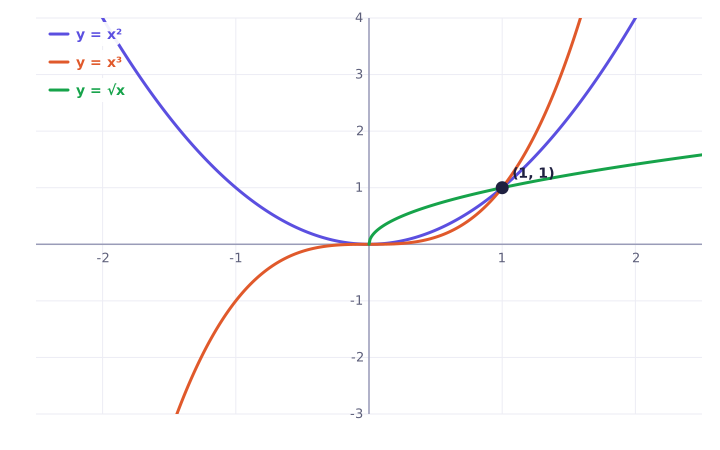
How the exponent shapes the graph:
- Even whole n (x^2, x^4, \ldots): U-shaped, even function, range [0, \infty).
- Odd whole n (x^3, x^5, \ldots): S-shaped, odd function, range all reals.
- Negative n (x^{-1}, x^{-2}, \ldots): undefined at 0, with a vertical asymptote at x = 0 and a horizontal asymptote y = 0.
- Fractional n = \frac{p}{q}: an even root (q even) restricts the domain to x \ge 0; an odd root allows all reals.
- On (0, 1) higher powers are smaller; on (1, \infty) higher powers are larger.
Derivative of a power function
Bring the exponent down, then subtract one. This holds for every real constant n wherever x^n is differentiable. Note that for 0 < n < 1, such as \sqrt{x}, the derivative blows up at x = 0, where the graph has a vertical tangent.
Integral of a power function
Add one to the exponent, then divide by the new exponent. The case n = -1 would divide by zero; instead
See the reverse power rule.
Worked examples
Example 1. \frac{d}{dx}x^7 = 7x^6.
Example 2: negative power. \frac{d}{dx}\frac{4}{x^3} = \frac{d}{dx}4x^{-3} = -12x^{-4} = -\frac{12}{x^4}.
Example 3: fractional power. \frac{d}{dx}\sqrt[3]{x} = \frac{d}{dx}x^{1/3} = \frac{1}{3}x^{-2/3}.
Example 4: integral. \int x^{3/2}\,dx = \frac{x^{5/2}}{5/2} + C = \frac{2}{5}x^{5/2} + C.
Example 5: definite integral. \int_1^4 \frac{1}{\sqrt{x}}\,dx = \left[2x^{1/2}\right]_1^4 = 4 - 2 = 2.
Common mistakes
- Using the power rule on 2^x. That is an exponential function; its derivative is 2^x\ln 2.
- Subtracting one from a negative exponent in the wrong direction. x^{-3} differentiates to -3x^{-4}, not -3x^{-2}.
- Applying the integral formula at n = -1. \frac{x^0}{0} is meaningless; use \ln|x|.
- Not rewriting first. Turn \frac{1}{x^2} into x^{-2} and \sqrt{x} into x^{1/2} before using either rule.
How it connects
Sums of power functions with whole exponents are polynomial functions, and power series extend that idea to infinitely many terms. For a deeper walkthrough with practice problems, read the guide to the power rule and to antiderivatives.
Practice it now
The power rule
Solve real problems on this topic with instant feedback, hints and a step-by-step walkthrough for every answer. Free, no sign-up needed to start.
Practice this lesson