Polynomial Functions: Degree, Graphs, Derivatives and Integrals
Polynomial functions explained: degree, leading term, end behavior, roots and turning points, plus how to differentiate and integrate any polynomial.
Algebraic functions Updated 3 min read
At a glance
- Domain
- (-\infty, \infty)
- Derivative
- na_nx^{n-1} + (n-1)a_{n-1}x^{n-2} + \cdots + a_1
- Integral
- \frac{a_n}{n+1}x^{n+1} + \cdots + \frac{a_1}{2}x^2 + a_0x + C
- Continuity
- Continuous and differentiable everywhere
- Real roots
- At most n
- Turning points
- At most n - 1
On this page
A polynomial function is a finite sum of power functions with whole-number exponents, each multiplied by a constant. Lines, parabolas and cubics are all polynomials. They are the friendliest functions in calculus: continuous everywhere, smooth everywhere, and differentiated or integrated term by term.
Definition and formula
- The degree is n, the highest power with a nonzero coefficient.
- The leading term is a_nx^n and the leading coefficient is a_n.
- The constant term a_0 is the y-intercept.
Exponents must be whole numbers 0, 1, 2, \ldots. So x^3 - 2x is a polynomial, but \sqrt{x}, \frac{1}{x} and 2^x are not.
| Degree | Name | Example |
|---|---|---|
| 0 | constant | 5 |
| 1 | linear | 2x - 1 |
| 2 | quadratic | x^2 + 3x |
| 3 | cubic | x^3 - 3x |
| 4 | quartic | x^4 - x^2 |
Graph of a polynomial
Key properties
- Continuous and differentiable everywhere. No holes, jumps, corners or asymptotes, so every limit is found by direct substitution.
- End behavior comes from the leading term alone. Even degree with a_n > 0: both ends up. Odd degree with a_n > 0: down on the left, up on the right. A negative a_n flips the picture.
- Roots. A degree n polynomial has at most n real roots. An odd-degree polynomial always has at least one, by the intermediate value theorem.
- Turning points. At most n - 1, because f' has degree n - 1.
Derivative of a polynomial
Combine the power rule, constant multiple rule and sum rule:
The constant term disappears and the degree drops by one. Differentiating n + 1 times gives 0.
Integral of a polynomial
The degree rises by one. Definite integrals of polynomials are always easy to evaluate with the fundamental theorem of calculus.
Worked examples
Example 1: derivative. \frac{d}{dx}\left(4x^5 - 2x^3 + 7x - 1\right) = 20x^4 - 6x^2 + 7.
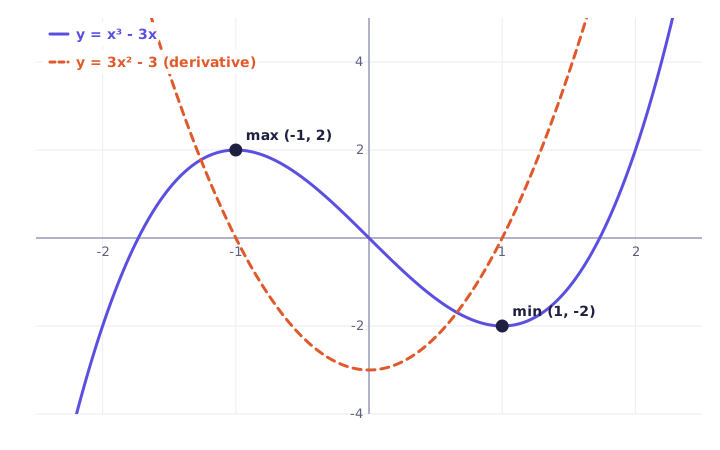
Example 2: turning points. For f(x) = x^3 - 3x, f'(x) = 3x^2 - 3 = 3(x-1)(x+1), which is zero at x = \pm 1. Then f(-1) = 2 is a local maximum and f(1) = -2 is a local minimum.
Example 3: integral. \int (6x^2 - 4x + 3)\,dx = 2x^3 - 2x^2 + 3x + C.
Example 4: definite integral. \int_0^2 (x^3 - x)\,dx = \left[\frac{x^4}{4} - \frac{x^2}{2}\right]_0^2 = (4 - 2) - 0 = 2.
Common mistakes
- Differentiating a product without expanding or using the product rule. \frac{d}{dx}\left[(x^2 + 1)(x - 3)\right] is not 2x \cdot 1. Expand first or use the product rule.
- Keeping the constant term in a derivative. \frac{d}{dx}(x^2 + 5) = 2x, not 2x + 5.
- Forgetting +\,C on indefinite integrals.
- Judging end behavior from the first term written. Use the term of highest degree, wherever it appears.
How it connects
Dividing two polynomials gives the rational functions. Taylor polynomials approximate other functions by polynomials, and Taylor series push this to infinitely many terms. For the rules behind each step, see power functions.
Practice it now
Sums and constants
Solve real problems on this topic with instant feedback, hints and a step-by-step walkthrough for every answer. Free, no sign-up needed to start.
Practice this lesson