Integral of 1/(1+x²): Formula, Steps and Examples
The integral of 1/(1+x²) is arctan x + C. See why with a tan substitution, the 1/(a²+x²) version, a graph and worked examples.
Inverse trig integrals Updated 3 min read
At a glance
- Antiderivative
- \arctan x + C
- General form
- \displaystyle\int \frac{dx}{a^2+x^2} = \frac{1}{a}\arctan\frac{x}{a} + C
- Method
- Substitution x = \tan\theta, or recognize the arctan derivative
- From 0 to 1
- \dfrac{\pi}{4}
- Over the whole line
- \pi
On this page
The integral of \dfrac{1}{1+x^2} is \arctan x + C. It is one of the few integrals you should know on sight, because it turns a plain rational function into an angle.
The more general version, for any constant a > 0, is
Graph of 1/(1+x²) and its antiderivative
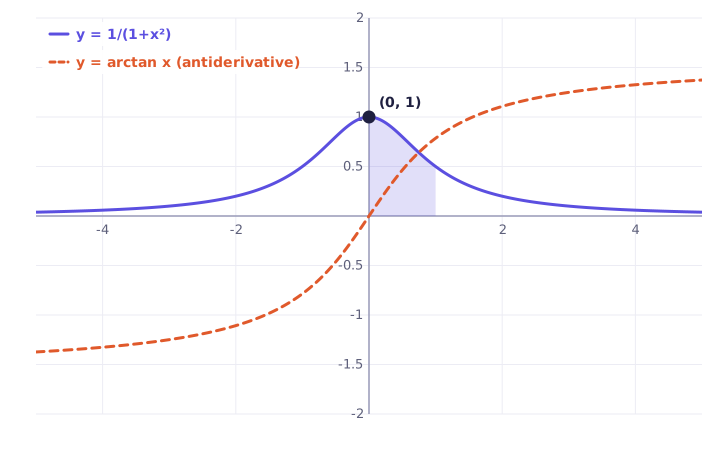
The curve \frac{1}{1+x^2} is positive everywhere, so its antiderivative is always increasing. It also flattens out fast, which is why \arctan x approaches the horizontal lines y = \pm\frac{\pi}{2}.
How to integrate 1/(1+x²) step by step
You can simply recognize the derivative of arctan x. If you want to see where the answer comes from, use the substitution x = \tan\theta.
- Let x = \tan\theta, so dx = \sec^2\theta\,d\theta.
- Use the identity 1 + \tan^2\theta = \sec^2\theta: \int \frac{\sec^2\theta}{1+\tan^2\theta}\,d\theta = \int \frac{\sec^2\theta}{\sec^2\theta}\,d\theta = \int 1\,d\theta = \theta + C
- Go back to x. Since x = \tan\theta, we have \theta = \arctan x.
For \frac{1}{a^2+x^2}, factor out a^2 and substitute u = \frac{x}{a}, dx = a\,du:
This is the same idea as trig substitution, in its simplest form.
Check by differentiating
With a = 1 this gives back \frac{1}{1+x^2}.
Definite integrals
| Integral | Value |
|---|---|
| \int_0^1 \frac{dx}{1+x^2} | \frac{\pi}{4} \approx 0.785 |
| \int_{-1}^{1} \frac{dx}{1+x^2} | \frac{\pi}{2} |
| \int_0^{\sqrt{3}} \frac{dx}{1+x^2} | \frac{\pi}{3} |
| \int_{-\infty}^{\infty} \frac{dx}{1+x^2} | \pi |
The last one is an improper integral. It converges even though the interval is infinite, because \frac{1}{1+x^2} shrinks like \frac{1}{x^2}.
Worked examples
Example 1: a constant other than 1. \displaystyle\int \frac{dx}{9 + x^2}. Here a = 3:
Example 2: a coefficient on x². \displaystyle\int \frac{dx}{1 + 4x^2}. Let u = 2x, du = 2\,dx:
Example 3: complete the square. \displaystyle\int \frac{dx}{x^2 + 2x + 5}. Write x^2 + 2x + 5 = (x+1)^2 + 4, then use a = 2 with u = x + 1:
Example 4: split the numerator. \displaystyle\int \frac{x + 3}{x^2 + 1}\,dx. Split into two integrals you know:
The first part is covered on the integral of x/(x²+1) page.
Common mistakes
- Writing \ln(1 + x^2). That is the antiderivative of \frac{2x}{1+x^2}, not \frac{1}{1+x^2}. Without an x on top, there is no du for a log substitution.
- Dropping the \frac{1}{a}. \int \frac{dx}{4+x^2} is \frac{1}{2}\arctan\frac{x}{2}, not \arctan\frac{x}{2}. Differentiate your answer to catch this.
- Mixing it up with \frac{1}{1-x^2}. A minus sign changes everything. \frac{1}{1-x^2} needs partial fractions and gives logs; see the integral of 1/(x²−1).
- Using degrees. \arctan 1 = \frac{\pi}{4}, not 45. Calculus always uses radians.
For the inverse function itself, see the arctangent page. To integrate \arctan x (instead of getting it as an answer), see the integral of arctan x.
Practice it now
Trig substitution
Solve real problems on this topic with instant feedback, hints and a step-by-step walkthrough for every answer. Free, no sign-up needed to start.
Practice this lesson