Integral of 1/(x² - 1): Formula, Partial Fractions, Examples
The integral of 1/(x² - 1) is ½ ln|(x - 1)/(x + 1)| + C. See the partial fraction steps, the general 1/(x² - a²) formula and worked definite integrals.
Powers, roots and rational functions Updated 2 min read
At a glance
- Antiderivative
- \dfrac{1}{2}\ln\left\lvert\dfrac{x - 1}{x + 1}\right\rvert + C
- Method
- Partial fractions
- Decomposition
- \dfrac{1}{x^2 - 1} = \dfrac{1}{2}\left(\dfrac{1}{x - 1} - \dfrac{1}{x + 1}\right)
- General form
- \int\dfrac{dx}{x^2 - a^2} = \dfrac{1}{2a}\ln\left\lvert\dfrac{x - a}{x + a}\right\rvert + C
- Undefined at
- x = \pm 1
On this page
The integral of \dfrac{1}{x^2 - 1} is \dfrac{1}{2}\ln\left\lvert\dfrac{x - 1}{x + 1}\right\rvert + C. It is the simplest integral that needs partial fractions.
Graph of 1/(x² - 1)
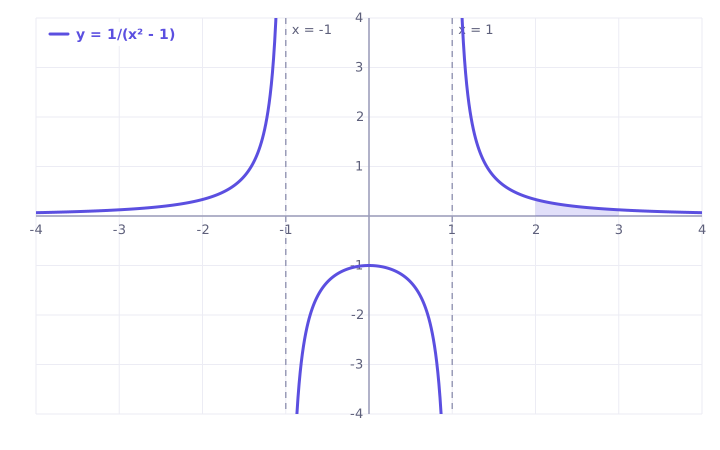
Between the asymptotes the function is negative, with a maximum of -1 at x = 0. Outside them it is positive and falls toward 0.
Partial fractions, step by step
- Factor the denominator: x^2 - 1 = (x - 1)(x + 1).
- Set up the split: \dfrac{1}{(x - 1)(x + 1)} = \dfrac{A}{x - 1} + \dfrac{B}{x + 1}.
- Clear denominators: 1 = A(x + 1) + B(x - 1).
- Put x = 1: 1 = 2A, so A = \frac{1}{2}. Put x = -1: 1 = -2B, so B = -\frac{1}{2}.
- Integrate each piece with the integral of 1/x:
- Combine the logs: \frac{1}{2}\ln\left\lvert\frac{x - 1}{x + 1}\right\rvert + C.
The guide to partial fractions covers repeated and quadratic factors too.
Check by differentiating
The general formula: 1/(x² - a²)
The same steps with (x - a)(x + a) give A = \frac{1}{2a}, B = -\frac{1}{2a}, so
For example, \int\frac{1}{x^2 - 9}\,dx = \frac{1}{6}\ln\left\lvert\frac{x - 3}{x + 3}\right\rvert + C.
Worked examples
Example 1: definite integral. For the shaded region:
Example 2: improper integral. As x \to \infty, \frac{x - 1}{x + 1} \to 1 and the log goes to 0:
Example 3: inside the asymptotes. \int_0^{1/2}\frac{dx}{x^2 - 1} = \frac{1}{2}\ln\frac{1/2}{3/2} - 0 = -\frac{1}{2}\ln 3. Negative, as the graph predicts.
Example 4: the flipped sign. \int\frac{1}{1 - x^2}\,dx = -\int\frac{1}{x^2 - 1}\,dx = \frac{1}{2}\ln\left\lvert\frac{1 + x}{1 - x}\right\rvert + C.
Example 5: a substitution first. \int\frac{\cos x}{\sin^2 x - 1}\,dx with u = \sin x becomes \int\frac{du}{u^2 - 1} = \frac{1}{2}\ln\left\lvert\frac{\sin x - 1}{\sin x + 1}\right\rvert + C.
Common mistakes
- Answering \arctan x. That is for x^2 + 1. Check the sign in the denominator.
- Answering \ln\lvert x^2 - 1\rvert. The numerator is 1, not 2x, so the \frac{f'}{f} pattern does not apply. That pattern gives the integral of x/(x² + 1) instead.
- Getting the sign of B wrong. Plug values back in to check the decomposition.
- Integrating across x = \pm 1. Those integrals are improper and diverge.
Practise on partial fraction problems.
Practice it now
Partial fractions
Solve real problems on this topic with instant feedback, hints and a step-by-step walkthrough for every answer. Free, no sign-up needed to start.
Practice this lesson