Integral of x/(x² + 1): Formula, Steps and Examples
The integral of x/(x² + 1) is ½ ln(x² + 1) + C. See the u-substitution step by step, why no absolute value is needed, and related integrals like 1/(x² + 1).
Powers, roots and rational functions Updated 2 min read
At a glance
- Antiderivative
- \dfrac{1}{2}\ln\left(x^2 + 1\right) + C
- Method
- u-substitution with u = x^2 + 1
- Absolute value
- Not needed, since x^2 + 1 > 0
- Symmetric interval
- \int_{-a}^{a}\dfrac{x}{x^2 + 1}\,dx = 0
- Compare
- \int \dfrac{1}{x^2 + 1}\,dx = \arctan x + C
On this page
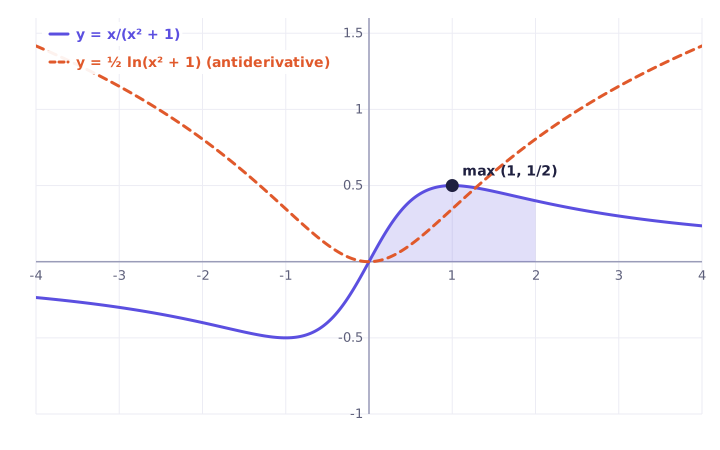
The integral of \dfrac{x}{x^2 + 1} is \dfrac{1}{2}\ln\left(x^2 + 1\right) + C. It is the textbook example of a u-substitution that turns into a log.
Graph of x/(x² + 1) and its antiderivative
The substitution, step by step
- Spot that the derivative of the denominator, 2x, matches the numerator up to a constant.
- Let u = x^2 + 1. Then du = 2x\,dx, so x\,dx = \frac{1}{2}du.
- Rewrite: \displaystyle\int \frac{x}{x^2 + 1}\,dx = \frac{1}{2}\int\frac{1}{u}\,du.
- Integrate with the integral of 1/x: \frac{1}{2}\ln\lvert u\rvert + C.
- Substitute back: \frac{1}{2}\ln\lvert x^2 + 1\rvert + C.
- Since x^2 + 1 \ge 1 > 0, drop the bars: \frac{1}{2}\ln(x^2 + 1) + C.
The general pattern is \int\frac{f'(x)}{f(x)}\,dx = \ln\lvert f(x)\rvert + C. Here the numerator is \frac{1}{2}f'(x), which gives the factor \frac{1}{2}.
Check by differentiating
Definite integrals
Example 1. \int_0^1 \frac{x}{x^2 + 1}\,dx = \frac{1}{2}\ln 2 \approx 0.347.
Example 2. \int_{-3}^{3}\frac{x}{x^2 + 1}\,dx = 0. The integrand is odd, so the area on the left cancels the area on the right.
Example 3: changing the limits. With u = x^2 + 1, the limits x = 0 and x = 2 become u = 1 and u = 5:
Related integrals
Small changes to the integrand change the method completely:
| Integral | Method | Answer |
|---|---|---|
| \int\frac{x}{x^2 + 1}\,dx | u = x^2 + 1 | \frac{1}{2}\ln(x^2 + 1) + C |
| \int\frac{1}{x^2 + 1}\,dx | known formula | \arctan x + C |
| \int\frac{x}{(x^2 + 1)^2}\,dx | u = x^2 + 1 | -\frac{1}{2(x^2 + 1)} + C |
| \int\frac{x}{x^2 + a^2}\,dx | u = x^2 + a^2 | \frac{1}{2}\ln(x^2 + a^2) + C |
| \int\frac{x^3}{x^2 + 1}\,dx | divide first | \frac{x^2}{2} - \frac{1}{2}\ln(x^2 + 1) + C |
For the last row, polynomial division gives \frac{x^3}{x^2 + 1} = x - \frac{x}{x^2 + 1}.
Example 4: split the numerator.
The second piece uses the integral of 1/(1 + x²).
Common mistakes
- Forgetting the \frac{1}{2}. du = 2x\,dx, so x\,dx is only half of du.
- Answering \arctan x. That is the integral of \frac{1}{x^2 + 1}, without the x on top.
- Writing \ln\lvert x\rvert\cdot\ln\lvert x^2 + 1\rvert or splitting the fraction as \frac{x}{x^2} + \frac{x}{1}. A fraction cannot be split over a sum in the denominator.
- Integrating \frac{x}{x^2 - 1} the same way and dropping the bars. That one gives \frac{1}{2}\ln\lvert x^2 - 1\rvert + C, and the absolute value matters.
More practice: u-substitution problems.
Practice it now
U-substitution
Solve real problems on this topic with instant feedback, hints and a step-by-step walkthrough for every answer. Free, no sign-up needed to start.
Practice this lesson