Power Series: Radius and Interval of Convergence, With Examples
Find the radius and interval of convergence of a power series with the ratio test, check both endpoints correctly, and follow five fully worked examples.
By the PracticeCalculus team Published 8 min read
On this page
- What is a power series?
- Radius of convergence: the three possibilities
- How to find the radius of convergence with the ratio test
- Why the endpoints need a separate check
- Worked example 1: endpoints that disagree
- Worked example 2: a series not centered at 0
- Worked example 3: both endpoints diverge
- Worked example 4: radius infinity and radius zero
- Worked example 5: a coefficient on x
- Common mistakes with power series
- Quick reference: radius and interval of convergence
- Practice until the steps feel automatic
You know how to decide whether a series of numbers converges. A power series adds a twist: it has an x in every term, so it converges for some values of x and diverges for others. Your job is to find exactly which ones, and the ratio test does almost all of the work.
This guide shows you how to find the radius and interval of convergence step by step, why the endpoints need extra care, and five worked examples that cover every case you will meet on an exam.
What is a power series?
A power series centered at a is an infinite sum of powers of (x - a), each with its own coefficient:
Think of it as a polynomial that never ends. For each number you plug in for x, you get an ordinary series of numbers, which either converges or diverges.
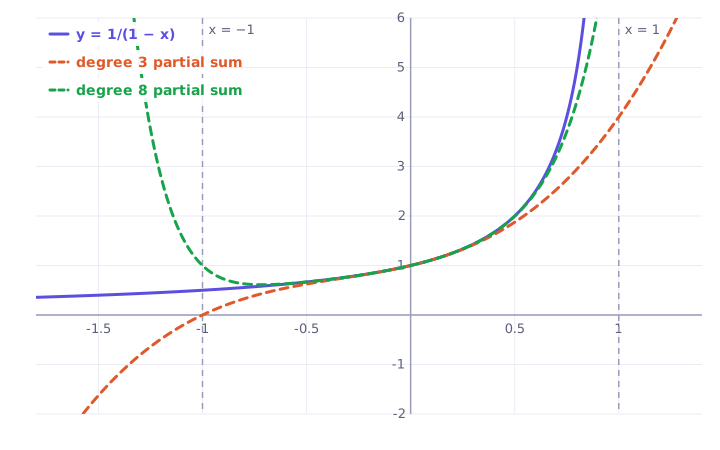
The most famous example is the geometric series
It works perfectly inside (-1, 1) and fails everywhere else. That pattern, a clean interval around the center, is true of every power series.
Radius of convergence: the three possibilities
For every power series centered at a, exactly one of these is true:
- It converges only at x = a. The radius is R = 0.
- It converges for every x. The radius is R = \infty.
- There is a number R > 0 so that it converges when |x - a| < R and diverges when |x - a| > R.
The number R is the radius of convergence. The interval of convergence is the set of all x where the series converges. In case 3 that is the interval from a - R to a + R, plus whichever endpoints happen to work.
How to find the radius of convergence with the ratio test
The ratio test says a series \sum b_n converges absolutely if \lim_{n\to\infty} \left|\frac{b_{n+1}}{b_n}\right| < 1 and diverges if that limit is greater than 1. Apply it to the terms b_n = c_n (x-a)^n:
Then set L < 1 and solve for |x - a|. The recipe:
- Write the ratio \left|\frac{b_{n+1}}{b_n}\right| and simplify it. The powers of (x - a) cancel down to a single |x - a|.
- Take the limit as n \to \infty. The x stays put because it does not depend on n.
- Solve L < 1. You get |x - a| < R.
- Check both endpoints x = a - R and x = a + R by plugging them in.
Why the endpoints need a separate check
At x = a \pm R the ratio test limit equals exactly 1, and a limit of 1 tells you nothing. The series might converge or diverge, and the two endpoints do not have to agree. So at each endpoint you substitute the number into the series and use a different test: the p-series test, the alternating series test, the nth-term test or a comparison. If you need a refresher on those, see our guide to convergence tests.
Tip: never skip the endpoints. An answer of (-1, 1) when the truth is [-1, 1) is marked wrong, even though the radius is right.
Worked example 1: endpoints that disagree
Find the interval of convergence of \displaystyle\sum_{n=1}^{\infty} \frac{x^n}{n}.
Step 1. Set up the ratio.
Step 2. Take the limit. Since \frac{n}{n+1} \to 1, we get L = |x|.
Step 3. Solve L < 1. The series converges for |x| < 1, so R = 1.
Step 4. Check the endpoints.
- At x = 1 the series is \sum \frac{1}{n}, the harmonic series, which diverges.
- At x = -1 the series is \sum \frac{(-1)^n}{n}, the alternating harmonic series, which converges by the alternating series test.
The interval of convergence is [-1, 1).
Worked example 2: a series not centered at 0
Find the interval of convergence of \displaystyle\sum_{n=1}^{\infty} \frac{(x-3)^n}{n^2\, 2^n}.
Step 1. Set up the ratio.
Step 2. Take the limit. The fraction \frac{n^2}{(n+1)^2} tends to 1, so L = \frac{|x-3|}{2}.
Step 3. Solve L < 1. We need |x - 3| < 2, so R = 2 and the open interval is 1 < x < 5.
Step 4. Check the endpoints.
- At x = 5: (x-3)^n = 2^n, and the series becomes \sum \frac{2^n}{n^2\, 2^n} = \sum \frac{1}{n^2}, a p-series with p = 2. It converges.
- At x = 1: (x-3)^n = (-2)^n, and the series becomes \sum \frac{(-1)^n}{n^2}. It converges absolutely, since \sum \frac{1}{n^2} converges.
The interval of convergence is [1, 5]. Notice that the center is 3 and the interval stretches 2 units each way.
Worked example 3: both endpoints diverge
Find the interval of convergence of \displaystyle\sum_{n=1}^{\infty} \frac{n\,(x+1)^n}{4^n}.
Step 1. Set up the ratio.
Step 2. Take the limit. L = \frac{|x+1|}{4}.
Step 3. Solve L < 1. |x + 1| < 4, so R = 4 and the center is a = -1. That gives -5 < x < 3.
Step 4. Check the endpoints.
- At x = 3: the series is \sum \frac{n \cdot 4^n}{4^n} = \sum n. The terms grow, so it diverges by the nth-term test.
- At x = -5: the series is \sum n(-1)^n. The terms do not approach 0, so it also diverges.
The interval of convergence is (-5, 3).
Watch the center. In (x + 1)^n the center is a = -1, not 1. Rewrite it as (x - (-1))^n if that helps.
Worked example 4: radius infinity and radius zero
Factorials push the radius to one of the two extremes.
Series A: \displaystyle\sum_{n=0}^{\infty} \frac{x^n}{n!}.
The limit is 0 for every x, and 0 < 1 always. So R = \infty and the interval is (-\infty, \infty). There are no endpoints to check. (This series equals e^x, as you will see in our guide to Taylor series.)
Series B: \displaystyle\sum_{n=0}^{\infty} n!\, x^n.
If x \ne 0 this grows without bound, so the series diverges. It converges only at the center. So R = 0 and the "interval" is the single point \{0\}.
Worked example 5: a coefficient on x
Find the radius of convergence of \displaystyle\sum_{n=0}^{\infty} \frac{(2x-1)^n}{5^n}.
Step 1. Set up the ratio. The ratio of consecutive terms is \frac{|2x - 1|}{5}, with no n left over, so L = \frac{|2x-1|}{5}.
Step 2. Solve L < 1. |2x - 1| < 5. Factor out the 2 to put it in the form |x - a| < R:
So the center is a = \frac{1}{2} and the radius is R = \frac{5}{2}, not 5. The open interval is -2 < x < 3.
Step 3. Check the endpoints. At x = 3 the series is \sum 1^n, and at x = -2 it is \sum (-1)^n. Neither has terms going to 0, so both diverge. The interval is (-2, 3).
Common mistakes with power series
- Forgetting the endpoints. This is the most common lost point. The ratio test never decides them.
- Reading off the wrong center. (x + 2)^n is centered at -2, and (3x - 6)^n is centered at 2.
- Not factoring out the coefficient of x. From |2x - 1| < 5 the radius is \frac{5}{2}. Always rewrite as |x - a| < R first.
- Dropping the absolute value. The ratio test uses |x - a|. Without it you lose the left half of the interval.
- Letting x "go to infinity" with n. In the limit, x is a fixed number. Only n changes.
- Using the ratio test result at an endpoint. At an endpoint you need a different test, applied to the series with the number substituted in.
Quick reference: radius and interval of convergence
| Series | Ratio test limit L | Radius R | Interval |
|---|---|---|---|
| \sum x^n | \lvert x \rvert | 1 | (-1, 1) |
| \sum \frac{x^n}{n} | \lvert x \rvert | 1 | [-1, 1) |
| \sum \frac{x^n}{n^2} | \lvert x \rvert | 1 | [-1, 1] |
| \sum \frac{(x-3)^n}{n^2\, 2^n} | \frac{\lvert x-3 \rvert}{2} | 2 | [1, 5] |
| \sum \frac{x^n}{n!} | 0 | \infty | (-\infty, \infty) |
| \sum n!\, x^n | \infty for x \ne 0 | 0 | \{0\} |
A useful pattern from the first three rows: polynomial factors like n or n^2 do not change the radius, but they can change what happens at the endpoints.
Practice until the steps feel automatic
Finding an interval of convergence is a fixed routine: ratio, limit, solve, check two endpoints. The routine only becomes fast after you have run it on a dozen different series. The interactive lesson below gives you fresh series to work through, checks each step instantly, and shows you exactly where an endpoint test went wrong.
Practice it now
Power series and radius of convergence
Solve real problems on this topic with instant feedback, hints and a step-by-step walkthrough for every answer. Free, no sign-up needed to start.
Practice this lesson