Related Rates: Step-by-Step Method With Ladder and Cone Examples
Solve related rates problems with a clear method: sliding ladder, inflating balloon and filling cone examples worked in full, plus the mistakes to avoid.
By the PracticeCalculus team Published 6 min read
On this page
Air is pumped into a balloon at a steady rate. Is the radius growing at a steady rate too? No, and figuring out exactly how fast it grows is a related rates problem. These problems scare a lot of students because they are wordy, but they all follow the same short recipe. Once you see it, the ladder, the balloon and the cone are the same problem in different costumes.
What are related rates?
In a related rates problem, two or more quantities change over time and are tied together by an equation. You know how fast one of them is changing, and you want how fast another is changing at a specific moment.
The tool is implicit differentiation with respect to time. If x and y both depend on t, the chain rule gives, for example,
Each variable picks up its own rate. That single equation is how the rates become "related."
The related rates method
- Draw a picture and label every quantity that changes with a variable. Label constants with their numbers.
- List what you know and what you want, as rates: for example "know \frac{dx}{dt} = 2, want \frac{dy}{dt} when x = 6."
- Write an equation relating the variables (Pythagoras, a volume formula, similar triangles).
- Differentiate both sides with respect to t.
- Substitute the values at the moment in question, then solve for the unknown rate. Include units and check the sign.
The most important rule is in steps 4 and 5: differentiate first, plug in second.
Worked example 1: the sliding ladder
A 10-foot ladder leans against a wall. The bottom slides away from the wall at 2 feet per second. How fast is the top sliding down when the bottom is 6 feet from the wall?
Step 1. Picture. Let x be the distance from the wall to the bottom of the ladder and y the height of the top. The ladder length, 10, is constant.
Step 2. Know and want. Know \frac{dx}{dt} = 2 ft/s. Want \frac{dy}{dt} when x = 6.
Step 3. Equation. The wall, floor and ladder form a right triangle:
Step 4. Differentiate with respect to t.
Step 5. Substitute and solve. When x = 6, the equation gives y = \sqrt{100 - 36} = 8. So
Answer: the top slides down at 1.5 feet per second. The negative sign means the height is decreasing, which matches the picture.
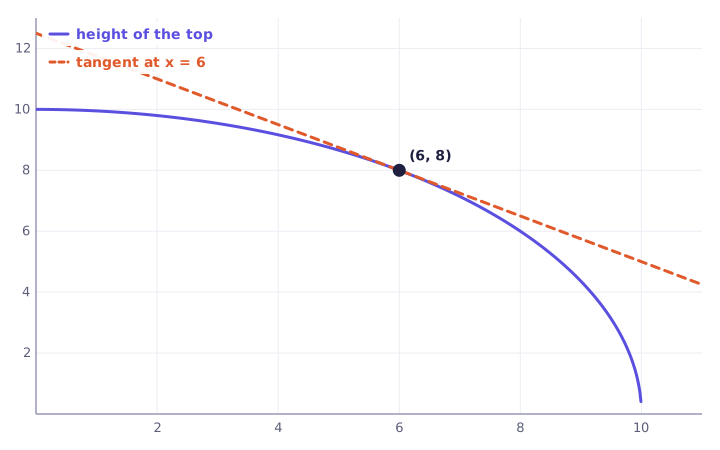
The graph shows something the formula hides. The curve gets steeper as x approaches 10, so even with the base moving at a steady 2 ft/s, the top falls faster and faster near the end.
Worked example 2: the inflating balloon
Air is pumped into a spherical balloon at 100 cubic centimeters per second. How fast is the radius increasing when the radius is 5 cm?
Step 1. Picture. A sphere of radius r and volume V, both changing.
Step 2. Know and want. Know \frac{dV}{dt} = 100 cm³/s. Want \frac{dr}{dt} when r = 5.
Step 3. Equation. The volume of a sphere:
Step 4. Differentiate with respect to t.
Step 5. Substitute and solve.
Answer: the radius grows at about 0.32 cm per second at that moment.
This answers the opening question. Solving step 4 in general gives \frac{dr}{dt} = \frac{100}{4\pi r^2} = \frac{25}{\pi r^2}, which shrinks as r grows. The air goes in at a constant rate, but it has to spread over a bigger and bigger surface, so the radius grows more slowly.
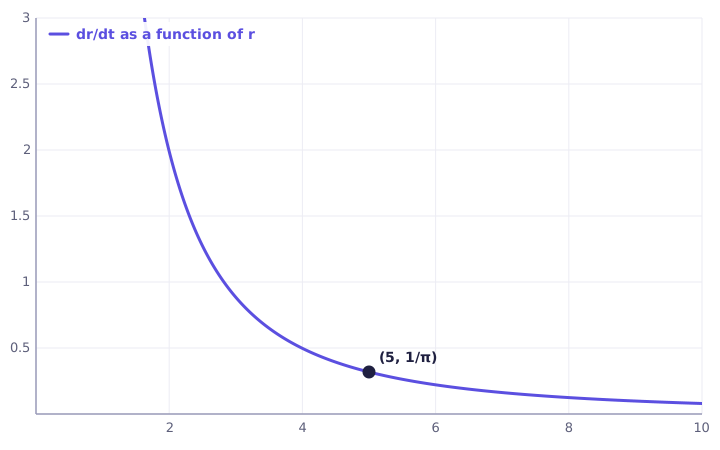
You can push the same example further. The surface area is S = 4\pi r^2, so \frac{dS}{dt} = 8\pi r\frac{dr}{dt} = 8\pi(5)\cdot\frac{1}{\pi} = 40 cm²/s at that same moment.
Worked example 3: filling a cone-shaped tank
A tank is an upside-down cone, 12 feet tall with a top radius of 4 feet. Water flows in at 2 cubic feet per minute. How fast is the water level rising when the water is 6 feet deep?
Step 1. Picture. The water forms a smaller cone with depth h and surface radius r, both changing.
Step 2. Know and want. Know \frac{dV}{dt} = 2 ft³/min. Want \frac{dh}{dt} when h = 6.
Step 3. Equation. The cone volume is V = \frac{1}{3}\pi r^2 h, which has two changing variables. Remove r with similar triangles: the water cone has the same shape as the tank, so
Substitute this relation (it is true at every moment, so it is safe to use now):
Step 4. Differentiate with respect to t.
Step 5. Substitute and solve. With h = 6:
Answer: the water level rises at about 0.16 feet per minute, or roughly 1.9 inches per minute.
Tip: in cone problems, eliminate the radius with similar triangles before differentiating. Otherwise you are left with both \frac{dr}{dt} and \frac{dh}{dt} and only one equation.
Common mistakes: plugging in too early, and more
1. Plugging in numbers before differentiating. This is the biggest one. In the ladder problem, suppose you substitute x = 6 first:
Differentiating now gives 2y\frac{dy}{dt} = 0, so \frac{dy}{dt} = 0. That says the top of the ladder is not moving, which is absurd. By plugging in x = 6 you froze x in place and erased \frac{dx}{dt}. The values at "the moment in question" are a snapshot; substitute them only after the derivative is taken.
The exception is a true constant. The ladder length of 10 and the tank dimensions 4 and 12 never change, so you may use them from the start. The relation r = \frac{h}{3} is also safe, because it holds at every instant.
2. Forgetting a rate factor. \frac{d}{dt}(r^3) = 3r^2\frac{dr}{dt}, not 3r^2. Every changing variable carries its own rate.
3. Wrong signs. If a quantity is shrinking (a draining tank, a falling ladder top), its rate is negative. Enter it that way, and check the sign of your answer against the picture.
4. Missing values. In the ladder problem you are given x but also need y. Use the original equation to find it.
5. Mixing up units. Rates have units like ft/s or cm³/s. If one rate is in minutes and another in seconds, convert before substituting.
Quick reference
| Problem type | Equation | After differentiating |
|---|---|---|
| Ladder, distance | x^2 + y^2 = L^2 | x\frac{dx}{dt} + y\frac{dy}{dt} = 0 |
| Sphere volume | V = \frac{4}{3}\pi r^3 | \frac{dV}{dt} = 4\pi r^2\frac{dr}{dt} |
| Circle area | A = \pi r^2 | \frac{dA}{dt} = 2\pi r\frac{dr}{dt} |
| Cone, r = kh | V = \frac{1}{3}\pi k^2 h^3 | \frac{dV}{dt} = \pi k^2 h^2\frac{dh}{dt} |
| Cylinder, fixed r | V = \pi r^2 h | \frac{dV}{dt} = \pi r^2\frac{dh}{dt} |
Build confidence with practice
Related rates feel hard only until the method becomes a habit: picture, equation, differentiate, then substitute. The interactive lesson below breaks each problem into those steps and gives instant feedback, so you learn to catch an early substitution or a missing rate before it costs you points on a test.
Practice it now
Related rates
Solve real problems on this topic with instant feedback, hints and a step-by-step walkthrough for every answer. Free, no sign-up needed to start.
Practice this lesson