What Is a Limit in Calculus? A Clear, Visual Explanation
Understand limits in calculus: what they mean, how to read the notation, one-sided limits, graphs with holes, and the three ways a limit can fail to exist.
By the PracticeCalculus team Published 7 min read
On this page
- What is a limit? The plain-language definition
- Reading limit notation
- A limit at a hole: the classic example
- Worked example 1: reading a limit from a table
- One-sided limits: approaching from the left and right
- Worked example 2: a jump in a piecewise function
- Worked example 3: a limit that differs from the function value
- When does a limit not exist?
- Common mistakes with limits
- Why limits matter for the rest of calculus
- Build your limit intuition with practice
You can plug x = 1 into f(x) = x^2 + 1 and get 2. But try plugging x = 1 into \frac{x^2 - 1}{x - 1} and you get \frac{0}{0}, which means nothing. Yet the graph clearly heads toward a specific height near x = 1. A limit is the tool that names that height, and it is the idea that every other part of calculus is built on.
What is a limit? The plain-language definition
A limit is the value a function approaches as its input approaches some number. We write
and read it as "the limit of f(x) as x approaches a equals L." It means: if you choose x values close enough to a (but not equal to a), the outputs f(x) get as close to L as you like.
The key phrase is "but not equal to a." A limit never asks what happens at the point. It asks what happens near the point. That single idea is what lets limits handle holes, gaps and \frac{0}{0} expressions that ordinary arithmetic cannot.
Reading limit notation
Every piece of the notation has a job:
| Symbol | Meaning |
|---|---|
| \lim | "the limit of" |
| x \to a | x approaches a from both sides |
| x \to a^- | x approaches a from the left (values less than a) |
| x \to a^+ | x approaches a from the right (values greater than a) |
| f(x) | the function whose outputs we watch |
| = L | the value the outputs approach |
| = \infty | the outputs grow without bound (the limit does not exist as a number) |
A useful habit: say the notation out loud in words every time you write it. It keeps you focused on the trend, not the single point.
A limit at a hole: the classic example
Let's go back to the function that broke our calculator:
At x = 1 it is undefined. But we can look at nearby values.
| x | 0.9 | 0.99 | 0.999 | 1 | 1.001 | 1.01 | 1.1 |
|---|---|---|---|---|---|---|---|
| f(x) | 1.9 | 1.99 | 1.999 | undefined | 2.001 | 2.01 | 2.1 |
From both sides the outputs close in on 2. So
even though f(1) does not exist. The algebra confirms it: for every x \neq 1,
so the graph is the line y = x + 1 with a single point punched out.
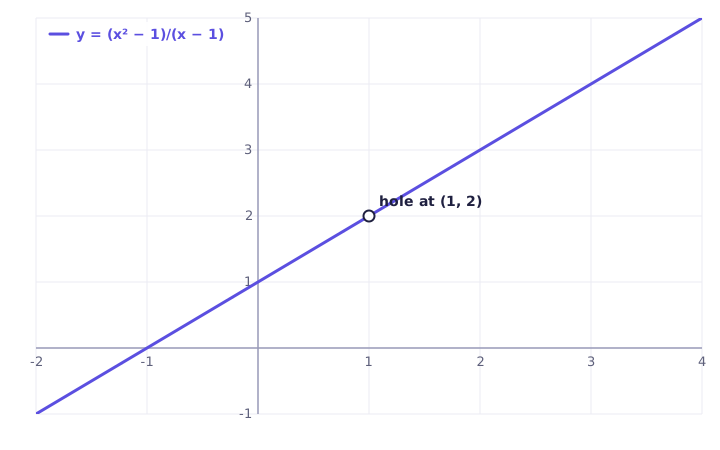
Tip: an open circle on a graph means "the curve gets here but this exact point is missing." The limit only cares where the curve is heading, so an open circle does not stop a limit from existing.
Worked example 1: reading a limit from a table
Estimate \lim_{x \to 0} \frac{\sin x}{x} (with x in radians).
Step 1. Notice the problem. At x = 0 we get \frac{0}{0}, so we cannot just substitute.
Step 2. Try values close to 0. \frac{\sin 0.1}{0.1} \approx 0.9983, \frac{\sin 0.01}{0.01} \approx 0.99998. Because \frac{\sin x}{x} gives the same output for x and -x, the left side matches.
Step 3. Read the trend. The outputs approach 1 from both sides, so
Tables are good for building intuition, but they are not proof. A table can be fooled by a function that does something strange very close to the point. That is why we also learn algebraic methods, covered in how to evaluate limits.
One-sided limits: approaching from the left and right
Sometimes a function behaves differently on each side of a point. One-sided limits let us describe each side separately.
- \lim_{x \to a^-} f(x) is the left-hand limit: use only x < a.
- \lim_{x \to a^+} f(x) is the right-hand limit: use only x > a.
The rule that connects them is the most important fact in this whole topic:
In words: a two-sided limit exists only if both one-sided limits exist and agree.
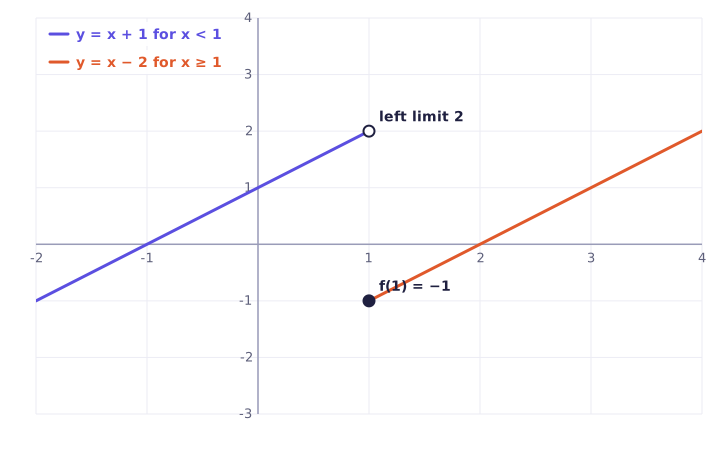
Worked example 2: a jump in a piecewise function
Let
Find the one-sided limits and the two-sided limit at x = 1.
Step 1. Left-hand limit. For x < 1 the function is x + 1, so \lim_{x \to 1^-} f(x) = 1 + 1 = 2.
Step 2. Right-hand limit. For x > 1 the function is x - 2, so \lim_{x \to 1^+} f(x) = 1 - 2 = -1.
Step 3. Compare. The left side heads to 2 and the right side heads to -1. They disagree, so \lim_{x \to 1} f(x) does not exist.
Step 4. Don't confuse this with f(1). The function value is f(1) = 1 - 2 = -1. The function is defined at 1, but the two-sided limit is not.
Worked example 3: a limit that differs from the function value
Let g(x) = x^2 for every x \neq 2, and define g(2) = 7. What is \lim_{x \to 2} g(x)?
Step 1. Ignore the point itself. The limit only looks at x near 2, where g(x) = x^2.
Step 2. Follow the trend. As x \to 2, x^2 \to 4 from both sides.
Step 3. State the answer. \lim_{x \to 2} g(x) = 4, while g(2) = 7.
This is the clearest demonstration that a limit and a function value are two different questions. When they do match, the function is continuous there, which is exactly how continuity is defined.
When does a limit not exist?
There are three common ways a limit at x = a can fail.
1. The one-sided limits disagree (a jump)
This is worked example 2. Each side settles down, but to different heights. Piecewise functions and expressions like \frac{|x|}{x} (which is -1 for x < 0 and 1 for x > 0) behave this way.
2. The function grows without bound (a vertical asymptote)
Near x = 0, the function \frac{1}{x^2} shoots up to infinity from both sides. We write
but this is shorthand for a specific way of not existing: there is no real number L that the outputs approach. For \frac{1}{x} the situation is worse, since the left side goes to -\infty and the right side to +\infty, so we cannot even write \infty for the two-sided limit.
3. The function oscillates forever
The function \sin\left(\frac{1}{x}\right) swings between -1 and 1 infinitely many times as x \to 0. It never settles on one height, so \lim_{x \to 0} \sin\left(\frac{1}{x}\right) does not exist.
| Behavior near a | Example | Does the limit exist? |
|---|---|---|
| Hole in the graph | \frac{x^2-1}{x-1} at x = 1 | Yes, 2 |
| Misplaced point | g(x) above at x = 2 | Yes, 4 |
| Jump | \frac{\lvert x \rvert}{x} at x = 0 | No |
| Vertical asymptote | \frac{1}{x^2} at x = 0 | No (written \infty) |
| Oscillation | \sin(1/x) at x = 0 | No |
Common mistakes with limits
- Thinking the limit is the function value. f(a) and \lim_{x \to a} f(x) are separate questions. They are equal only when the function is continuous at a.
- Saying \frac{0}{0} means the limit does not exist. A \frac{0}{0} result after substituting is a signal to do more work (factor, simplify, rationalize), not an answer. Often the limit exists.
- Checking only one side. If a function is defined differently on each side, you must compute both one-sided limits before claiming a two-sided limit.
- Treating \infty as a number. Writing \lim = \infty describes unbounded growth. You cannot add, subtract or cancel it like an ordinary value.
- Trusting a short table. A few sample values suggest a limit. Algebra or a theorem confirms it.
Why limits matter for the rest of calculus
Every big idea in calculus is a limit in disguise. The derivative is the limit of slopes of secant lines as the two points merge. The definite integral is the limit of sums of thinner and thinner rectangles. Continuity, asymptotes and end behavior are all statements about limits. Getting comfortable with what a limit means now makes every later topic easier.
Build your limit intuition with practice
Limits feel abstract until you have read a few dozen graphs and tables yourself. The interactive lesson below gives you graphs, tables and piecewise functions to read, checks each answer instantly, and shows you exactly where a one-sided limit or a hole tripped you up. A few minutes of practice now will make derivatives feel natural later.
Practice it now
What is a limit?
Solve real problems on this topic with instant feedback, hints and a step-by-step walkthrough for every answer. Free, no sign-up needed to start.
Practice this lesson