Integral of arctan x: Formula, Steps and Examples
The integral of arctan x is x arctan x − ½ ln(1+x²) + C. See the integration by parts steps, a check, definite integrals and examples.
Inverse trig integrals Updated 3 min read
At a glance
- Antiderivative
- x\arctan x - \frac{1}{2}\ln(1+x^2) + C
- Method
- Integration by parts with u = \arctan x, dv = dx
- From 0 to 1
- \frac{\pi}{4} - \frac{1}{2}\ln 2 \approx 0.439
- Related integral
- \int \frac{dx}{1+x^2} = \arctan x + C
On this page
The integral of \arctan x is x\arctan x - \dfrac{1}{2}\ln(1+x^2) + C. There is no basic rule that undoes arctan directly, so the standard route is integration by parts with a "hidden" factor of 1.
Graph of arctan x and its antiderivative
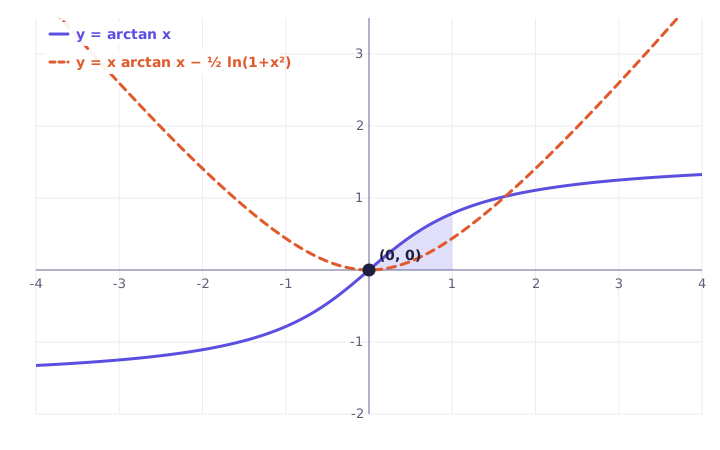
How to integrate arctan x step by step
The trick is to write \arctan x as \arctan x \cdot 1 and use integration by parts, \int u\,dv = uv - \int v\,du.
- Choose the parts. u = \arctan x and dv = dx. Then du = \frac{1}{1+x^2}\,dx and v = x.
- Apply the formula. \int \arctan x\,dx = x\arctan x - \int \frac{x}{1+x^2}\,dx
- Finish the leftover integral with w = 1 + x^2, dw = 2x\,dx: \int \frac{x}{1+x^2}\,dx = \frac{1}{2}\int\frac{dw}{w} = \frac{1}{2}\ln(1+x^2) + C
- Combine. \int \arctan x\,dx = x\arctan x - \frac{1}{2}\ln(1+x^2) + C
Why choose u = \arctan x? Its derivative \frac{1}{1+x^2} is algebraic and much easier to work with. In the LIATE order, inverse trig functions come near the front, so they are good choices for u.
Check by differentiating
The two fractions cancel exactly, leaving \arctan x.
Definite integrals
From 0 to 1:
From −1 to 1: \arctan x is an odd function, so \int_{-1}^{1}\arctan x\,dx = 0. The area above the axis on the right cancels the area below on the left.
From 0 to √3: \sqrt{3}\cdot\frac{\pi}{3} - \frac{1}{2}\ln 4 = \frac{\pi\sqrt{3}}{3} - \ln 2 \approx 1.121.
Worked examples
Example 1: a scaled input. \int \arctan(2x)\,dx. Let u = 2x, so dx = \frac{du}{2}:
Check: the derivative is \arctan 2x + \frac{2x}{1+4x^2} - \frac{1}{4}\cdot\frac{8x}{1+4x^2} = \arctan 2x.
Example 2: x times arctan x. Take u = \arctan x and dv = x\,dx, so v = \frac{x^2}{2}:
Write \frac{x^2}{1+x^2} = 1 - \frac{1}{1+x^2}, which integrates to x - \arctan x. So
Example 3: arctan of the square root. For \int\arctan\sqrt{x}\,dx, let x = t^2 first, then use parts. The result is (x+1)\arctan\sqrt{x} - \sqrt{x} + C, which you can confirm by differentiating.
Common mistakes
- Answering \frac{1}{1+x^2}. That is the derivative of \arctan x, not its integral. See the derivative of arctan x.
- Mixing up arctan and the reciprocal of tan. \tan^{-1}x is the inverse function. \frac{1}{\tan x} = \cot x is a different function; see the integral of cot x.
- Losing the factor \frac{1}{2}. In \int\frac{x}{1+x^2}\,dx, the substitution gives \frac{1}{2}\ln(1+x^2), not \ln(1+x^2).
- Swapping the roles. Picking u = 1 and dv = \arctan x\,dx needs the integral you are trying to find. Always differentiate the inverse trig function.
To get arctan as an answer rather than integrate it, see the integral of 1/(1+x²). The same parts trick is shown on the integral of ln x page, and the integration by parts guide has more practice.
Practice it now
Integration by parts
Solve real problems on this topic with instant feedback, hints and a step-by-step walkthrough for every answer. Free, no sign-up needed to start.
Practice this lesson