Integral of sin² x: Formula, Derivation and Examples
The integral of sin² x is x/2 - sin(2x)/4 + C. See the power-reducing identity step by step, a check by differentiating, sin²(ax) and definite integrals.
Trigonometric integrals Updated 3 min read
At a glance
- Antiderivative
- \dfrac{x}{2} - \dfrac{\sin 2x}{4} + C
- Identity used
- \sin^2 x = \dfrac{1 - \cos 2x}{2}
- Equivalent form
- \dfrac{x - \sin x\cos x}{2} + C
- From 0 to π
- \dfrac{\pi}{2}
- Average value
- \dfrac{1}{2} over a full period
On this page
The integral of \sin^2 x is \dfrac{x}{2} - \dfrac{\sin 2x}{4} + C. The key is a power-reducing identity that turns the square into something you can integrate term by term.
Graph of sin² x and its antiderivative
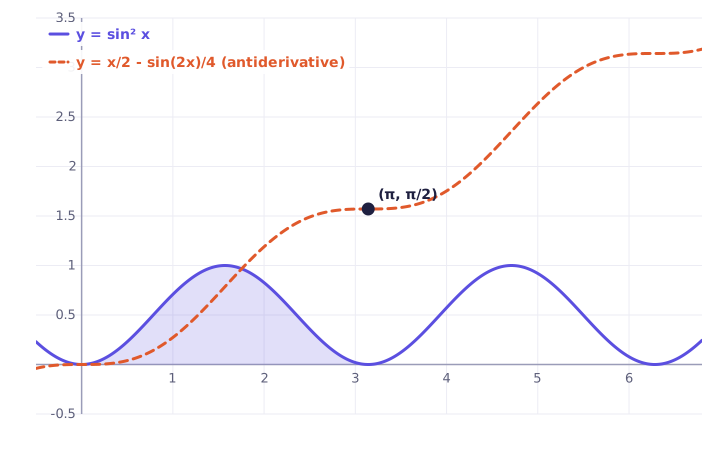
The graph of \sin^2 x oscillates between 0 and 1 with period \pi, centred on y = \frac{1}{2}. That is why the antiderivative grows on average like \frac{x}{2}.
Derivation, step by step
- Start from the double-angle identity \cos 2x = 1 - 2\sin^2 x.
- Solve for \sin^2 x: \sin^2 x = \dfrac{1 - \cos 2x}{2}.
- Substitute into the integral: \int\sin^2 x\,dx = \frac{1}{2}\int(1 - \cos 2x)\,dx
- Integrate each term. \int 1\,dx = x and \int\cos 2x\,dx = \frac{\sin 2x}{2}, from the integral of cos x with a = 2.
- Combine: \frac{1}{2}\left(x - \frac{\sin 2x}{2}\right) + C = \frac{x}{2} - \frac{\sin 2x}{4} + C.
Using \sin 2x = 2\sin x\cos x, you can also write the answer as \frac{1}{2}(x - \sin x\cos x) + C.
Check by differentiating
The forward direction is on the derivative of sin² x page: \frac{d}{dx}\sin^2 x = \sin 2x.
Definite integrals
| Integral | Value |
|---|---|
| \int_0^{\pi/2}\sin^2 x\,dx | \frac{\pi}{4} |
| \int_0^{\pi}\sin^2 x\,dx | \frac{\pi}{2} |
| \int_0^{2\pi}\sin^2 x\,dx | \pi |
| \int_0^{\pi/4}\sin^2 x\,dx | \frac{\pi}{8} - \frac{1}{4} |
For the last row: \frac{\pi/4}{2} - \frac{\sin(\pi/2)}{4} = \frac{\pi}{8} - \frac{1}{4} \approx 0.143.
A shortcut: over a full period, \sin^2 x and \cos^2 x have the same area, and together they integrate 1. So each one gets half of the interval length.
Substitution variants
For \sin^2(ax), use \sin^2(ax) = \frac{1 - \cos 2ax}{2}:
So \int\sin^2(3x)\,dx = \frac{x}{2} - \frac{\sin 6x}{12} + C.
When a \cos x factor is present, skip the identity and substitute u = \sin x:
Worked examples
Example 1: average value. The average of \sin^2 x on [0, 2\pi] is \frac{1}{2\pi}\cdot\pi = \frac{1}{2}. This is why AC power uses the factor \frac{1}{2} (and the RMS uses \frac{1}{\sqrt{2}}).
Example 2: volume. Rotating one arch of y = \sin x about the x-axis gives a solid with volume \pi\int_0^\pi\sin^2 x\,dx = \frac{\pi^2}{2}.
Example 3: sin⁴ x. Square the identity: \sin^4 x = \frac{(1 - \cos 2x)^2}{4} = \frac{1}{4} - \frac{\cos 2x}{2} + \frac{\cos^2 2x}{4}, then reduce \cos^2 2x again. The result is \frac{3x}{8} - \frac{\sin 2x}{4} + \frac{\sin 4x}{32} + C.
Common mistakes
- Answering \frac{\sin^3 x}{3}. Its derivative is \sin^2 x\cos x, not \sin^2 x.
- Answering -\cos^2 x. Its derivative is 2\sin x\cos x = \sin 2x.
- Using the wrong identity sign. For \sin^2 it is 1 - \cos 2x. For \cos^2 it is 1 + \cos 2x.
- Forgetting to divide \sin 2x by 2 when integrating \cos 2x, which gives \frac{\sin 2x}{2} instead of \frac{\sin 2x}{4} at the end.
Next: the integral of cos² x uses the same idea. Practise on trig integral problems.
Practice it now
Powers of sine and cosine
Solve real problems on this topic with instant feedback, hints and a step-by-step walkthrough for every answer. Free, no sign-up needed to start.
Practice this lesson