Alternating Series Test: Conditions, Error Bound and Examples
The alternating series test (Leibniz test): if bₙ decreases to 0, then the series of (−1)ⁿbₙ converges. Conditions, the error bound and examples.
Series rules Updated 3 min read
At a glance
- Also called
- The Leibniz test
- Condition 1
- The terms alternate in sign: \sum (-1)^{n+1} b_n with b_n > 0
- Condition 2
- b_n is decreasing, at least eventually
- Condition 3
- \lim_{n\to\infty} b_n = 0
- Error bound
- \lvert S - S_N\rvert \le b_{N+1}
- Cannot prove
- Divergence, or absolute convergence
On this page
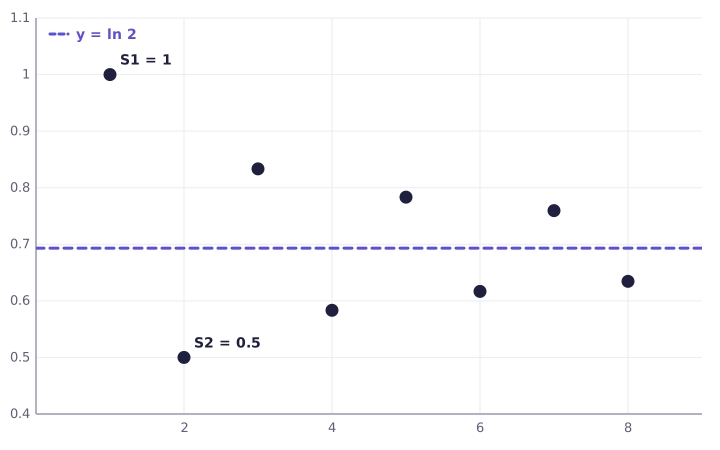
The alternating series test handles series whose terms switch sign, like 1 - \frac{1}{2} + \frac{1}{3} - \frac{1}{4} + \cdots. If the sizes of the terms shrink steadily to zero, the partial sums zigzag ever more tightly around a limit, and the series converges.
The test
Suppose b_n > 0 for all n. The series
converges if both:
- b_{n+1} \le b_n for all n (or for all n past some point), and
- \lim_{n\to\infty} b_n = 0.
The same holds for \sum (-1)^n b_n, which only flips every sign.
The error bound
If the conditions hold and S is the sum, the partial sum S_N is within one term of the truth:
Moreover, S lies between any two consecutive partial sums. This is the alternating series estimation theorem, and it makes alternating series easy to approximate.
Why it works
Because the b_n decrease, each step overshoots less than the previous one. The even partial sums S_2, S_4, S_6, \ldots increase, the odd ones S_1, S_3, S_5, \ldots decrease, and every even sum stays below every odd sum. Both sequences are bounded and monotone, so they converge, and since S_{2k+1} - S_{2k} = b_{2k+1} \to 0, they converge to the same limit.
Worked examples
Example 1: the alternating harmonic series. For \sum \frac{(-1)^{n+1}}{n}, b_n = \frac{1}{n} is positive, decreasing and tends to 0. The series converges (to \ln 2). Since \sum \frac{1}{n} diverges, the convergence is conditional.
Example 2: failing the limit condition. For \sum (-1)^n \frac{n}{n+1}, b_n = \frac{n}{n+1} \to 1 \ne 0. The alternating series test does not apply, and the nth-term test shows the series diverges.
Example 3: checking "decreasing" with a derivative. For \sum (-1)^{n+1}\frac{\ln n}{n} (starting at n = 2), let f(x) = \frac{\ln x}{x}. Then f'(x) = \frac{1 - \ln x}{x^2} < 0 for x > e, so b_n decreases for n \ge 3, and \frac{\ln n}{n} \to 0. The series converges.
Example 4: estimating a sum. The series \sum_{n=1}^{\infty} \frac{(-1)^{n+1}}{n!} = 1 - \frac{1}{2} + \frac{1}{6} - \frac{1}{24} + \cdots satisfies the test. Four terms give
with error at most b_5 = \frac{1}{120} \approx 0.0083. The true sum is 1 - \frac{1}{e} \approx 0.6321, and the actual error is about 0.0071.
Absolute vs conditional convergence
The test proves convergence but says nothing about absolute convergence. Check \sum b_n separately:
| Series | \sum b_n | Verdict |
|---|---|---|
| \sum \frac{(-1)^{n+1}}{n^2} | converges | absolutely convergent |
| \sum \frac{(-1)^{n+1}}{n} | diverges | conditionally convergent |
| \sum \frac{(-1)^{n+1}}{\sqrt{n}} | diverges | conditionally convergent |
The ratio test gives L = 1 for all three, so it cannot settle any of them.
Common mistakes
- Using the test to prove divergence. Failing the decreasing condition does not mean divergence. Only b_n \not\to 0 does, and that is the nth-term test.
- Including the sign in b_n. b_n is the positive size of the term, with (-1)^n removed.
- Skipping the decreasing check. It is usually true, but must be verified, sometimes with a derivative.
- Calling a series absolutely convergent because it passed this test.
For a comparison of every convergence test and how to pick one, read the full guide to convergence tests.
Practice it now
Alternating series
Solve real problems on this topic with instant feedback, hints and a step-by-step walkthrough for every answer. Free, no sign-up needed to start.
Practice this lesson