Clairaut's Theorem: Equality of Mixed Partial Derivatives
Clairaut's theorem: if the mixed partials f_xy and f_yx are continuous, they are equal. Statement, a classic counterexample, a graph and worked examples.
Series and multivariable theorems Updated 3 min read
At a glance
- Also called
- Schwarz's theorem, symmetry of second derivatives
- Hypotheses
- f is defined on a disk around (a, b), and f_{xy} and f_{yx} are both continuous on that disk
- Conclusion
- f_{xy}(a, b) = f_{yx}(a, b)
- In practice
- Differentiate in whichever order is easier
- Used for
- Testing whether a vector field is conservative, the Hessian matrix
- Course
- Calculus 3
On this page
Clairaut's theorem says that for a well-behaved function of two variables, the order in which you take mixed partial derivatives does not matter: differentiating in x then y gives the same result as y then x. It is the reason a function has one Hessian matrix, not two.
Statement of Clairaut's theorem
Suppose f(x, y) is defined on an open disk D that contains the point (a, b). If the mixed partial derivatives f_{xy} and f_{yx} are both continuous on D, then
Notation: f_{xy} = (f_x)_y means differentiate with respect to x first, then y. In Leibniz form, f_{xy} = \frac{\partial^2 f}{\partial y\,\partial x}. The theorem extends to more variables and higher orders: with continuous partials, only the count of each variable matters.
What Clairaut's theorem means
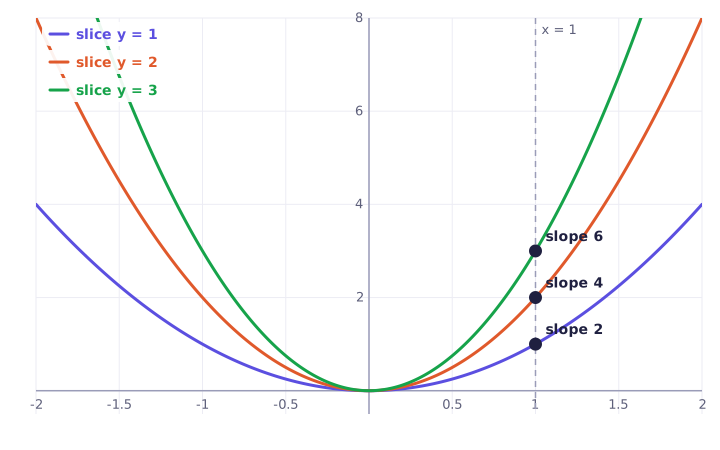
f_{xy} measures how the x-slope of the surface changes as you move in the y direction. f_{yx} measures how the y-slope changes as you move in the x direction. Clairaut says these two "twists" of the surface are the same number.
Take f(x, y) = x^2 y. Slicing the surface at fixed y gives the curves y = 1: x^2, y = 2: 2x^2, y = 3: 3x^2.
Why continuity matters: the classic counterexample
Define
Along the axes, a direct computation from the limit definition gives f_x(0, y) = -y and f_y(x, 0) = x. Therefore
The mixed partials disagree. Clairaut's theorem is not contradicted: f_{xy} and f_{yx} are not continuous at the origin, so the hypothesis fails.
Worked examples
Example 1: verify Clairaut for f(x, y) = x^3 y^2 + \sin(xy).
Step 1. First partials:
Step 2. Differentiate f_x with respect to y (product rule on y\cos(xy)):
Step 3. Differentiate f_y with respect to x (product rule on x\cos(xy)):
They match, as Clairaut predicts for a function built from polynomials and sines.
Example 2: choose the easier order. Find f_{xy} for f(x, y) = y e^{x^2} + x\ln(1 + y^4), for any (x, y).
Differentiating in x first means working through the chain rule on e^{x^2} and then on \ln(1 + y^4). Instead use f_{xy} = f_{yx}:
All partials are continuous everywhere, so f_{xy} = 2xe^{x^2} + \frac{4y^3}{1 + y^4}.
Example 3: a conservative field test. If \mathbf{F} = \langle P, Q \rangle = \nabla f, then P = f_x and Q = f_y, so Clairaut forces P_y = f_{xy} = f_{yx} = Q_x.
- \mathbf{F} = \langle 2xy,\; x^2 + 3y^2 \rangle: P_y = 2x = Q_x, consistent with a gradient, and indeed \mathbf{F} = \nabla(x^2 y + y^3).
- \mathbf{F} = \langle y,\; -x \rangle: P_y = 1 but Q_x = -1, so \mathbf{F} is not the gradient of any function.
Common mistakes
- Reading Leibniz notation in the wrong order. \frac{\partial^2 f}{\partial y\,\partial x} means x first. When Clairaut applies the order does not matter, but in the counterexample it does.
- Assuming equality without continuity. Piecewise functions defined separately at a point are where Clairaut can fail.
- Thinking P_y = Q_x alone proves a field is conservative. It is necessary; it is sufficient only on a simply connected region, a subtlety tied to Green's theorem.
Related theorems and guides
For computing partial derivatives, see partial derivatives. Clairaut's theorem underlies the curl test for conservative fields used with Green's theorem and Stokes' theorem, and it makes the multivariable Taylor expansion symmetric.
Practice it now
Second partial derivatives
Solve real problems on this topic with instant feedback, hints and a step-by-step walkthrough for every answer. Free, no sign-up needed to start.
Practice this lesson