Fundamental Theorem of Calculus Part 2: Evaluating Integrals
FTC part 2: the definite integral of f from a to b equals F(b) − F(a) for any antiderivative F. Statement, graph, a key counterexample and worked examples.
Integral calculus theorems Updated 3 min read
At a glance
- Also called
- Evaluation theorem, Newton-Leibniz formula
- Hypotheses
- f is continuous on [a, b], and F is any antiderivative of f there (F' = f)
- Conclusion
- \int_a^b f(x)\,dx = F(b) - F(a)
- Notation
- \big[F(x)\big]_a^b = F(b) - F(a)
- Net change form
- \int_a^b F'(x)\,dx = F(b) - F(a)
- Course
- Calculus 1
On this page
The fundamental theorem of calculus, part 2 (FTC 2), also called the evaluation theorem, says that a definite integral can be computed by finding an antiderivative and subtracting its values at the endpoints. It replaces the limit of Riemann sums with one line of algebra.
Statement of FTC part 2
Suppose that
- f is continuous on [a, b], and
- F is any antiderivative of f on [a, b], so F'(x) = f(x).
Then
The right side is often written \big[F(x)\big]_a^b or F(x)\Big|_a^b.
What FTC 2 means
The definite integral adds up f(x)\,dx across the interval. If f is the rate of change of F, adding up all the small changes F'(x)\,dx gives the total change in F, which is F(b) - F(a). This is the net change theorem: integrate velocity to get displacement, integrate a flow rate to get the total volume.
Why continuity matters
Consider \int_{-1}^{1}\frac{1}{x^2}\,dx. An antiderivative of x^{-2} is -\frac{1}{x}, and blindly applying the formula gives
But \frac{1}{x^2} > 0 everywhere, so its integral cannot be negative. The mistake: \frac{1}{x^2} is not continuous on [-1, 1] because it blows up at x = 0, so FTC 2 does not apply. Treated correctly as an improper integral, it diverges to \infty. Always check for discontinuities inside the interval before plugging in.
Worked examples
Example 1: a polynomial. Evaluate \int_1^3 (2x + 1)\,dx.
Step 1. An antiderivative is F(x) = x^2 + x.
Step 2. F(3) = 9 + 3 = 12 and F(1) = 1 + 1 = 2.
Step 3. \int_1^3 (2x + 1)\,dx = 12 - 2 = 10.
Check with geometry: the region is a trapezoid with parallel sides f(1) = 3 and f(3) = 7 and width 2, so its area is \frac{3 + 7}{2}\cdot 2 = 10.
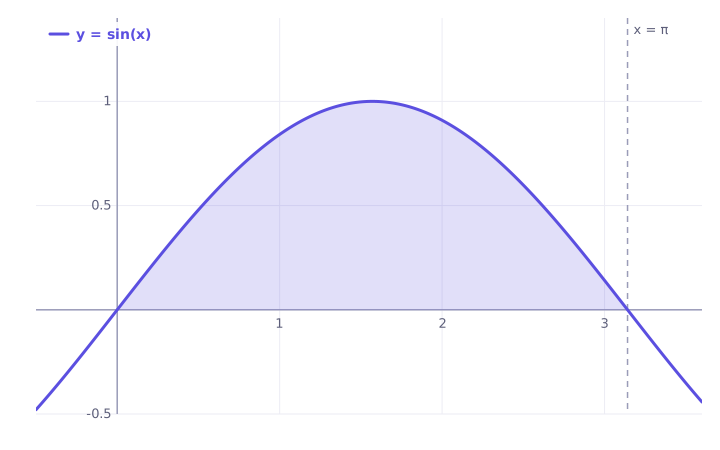
Example 2: a trig integral. Evaluate \int_0^\pi \sin x\,dx.
This is the area under one arch of the sine curve, shown in the graph above.
Example 3: a logarithm. Evaluate \int_1^e \frac{1}{x}\,dx.
\frac{1}{x} is continuous on [1, e], and an antiderivative is \ln x. So
Example 4: net change. A tank fills at r(t) = 3t^2 liters per minute. Between t = 1 and t = 2 minutes the volume increases by
Common mistakes
- Subtracting in the wrong order. It is F(b) - F(a), upper limit first.
- Dropping parentheses. With F(x) = x^2 - 3x, write F(b) - F(a) = (b^2 - 3b) - (a^2 - 3a). Losing the parentheses flips signs.
- Ignoring discontinuities. As shown above, an integrand that blows up inside [a, b] needs improper integral techniques.
- Confusing area with signed area. FTC 2 gives the signed area: regions below the x-axis count as negative. For total area, split where f changes sign, as in area between curves.
How FTC 2 connects to FTC 1
FTC part 1 says G(x) = \int_a^x f(t)\,dt is an antiderivative of f. Any other antiderivative differs from G by a constant (a consequence of the mean value theorem), so F(b) - F(a) = G(b) - G(a) = \int_a^b f(t)\,dt. That is the whole proof of part 2.
To find antiderivatives, see antiderivatives and u-substitution. For both parts of the theorem with more examples, read the fundamental theorem of calculus guide.
Practice it now
Evaluating definite integrals
Solve real problems on this topic with instant feedback, hints and a step-by-step walkthrough for every answer. Free, no sign-up needed to start.
Practice this lesson