The Squeeze Theorem: sin x/x, x² sin(1/x) and Classic Trig Limits
Learn the squeeze theorem step by step, see why sin x/x approaches 1, and work through classic trig limits like x² sin(1/x) and (1 - cos x)/x.
By the PracticeCalculus team Published 9 min read
On this page
- What is the squeeze theorem?
- The bound that powers almost every problem
- How to use the squeeze theorem in 4 steps
- Worked example 1: x² sin(1/x) as x approaches 0
- Worked example 2: sin x / x as x approaches infinity
- Worked example 3: why the limit of sin x / x as x approaches 0 is 1
- Worked example 4: the limit of (1 - cos x)/x
- Worked example 5: rescaling sin(kx)/x and tan x/x
- The absolute value version
- Common mistakes with the squeeze theorem
- Quick reference: classic trig limits
- Practice until the bounds come naturally
You plug x = 0 into \frac{\sin x}{x} and get \frac{0}{0}. You try x^2 \sin(1/x) and the calculator shows a wiggle that never settles down. Factoring does nothing, and the limit laws say you cannot split the product because \sin(1/x) has no limit. The squeeze theorem is the tool built for exactly these limits.
This guide explains what the squeeze theorem says, gives a reliable four-step method, and works through the classic trig limits every Calculus 1 course tests, including the famous proof that \frac{\sin x}{x} \to 1.
What is the squeeze theorem?
In plain language: if a function is stuck between a floor and a ceiling, and the floor and ceiling meet at the same height, the function in the middle gets squeezed to that height too.
Here is the formal statement. Suppose that for all x near a (except possibly at x = a itself),
and that
Then
The same statement holds for one-sided limits and for limits as x \to \infty. You will also see it called the sandwich theorem or the pinching theorem. The squeeze theorem reference page has the statement in compact form.
Two details matter:
- The inequality only has to hold near a, not everywhere. For x \to 0, it is enough that it holds on some small interval like 0 < \lvert x \rvert < 1.
- The two bounds must have the same limit. If the floor goes to -1 and the ceiling goes to 1, you have learned only that f stays between them, not where it goes.
If you want a refresher on what a limit is before going further, see What Is a Limit in Calculus?.
The bound that powers almost every problem
Sine and cosine never leave the interval [-1, 1], no matter what you feed them:
That is the whole trick. The input can be 1/x, x^3 or e^x, and the output is still trapped. Most squeeze problems start from this line and then multiply or divide every part of it by something that goes to 0 or \infty. You can see the bounded wave on the sine function page.
How to use the squeeze theorem in 4 steps
- Isolate the bounded piece. Find the oscillating part, usually a sine or cosine, and write -1 \le \sin(\dots) \le 1.
- Build the rest of the function. Multiply (or divide) all three parts by the remaining factor. If that factor can be negative, use absolute values so the inequality does not flip unexpectedly.
- Take the limit of both bounds. Use direct substitution or the limit laws.
- Check that they match. If both bounds approach L, conclude the middle function does too.
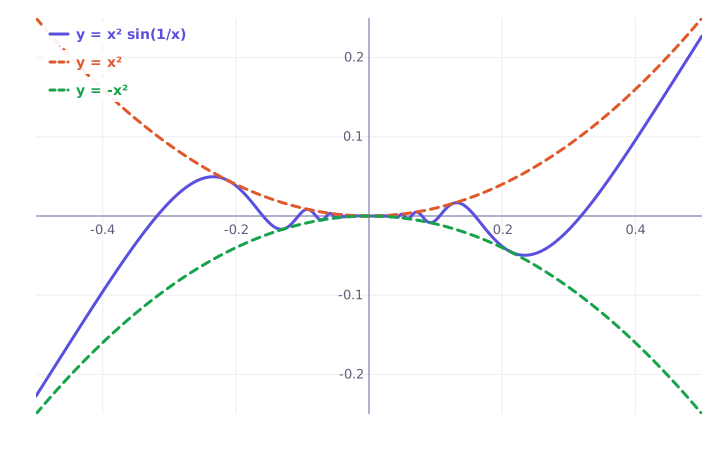
Worked example 1: x² sin(1/x) as x approaches 0
Find \displaystyle \lim_{x \to 0} x^2 \sin\left(\frac{1}{x}\right).
Why other methods fail. Substitution gives 0 \cdot \sin(1/0), which is undefined. The product law needs both limits to exist, but \sin(1/x) oscillates between -1 and 1 infinitely often near 0 and has no limit.
Step 1. Bound the oscillating piece. For every x \ne 0,
Step 2. Multiply by x^2. Since x^2 > 0 for x \ne 0, multiplying does not flip the inequalities:
Step 3. Take the limits of the bounds.
Step 4. Conclude. Both bounds go to 0, so
Worked example 2: sin x / x as x approaches infinity
Find \displaystyle \lim_{x \to \infty} \frac{\sin x}{x}.
Step 1. Start from -1 \le \sin x \le 1.
Step 2. We only care about large x, so take x > 0. Dividing by a positive number keeps the inequality direction:
Step 3. Both bounds go to 0 as x \to \infty (see limits at infinity if that step is unfamiliar).
Step 4. Therefore
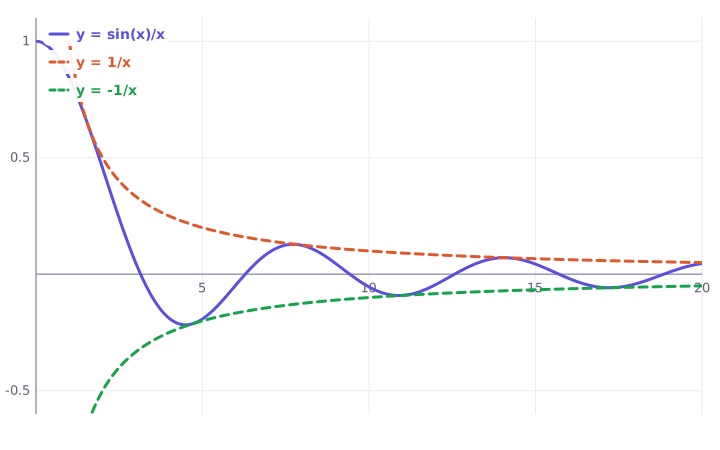
Notice the contrast with the next example. The same expression has limit 0 at infinity but limit 1 at zero. Always check where x is heading.
Worked example 3: why the limit of sin x / x as x approaches 0 is 1
This is the most important trig limit in Calculus 1:
Substitution gives \frac{0}{0}, and the simple -1 \le \sin x \le 1 bound is not good enough here (dividing by x gives bounds \pm\frac{1}{x}, which blow up). We need sharper bounds, and they come from geometry.
Step 1. Set up the unit circle. Take 0 < x < \frac{\pi}{2}, measured in radians. Let O be the origin, A = (1, 0), P = (\cos x, \sin x) on the circle, and T = (1, \tan x) where the line through O and P meets the vertical line x = 1.
Step 2. Compare three areas. The small triangle OAP sits inside the sector OAP, which sits inside the big triangle OAT:
- Triangle OAP: base 1, height \sin x, area \frac{1}{2}\sin x.
- Sector with angle x in a circle of radius 1: area \frac{1}{2}x.
- Triangle OAT: base 1, height \tan x, area \frac{1}{2}\tan x.
So
Step 3. Divide by \sin x. It is positive on 0 < x < \frac{\pi}{2}, so nothing flips:
Step 4. Take reciprocals. All three quantities are positive, and taking reciprocals of positive numbers reverses the inequalities:
Step 5. Handle negative x. Both \cos x and \frac{\sin x}{x} are even functions (replacing x with -x changes nothing), so the same inequality holds for -\frac{\pi}{2} < x < 0.
Step 6. Squeeze. \lim_{x \to 0} \cos x = 1 and \lim_{x \to 0} 1 = 1, so
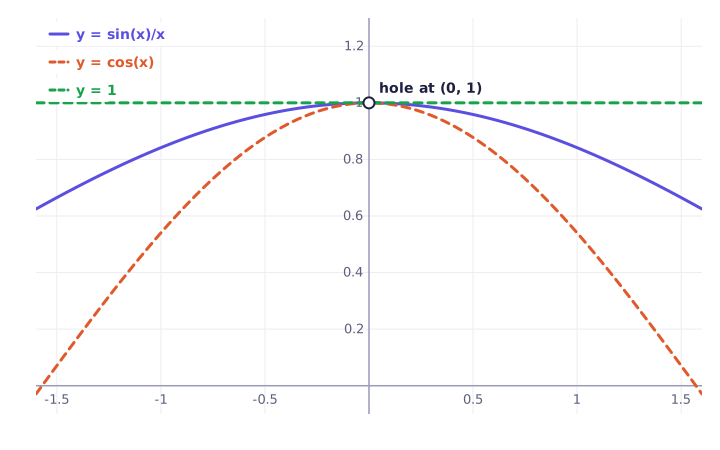
Tip: this limit is the reason the derivative of \sin x is \cos x. The proof in Derivatives of Trig Functions uses it directly. That is also why using L'Hôpital's rule on \frac{\sin x}{x} is circular: L'Hôpital needs that derivative first.
Worked example 4: the limit of (1 - cos x)/x
Find \displaystyle \lim_{x \to 0} \frac{1 - \cos x}{x}.
Once you know \frac{\sin x}{x} \to 1, you do not need a new squeeze. Algebra turns this into the limit you already have.
Step 1. Multiply by the conjugate 1 + \cos x:
Step 2. Use 1 - \cos^2 x = \sin^2 x:
Step 3. Take each limit. The first factor goes to 1. The second is continuous at 0, so substitute: \frac{\sin 0}{1 + \cos 0} = \frac{0}{2} = 0.
The same steps give a close cousin. For \frac{1 - \cos x}{x^2}, you get \left(\frac{\sin x}{x}\right)^2 \cdot \frac{1}{1 + \cos x} \to 1 \cdot \frac{1}{2} = \frac{1}{2}.
Worked example 5: rescaling sin(kx)/x and tan x/x
Many exam problems disguise \frac{\sin x}{x}. The fix is to make the denominator match the inside of the sine.
Find \displaystyle \lim_{x \to 0} \frac{\sin(5x)}{3x}.
The inside is 5x, so we want 5x in the denominator. Multiply and divide by 5:
As x \to 0, u = 5x \to 0 too, so \frac{\sin u}{u} \to 1. The answer is \frac{5}{3}.
Find \displaystyle \lim_{x \to 0} \frac{\tan x}{x}.
Write tangent as sine over cosine:
The absolute value version
A handy shortcut follows from the squeeze theorem: if \lvert f(x) \rvert \le h(x) and h(x) \to 0, then f(x) \to 0. That is because -h(x) \le f(x) \le h(x), and both sides go to 0.
For example, \lvert x \sin(1/x) \rvert \le \lvert x \rvert, and \lvert x \rvert \to 0, so \lim_{x \to 0} x \sin(1/x) = 0. This version only works when the target limit is 0.
Common mistakes with the squeeze theorem
- Bounds that do not match. Writing -1 \le \cos x \le 1 and stopping there proves nothing about the limit. The floor and ceiling must approach the same number.
- Flipping signs carelessly. For x \sin(1/x), writing -x \le x\sin(1/x) \le x is wrong when x < 0, because multiplying by a negative number reverses the inequalities. Use -\lvert x \rvert \le x\sin(1/x) \le \lvert x \rvert instead.
- Splitting the limit with the product law. Writing \lim x^2 \cdot \lim \sin(1/x) = 0 \cdot (\text{something}) is invalid, because \lim_{x \to 0}\sin(1/x) does not exist. The limit laws need every piece to have a limit.
- Confusing x \to 0 with x \to \infty. \frac{\sin x}{x} goes to 1 at 0 but to 0 at infinity.
- Mismatched inside and denominator. \frac{\sin(5x)}{x} is not 1. It is 5 \cdot \frac{\sin(5x)}{5x} \to 5.
- Using degrees. The area of a sector is \frac{1}{2}x only in radians. In degrees, \frac{\sin x}{x} approaches \frac{\pi}{180}, not 1.
For more traps like these across all of Calculus 1, see 12 Common Calculus Mistakes.
Quick reference: classic trig limits
| Limit | Value | How to get it |
|---|---|---|
| \lim_{x \to 0} \frac{\sin x}{x} | 1 | Squeeze with \cos x and 1 |
| \lim_{x \to 0} \frac{\sin(kx)}{x} | k | Rewrite as k \cdot \frac{\sin(kx)}{kx} |
| \lim_{x \to 0} \frac{\tan x}{x} | 1 | \frac{\sin x}{x} \cdot \frac{1}{\cos x} |
| \lim_{x \to 0} \frac{1 - \cos x}{x} | 0 | Multiply by conjugate 1 + \cos x |
| \lim_{x \to 0} \frac{1 - \cos x}{x^2} | \frac{1}{2} | Conjugate, then \left(\frac{\sin x}{x}\right)^2 \cdot \frac{1}{1 + \cos x} |
| \lim_{x \to 0} x^2 \sin\left(\frac{1}{x}\right) | 0 | Squeeze with \pm x^2 |
| \lim_{x \to 0} x \sin\left(\frac{1}{x}\right) | 0 | Squeeze with \pm\lvert x \rvert |
| \lim_{x \to \infty} \frac{\sin x}{x} | 0 | Squeeze with \pm\frac{1}{x} |
The squeeze theorem is one of five standard limit strategies. For the full toolkit, including when to reach for substitution, factoring or conjugates first, read How to Evaluate Limits.
Practice until the bounds come naturally
The hard part of the squeeze theorem is not the theorem. It is choosing the bounds and keeping the inequality signs straight. That becomes automatic after a dozen problems. Work through the interactive limits practice below: each question gives instant feedback, flags a mismatched bound or a flipped inequality right away, and shows the full solution so you can see exactly where the squeeze happens.
Practice it now
Limits practice
Solve real problems on this topic with instant feedback, hints and a step-by-step walkthrough for every answer. Free, no sign-up needed to start.
Practice this lesson