Squeeze Theorem: Statement, Proof Idea and Worked Examples
The squeeze (sandwich) theorem: if g ≤ f ≤ h near a and g and h share a limit L, then f has limit L too. Statement, graph and examples.
Limits and continuity theorems Updated 4 min read
At a glance
- Also called
- Sandwich theorem, pinching theorem
- Hypotheses
- g(x) \le f(x) \le h(x) near a, and g and h have the same limit L at a
- Conclusion
- \lim_{x \to a} f(x) = L
- Best for
- Limits with a bounded oscillating factor, such as \sin\frac{1}{x} or \cos x
- Famous use
- \lim_{x \to 0} \frac{\sin x}{x} = 1
- Course
- Calculus 1
On this page
The squeeze theorem finds a limit you cannot compute directly by trapping the function between two functions whose limits you can compute. If the lower and upper bounds approach the same number, the function caught between them must approach it too.
Statement of the squeeze theorem
Let f, g and h be functions defined on an open interval containing a, except possibly at a itself. Suppose that
- g(x) \le f(x) \le h(x) for every x in that interval with x \ne a, and
- \displaystyle \lim_{x \to a} g(x) = \lim_{x \to a} h(x) = L.
Then
The same statement holds for one-sided limits and for limits as x \to \infty or x \to -\infty, as long as the inequality holds on the corresponding one-sided interval or for all sufficiently large |x|.
What the squeeze theorem says in plain language
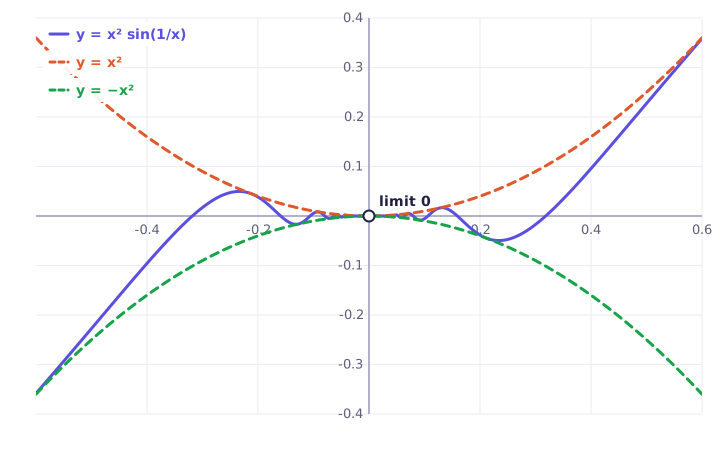
Picture two curves that meet at a single point above x = a. Any curve drawn between them has no room to go anywhere else near a, so it is pinched through the same point. The theorem turns that picture into a rule: you never have to compute \lim f(x) directly, only the limits of the two bounds.
Why each hypothesis matters
The bounds must share a limit. Every x \ne 0 satisfies -1 \le \sin\frac{1}{x} \le 1, but the bounds approach -1 and 1, which are different. The theorem gives no conclusion, and in fact \lim_{x \to 0}\sin\frac{1}{x} does not exist: the function hits every value in [-1, 1] infinitely often near 0.
The inequality must hold near a. A bound that holds only far from a tells you nothing about the limit at a. On the other hand, it may fail at a itself, or far away, without harm. Only a small interval around a matters.
Worked examples
Example 1: \lim_{x \to 0} x^2\sin\frac{1}{x}.
Step 1. Bound the oscillating factor: -1 \le \sin\frac{1}{x} \le 1 for all x \ne 0.
Step 2. Multiply by x^2, which is positive for x \ne 0, so the inequalities keep their direction:
Step 3. Both -x^2 and x^2 approach 0 as x \to 0. By the squeeze theorem, \lim_{x \to 0} x^2\sin\frac{1}{x} = 0.
Direct substitution fails here because \sin\frac{1}{0} is undefined, and the product rule for limits fails because \lim \sin\frac{1}{x} does not exist. The squeeze theorem is the right tool.
Example 2: \lim_{x \to \infty} \frac{\cos x}{x}.
For x > 0, -1 \le \cos x \le 1 gives
Both bounds approach 0 as x \to \infty, so \frac{\cos x}{x} \to 0. See limits at infinity for more limits of this type.
Example 3: the famous limit \lim_{x \to 0}\frac{\sin x}{x} = 1.
A geometric argument with the unit circle shows that for 0 < |x| < \frac{\pi}{2},
As x \to 0, \cos x \to 1 and the constant 1 stays at 1. The squeeze theorem gives \lim_{x \to 0}\frac{\sin x}{x} = 1. This single limit is the reason \frac{d}{dx}\sin x = \cos x, as shown in derivatives of trig functions.
How to use the squeeze theorem
- Find the part that misbehaves, usually a sine or cosine of something that blows up.
- Bound it with constants, typically -1 and 1.
- Multiply or add to rebuild f(x) in the middle. If you multiply by a negative quantity, flip the inequalities.
- Take the limit of each bound. If they agree, you are done.
A useful shortcut: if |f(x)| \le h(x) and h(x) \to 0, then f(x) \to 0. This is the squeeze theorem with g = -h.
Common mistakes
- Using bounds with different limits. The bounds -1 and 1 for \sin\frac{1}{x} alone prove nothing. You need to multiply by something that goes to zero.
- Forgetting sign when multiplying. For x\sin\frac{1}{x} with x < 0 the inequalities flip. Using |x\sin\frac{1}{x}| \le |x| avoids the issue.
- Splitting the limit into a product. Writing \lim x^2 \cdot \lim \sin\frac{1}{x} is invalid because the second limit does not exist.
Related theorems and guides
The squeeze theorem is one of the basic tools for evaluating limits. It is often taught next to the intermediate value theorem and the extreme value theorem, which describe what continuous functions must do. For a gentle introduction to limits themselves, start with what is a limit.
Practice it now
What is a limit?
Solve real problems on this topic with instant feedback, hints and a step-by-step walkthrough for every answer. Free, no sign-up needed to start.
Practice this lesson