Derivative of sin(x²): Formula, Proof and Examples
The derivative of sin(x²) is 2x cos(x²). See the chain rule step by step, how it differs from sin²x, the second derivative and worked examples.
Trigonometric derivatives Updated 2 min read
At a glance
- Derivative
- 2x\cos(x^2)
- Outer and inner
- Outer \sin u, inner u = x^2
- Second derivative
- 2\cos(x^2) - 4x^2\sin(x^2)
- Not the same as
- \sin^2 x, whose derivative is \sin 2x
- Integral
- \int\sin(x^2)\,dx has no elementary antiderivative
On this page
The derivative of \sin(x^2) is 2x\cos(x^2). This is a classic chain rule problem: the sine is on the outside and x^2 is on the inside.
Graph of sin(x²) and its derivative
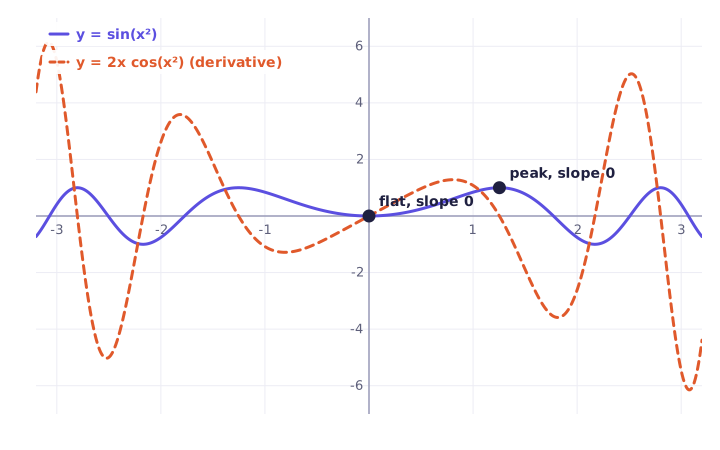
Unlike \sin x, this function is not periodic. It speeds up as you move away from 0, and the derivative grows roughly like 2x.
Proof with the chain rule
Set u = x^2, so y = \sin u. Then
Multiply:
The inside x^2 is copied unchanged into the cosine. The inside's derivative 2x goes out front. The two ingredients are the derivative of sin x and the derivative of x².
sin(x²) vs sin²x
These two are easy to mix up and have different derivatives:
| Function | Meaning | Derivative |
|---|---|---|
| \sin(x^2) | sine of x^2 | 2x\cos(x^2) |
| \sin^2 x | (\sin x)^2 | 2\sin x\cos x = \sin 2x |
| \sin 2x | sine of 2x | 2\cos 2x |
At x = 1, for example, \sin(1) \approx 0.841 while \sin^2(1) \approx 0.708. See the derivative of sin²x and the derivative of sin 2x.
Worked examples
Example 1: a constant inside. \frac{d}{dx}\sin(3x^2) = \cos(3x^2)\cdot 6x = 6x\cos(3x^2).
Example 2: a value. At x = \sqrt{\pi}, x^2 = \pi and \cos\pi = -1, so the slope is 2\sqrt{\pi}\cdot(-1) = -2\sqrt{\pi} \approx -3.54.
Example 3: a product. With the product rule:
Example 4: second derivative. Differentiate 2x\cos(x^2) with the product rule:
Example 5: other powers. \frac{d}{dx}\sin(x^3) = 3x^2\cos(x^3) and \frac{d}{dx}\cos(x^2) = -2x\sin(x^2).
Spotting the outside and the inside
The hardest part of this problem is reading it correctly. Ask yourself which operation you would do last if you plugged in a number. For \sin(x^2) with x = 3, you square first to get 9, then take the sine. The last step, sine, is the outside function. The first step, squaring, is the inside. That ordering tells you exactly how to apply the chain rule. The same test works for any composite: whatever happens last is differentiated first, and the rest is multiplied on as the inner derivative.
Common mistakes
- Dropping the 2x. \cos(x^2) alone is only the outer derivative.
- Changing the inside. Writing 2x\cos x or \cos 2x loses the x^2.
- Reading it as \sin^2 x. Check the parentheses before you start.
Running the chain rule backward is u-substitution: \int 2x\cos(x^2)\,dx = \sin(x^2) + C. Practice more with the chain rule problems.
Practice it now
Chain rule: trig
Solve real problems on this topic with instant feedback, hints and a step-by-step walkthrough for every answer. Free, no sign-up needed to start.
Practice this lesson