Integral of 1/x²: Formula, Derivation and Examples
The integral of 1/x² is -1/x + C. Rewrite it as x^(-2), check by differentiating, and see improper integrals like 1 to infinity and the classic -1 to 1 trap.
Powers, roots and rational functions Updated 2 min read
At a glance
- Antiderivative
- -\dfrac{1}{x} + C
- Rewrite first
- \dfrac{1}{x^2} = x^{-2}
- Valid for
- x \ne 0
- Improper integral
- \int_1^\infty \dfrac{1}{x^2}\,dx = 1
- Check
- \dfrac{d}{dx}\left(-\dfrac{1}{x}\right) = \dfrac{1}{x^2}
On this page
The integral of \dfrac{1}{x^2} is -\dfrac{1}{x} + C. Unlike \frac{1}{x}, this one is handled by the ordinary reverse power rule.
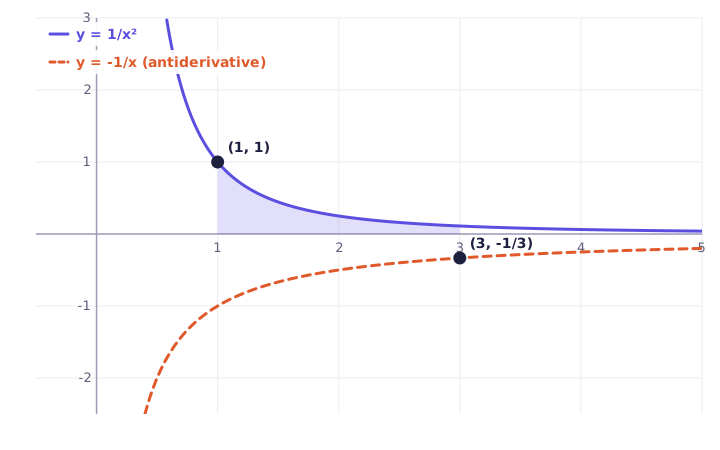
Graph of 1/x² and the area under it
Derivation, step by step
- Rewrite as a power: \frac{1}{x^2} = x^{-2}.
- Apply the reverse power rule with n = -2.
- Add one to the exponent: -2 + 1 = -1.
- Divide by -1: \frac{x^{-1}}{-1} = -\frac{1}{x}.
- Add C.
Check by differentiating
The forward rule is on the derivative of 1/x² page, and the derivative of 1/x page shows that \frac{d}{dx}\frac{1}{x} = -\frac{1}{x^2}, which is the same fact read the other way.
Improper integrals
The area under \frac{1}{x^2} out to infinity is finite:
Compare this with \int_1^\infty \frac{1}{x}\,dx, which diverges because \ln b \to \infty. This contrast is the start of the p-test for integrals and series. The lesson on infinite limits of integration covers it in detail.
Near zero the story flips: \int_0^1 \frac{1}{x^2}\,dx = \lim_{a\to 0^+}\left(\frac{1}{a} - 1\right) = \infty.
The classic trap: integrating across zero
Plugging into the antiderivative gives
But \frac{1}{x^2} is positive everywhere, so its integral cannot be negative. The error is that \frac{1}{x^2} has a vertical asymptote at x = 0, so the Fundamental Theorem of Calculus does not apply on [-1, 1]. Split the integral at 0: each half diverges, so the whole integral diverges.
Substitution variant
With u = ax + b:
For example, \int \frac{1}{(2x + 1)^2}\,dx = -\frac{1}{2(2x + 1)} + C. Check: the derivative is \frac{1}{2}(2x + 1)^{-2}\cdot 2 = \frac{1}{(2x + 1)^2}.
Worked examples
Example 1. \int \frac{3}{x^2}\,dx = -\frac{3}{x} + C.
Example 2. \int \frac{x + 1}{x^2}\,dx = \int\left(\frac{1}{x} + \frac{1}{x^2}\right)dx = \ln\lvert x\rvert - \frac{1}{x} + C. Split first, then use the integral of 1/x for the first piece.
Example 3. \int_2^4 \frac{1}{x^2}\,dx = -\frac{1}{4} + \frac{1}{2} = \frac{1}{4}.
Example 4. \int \frac{1}{x^3}\,dx = \frac{x^{-2}}{-2} + C = -\frac{1}{2x^2} + C.
Common mistakes
- Writing \ln(x^2). The log only appears for \frac{1}{x}.
- Writing -\frac{1}{x^3} or \frac{1}{x}. Exponents go up by one (-2 \to -1), and you divide by -1, which flips the sign.
- Integrating across an asymptote. Always check for division by zero inside the interval.
- Writing \frac{1}{3x^3} by treating \frac{1}{x^2} as (x^2) and integrating that. Rewrite as x^{-2} first.
Try improper integral problems to practise the infinite case.
Practice it now
The reverse power rule
Solve real problems on this topic with instant feedback, hints and a step-by-step walkthrough for every answer. Free, no sign-up needed to start.
Practice this lesson