Integral of √x: Formula, Derivation and Examples
The integral of √x is (2/3)x^(3/2) + C. Rewrite the root as a power, check by differentiating, and see √(ax + b), 1/√x and definite integral examples.
Powers, roots and rational functions Updated 2 min read
At a glance
- Antiderivative
- \dfrac{2}{3}x^{3/2} + C = \dfrac{2}{3}x\sqrt{x} + C
- Rewrite first
- \sqrt{x} = x^{1/2}
- Domain
- x \ge 0
- Related integral
- \int \dfrac{1}{\sqrt{x}}\,dx = 2\sqrt{x} + C
- Check
- \dfrac{d}{dx}\dfrac{2}{3}x^{3/2} = x^{1/2}
On this page
The integral of \sqrt{x} is \dfrac{2}{3}x^{3/2} + C. The trick is to write the square root as a power first.
Graph of √x and the area under it
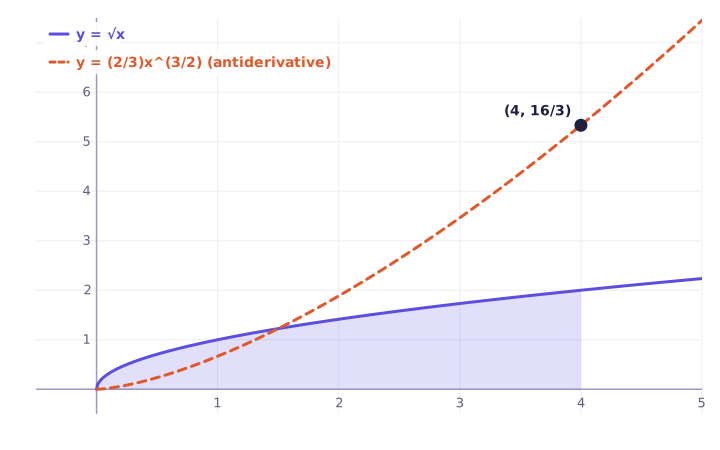
The shaded region fits inside a 4 by 2 rectangle of area 8. It fills exactly two thirds of it, which is where the \frac{2}{3} comes from.
Derivation, step by step
- Rewrite the root: \sqrt{x} = x^{1/2}.
- Use the reverse power rule with n = \frac{1}{2}.
- Add one to the exponent: \frac{1}{2} + 1 = \frac{3}{2}.
- Divide by \frac{3}{2}, which means multiply by \frac{2}{3}: \frac{2}{3}x^{3/2}.
- Add C.
A second derivation: area by slicing sideways
There is a neat way to see the \frac{2}{3} without any rule. The curve y = \sqrt{x} is the same as x = y^2 for y \ge 0. Draw the rectangle from (0, 0) to (b, \sqrt{b}). The curve splits it in two. The piece between the curve and the y-axis is the area under x = y^2 from y = 0 to y = \sqrt{b}, which is \frac{(\sqrt{b})^3}{3} by the integral of x². The full rectangle is b\sqrt{b}, so the area under \sqrt{x} is what is left over:
That matches the formula. It also shows why the two areas split in the ratio 1 : 2.
Check by differentiating
The forward rule is on the derivative of √x page.
Other roots and powers of x
The same method works for any root. Rewrite, then raise the power and divide:
| Integrand | As a power | Integral |
|---|---|---|
| \sqrt{x} | x^{1/2} | \frac{2}{3}x^{3/2} + C |
| \frac{1}{\sqrt{x}} | x^{-1/2} | 2x^{1/2} + C |
| x\sqrt{x} | x^{3/2} | \frac{2}{5}x^{5/2} + C |
| \sqrt[3]{x} | x^{1/3} | \frac{3}{4}x^{4/3} + C |
| \frac{x + 1}{\sqrt{x}} | x^{1/2} + x^{-1/2} | \frac{2}{3}x^{3/2} + 2x^{1/2} + C |
Substitution variant: integral of √(ax + b)
Let u = ax + b, so du = a\,dx:
For example, \int \sqrt{3x + 2}\,dx = \frac{2}{9}(3x + 2)^{3/2} + C. Check: \frac{2}{9}\cdot\frac{3}{2}(3x+2)^{1/2}\cdot 3 = \sqrt{3x + 2}.
A classic: \int x\sqrt{x^2 + 1}\,dx = \frac{1}{3}(x^2 + 1)^{3/2} + C, with u = x^2 + 1.
Definite integral examples
Example 1. \int_1^9 \sqrt{x}\,dx = \frac{2}{3}\left(9^{3/2} - 1^{3/2}\right) = \frac{2}{3}(27 - 1) = \frac{52}{3}.
Example 2. \int_0^1 \frac{1}{\sqrt{x}}\,dx = \Big[2\sqrt{x}\Big]_0^1 = 2. This is an improper integral, because \frac{1}{\sqrt{x}} blows up at 0, but the area is still finite.
Example 3. \int_0^4 (\sqrt{x} - 1)\,dx = \frac{16}{3} - 4 = \frac{4}{3}.
Common mistakes
- Using the power rule on the root sign directly. Write x^{1/2} first.
- Dividing by \frac{1}{2} instead of \frac{3}{2}. You divide by the new exponent, not the old one.
- Writing \frac{3}{2}x^{3/2}. Dividing by \frac{3}{2} gives \frac{2}{3}, not \frac{3}{2}.
- Integrating \sqrt{x^2 + 1} like \sqrt{x}. With a non-linear inside and no matching factor, substitution fails. That integral needs trig substitution.
Practise on antiderivative problems.
Practice it now
The reverse power rule
Solve real problems on this topic with instant feedback, hints and a step-by-step walkthrough for every answer. Free, no sign-up needed to start.
Practice this lesson