Integral of x: Formula, Derivation and Examples
The integral of x is x²/2 + C. See why with the reverse power rule and a triangle, plus definite integrals, the linear form ax + b and common mistakes.
Powers, roots and rational functions Updated 3 min read
At a glance
- Antiderivative
- \dfrac{x^2}{2} + C
- Rule used
- Reverse power rule with n = 1
- Definite form
- \int_0^b x\,dx = \dfrac{b^2}{2}
- Symmetric interval
- \int_{-a}^{a} x\,dx = 0
- Check
- \dfrac{d}{dx}\dfrac{x^2}{2} = x
On this page
The integral of x is \dfrac{x^2}{2} + C. It comes straight from the reverse power rule: add one to the exponent, then divide by the new exponent.
Graph of y = x and its antiderivative
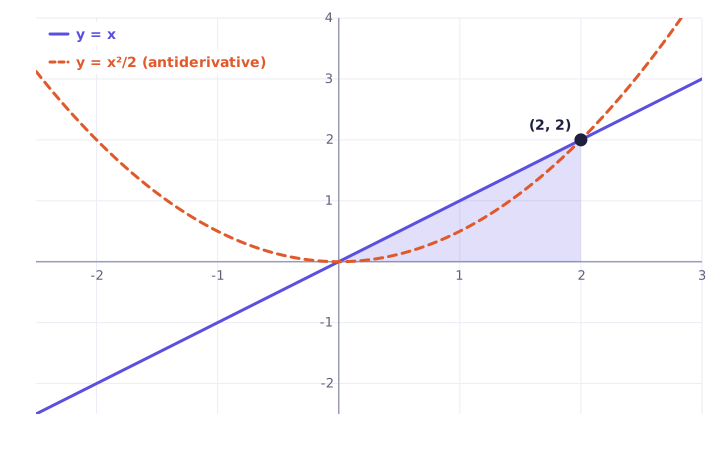
The antiderivative \frac{x^2}{2} is a parabola. Its slope at each point equals the height of the line y = x: slope 0 at the origin, slope 2 at x = 2, and negative slopes for negative x.
Derivation, step by step
- Write x as a power: x = x^1.
- Apply the reverse power rule, \int x^n\,dx = \frac{x^{n+1}}{n+1} + C, with n = 1.
- Add one to the exponent: x^{2}.
- Divide by the new exponent: \frac{x^2}{2}.
- Add the constant: \frac{x^2}{2} + C.
There is also a picture proof. The region under y = x from 0 to b is a right triangle with base b and height b, so its area is \frac{1}{2}b\cdot b = \frac{b^2}{2}. The area function is \frac{x^2}{2}, and that is exactly the antiderivative.
Check by differentiating
The forward direction is on the derivative of x page.
Definite integrals
For example, \int_1^3 x\,dx = \frac{9 - 1}{2} = 4. That region is a trapezoid with parallel sides 1 and 3 and width 2, and its area is \frac{1 + 3}{2}\cdot 2 = 4. Same answer.
When the interval crosses 0, area below the axis counts as negative: \int_{-1}^{1} x\,dx = \frac{1}{2} - \frac{1}{2} = 0.
The linear version: integral of ax + b
For a line ax + b you can integrate term by term:
With a u-substitution, u = ax + b, you get a second form:
Both are correct. Expanding the second gives \frac{ax^2}{2} + bx + \frac{b^2}{2a}, which differs from the first only by the constant \frac{b^2}{2a}.
Worked examples
Example 1. \int 6x\,dx = 6\cdot\frac{x^2}{2} + C = 3x^2 + C.
Example 2. \int (4x - 5)\,dx = 2x^2 - 5x + C. The -5 uses the integral of a constant.
Example 3. \int_0^4 \frac{x}{2}\,dx = \frac{1}{2}\cdot\frac{16}{2} = 4.
Example 4: average value. The average of f(x) = x on [0, 6] is \frac{1}{6}\int_0^6 x\,dx = \frac{1}{6}\cdot 18 = 3, the midpoint, as you would expect for a line.
Common mistakes
- Writing x^2 + C. You must divide by the new exponent. The derivative of x^2 is 2x, not x.
- Getting 1. That is the derivative of x, not its integral.
- Dropping + C on an indefinite integral.
- Expecting area to be positive. A definite integral gives signed area. Use \int\lvert x\rvert\,dx if you want total area; see the integral of |x|.
Keep going with the integral of x², or practice on antiderivative problems.
Practice it now
The reverse power rule
Solve real problems on this topic with instant feedback, hints and a step-by-step walkthrough for every answer. Free, no sign-up needed to start.
Practice this lesson