AP Calc BC Unit 10 Review: Infinite Sequences and Series
AP Calculus BC Unit 10 review: convergence tests, error bounds, Taylor and Maclaurin series, and the radius and interval of convergence, with practice.
AP Calculus units Updated 4 min read
At a glance
- AB exam weight
- Not on the AB exam
- BC exam weight
- 15–20%
- Big ideas
- Convergence tests, Taylor polynomials, error bounds, power series
- BC only
- The whole unit
- Comes after
- Unit 9, parametric, polar and vector-valued functions
- Practice here
- Calculus 2: Sequences and series
AP Calculus Unit 10, Infinite Sequences and Series, is the second BC-only unit and the largest. It asks a surprising question: can you add infinitely many numbers and get a finite answer? Sometimes you can. Then it uses that idea to write functions like e^x and \sin x as infinite polynomials, which is how calculators actually compute them.
| AP Calculus AB | AP Calculus BC | |
|---|---|---|
| Exam weight | not on the AB exam | 15–20% (BC only) |
| Extra topics | none | the whole unit is BC only |
What Unit 10 covers
College Board splits the unit into these topics. Each row links to a lesson where you can practice it with new numbers every time.
| Topic | What you learn | Practice |
|---|---|---|
| Convergent and divergent series | Partial sums and what convergence means | Series and partial sums |
| Geometric series | \sum ar^n = \frac{a}{1 - r} for \lvert r\rvert < 1 | Geometric series |
| The nth term test | If a_n \not\to 0, the series diverges | nth term test |
| Integral test, harmonic series and p-series | \sum \frac{1}{n^p} converges only when p > 1 | Integral test and p-series |
| Comparison tests | Direct and limit comparison | Comparison tests |
| Alternating series test | Decreasing terms that go to 0 | Alternating series |
| Ratio test | Using \lim \left\lvert\frac{a_{n+1}}{a_n}\right\rvert | Ratio and root tests |
| Absolute and conditional convergence | Whether \sum \lvert a_n\rvert also converges | Choosing a test |
| Alternating series error bound | Error is at most the first omitted term | Alternating series |
| Taylor polynomials | Approximating a function near a point | Taylor polynomials |
| Lagrange error bound | Bounding a Taylor approximation's error | Estimating with Taylor |
| Radius and interval of convergence | The ratio test plus checking endpoints | Power series and radius |
| Taylor and Maclaurin series | Building series for e^x, \sin x, \cos x and \frac{1}{1 - x} | Maclaurin series |
| Representing functions as power series | Substituting, differentiating and integrating series | Maclaurin series |
The key ideas
A series converges when its partial sums settle down. If S_N = a_1 + a_2 + \dots + a_N approaches a finite limit, the series converges to that limit. The terms going to 0 is necessary but not enough: the harmonic series \sum \frac{1}{n} has terms that go to 0, yet it diverges.
Each test fits a shape. The nth term test only proves divergence. The geometric series formula gives an exact sum. The ratio test handles factorials and exponentials. The alternating series test needs terms that decrease to 0.
Taylor polynomials match a function near a point. The degree n Taylor polynomial matches f and its first n derivatives at x = a. More terms give a better fit over a wider interval.
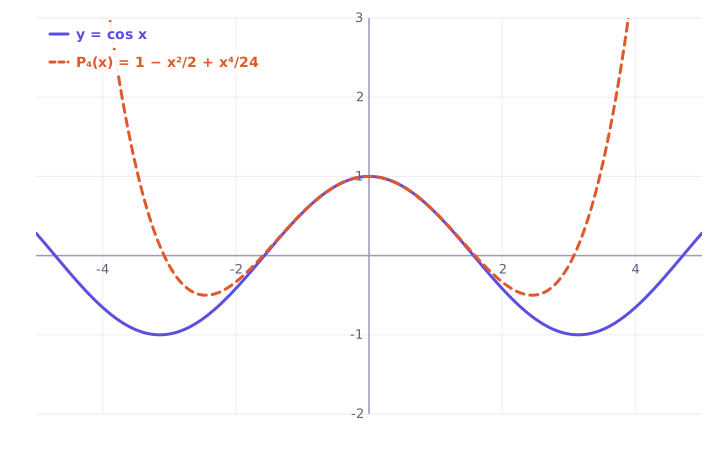
Power series converge on an interval. Use the ratio test to find the radius R, then test each endpoint separately, since the ratio test says nothing there. Read more in the guides on convergence tests, power series and Taylor series, and the Taylor's Theorem page.
Sample questions
1. Geometric series. \sum_{n=0}^{\infty} 3\left(\frac{1}{2}\right)^n has a = 3 and r = \frac{1}{2}, so it converges to \frac{3}{1 - 1/2} = 6.
2. Ratio test. For \sum_{n=1}^{\infty} \frac{n}{3^n}:
so the series converges.
3. Alternating series error. The alternating harmonic series 1 - \frac{1}{2} + \frac{1}{3} - \frac{1}{4} + \dots converges to \ln 2. The first four terms give \frac{7}{12} \approx 0.583, and the error is at most the next term, \frac{1}{5}. The actual error is about 0.110.
4. Interval of convergence. For \sum_{n=1}^{\infty} \frac{x^n}{n}, the ratio test gives |x| < 1. At x = 1 it is the harmonic series, which diverges. At x = -1 it is the alternating harmonic series, which converges. The interval is [-1, 1).
5. Lagrange error bound. The degree 2 Maclaurin polynomial of e^x gives e^{0.1} \approx 1 + 0.1 + 0.005 = 1.105. Every derivative of e^x is e^x, which is less than 3 on [0, 0.1], so
The true value is e^{0.1} \approx 1.105171, so the error is about 0.00017.
How to study Unit 10
- Make a test flowchart. Decide in what order you check nth term, geometric, p-series, alternating, ratio and comparison, then practice choosing quickly.
- Always test the endpoints. The interval of convergence free-response question gives a point for each endpoint, and they often behave differently.
- Memorize four Maclaurin series. e^x, \sin x, \cos x and \frac{1}{1 - x} cover most of the exam once you can substitute into them.
- Write the error bound in full. Show M, the factorial and the power, not just a number.
- Work through problem sets. Try the convergence tests practice problems, power series problems and Taylor series problems, each with full solutions.
For the full course map, see the AP Calculus BC guide, or compare the two courses in the AP Calculus AB guide.
AP and Advanced Placement are registered trademarks of College Board, which is not affiliated with PracticeCalculus and does not endorse this guide. Unit names and weights come from College Board's course framework; check it for any changes.
Practice it now
Series and partial sums
Solve real problems on this topic with instant feedback, hints and a step-by-step walkthrough for every answer. Free, no sign-up needed to start.
Practice this lesson