AP Calc Unit 7 Review: Differential Equations (AB and BC)
AP Calculus Unit 7 review for AB and BC: slope fields, separation of variables, exponential models, and BC Euler's method and logistic growth.
AP Calculus units Updated 4 min read
At a glance
- AB exam weight
- 5–10%
- BC exam weight
- 5–10%
- Big ideas
- Slope fields, separation of variables, particular solutions, exponential models
- BC only
- Euler's method, logistic models
- Comes before
- Unit 8, applications of integration
- Practice here
- Calculus 2: Differential equations
AP Calculus Unit 7, Differential Equations, puts derivatives and integrals together. A differential equation tells you how a quantity changes, like \frac{dy}{dx} = xy, and your job is to find the quantity itself. It is a smaller unit on the multiple-choice section, but it has its own free-response question on most exams.
| AP Calculus AB | AP Calculus BC | |
|---|---|---|
| Exam weight | 5–10% | 5–10% |
| Extra topics | none | Euler's method, logistic models |
What Unit 7 covers
College Board splits the unit into these topics. Each row links to a lesson where you can practice it with new numbers every time.
| Topic | What you learn | Practice |
|---|---|---|
| Modeling with differential equations | Turning "the rate is proportional to" into an equation | Growth and decay |
| Verifying solutions | Substituting a function into the equation | Separable equations |
| Sketching slope fields | Drawing short segments with slope \frac{dy}{dx} | Slope fields |
| Reasoning with slope fields | Matching fields to equations and tracing solutions | Slope fields |
| Euler's method (BC) | Stepping along tangent lines to estimate a solution | Euler's method |
| General solutions by separation | Separating variables and integrating | Separable equations |
| Particular solutions | Using an initial condition to find C | Separable equations |
| Exponential models | \frac{dy}{dt} = ky and y = y_0 e^{kt} | Growth and decay |
| Logistic models (BC) | Growth that levels off at a carrying capacity | Logistic growth |
The key ideas
A solution is a function, not a number. To check whether y = Ce^{3x} solves y' = 3y, differentiate: y' = 3Ce^{3x} = 3y. It works for every C, so there is a whole family of solutions. An initial condition picks one.
Slope fields show every solution at once. At each point (x, y), draw a short segment with slope \frac{dy}{dx}. A solution curve follows the segments like a leaf following a current. Where \frac{dy}{dx} depends only on x, segments in the same column are parallel.
Separation of variables solves the equation exactly. Move every y to one side with dy and every x to the other with dx, then integrate both sides.
Exponential growth is a differential equation. "The rate of change of y is proportional to y" means \frac{dy}{dt} = ky, and its solutions are y = y_0 e^{kt}. Growth has k > 0, decay has k < 0.
BC: logistic growth levels off. In \frac{dP}{dt} = kP\left(1 - \frac{P}{L}\right), the population approaches the carrying capacity L and grows fastest when P = \frac{L}{2}.
Sample questions
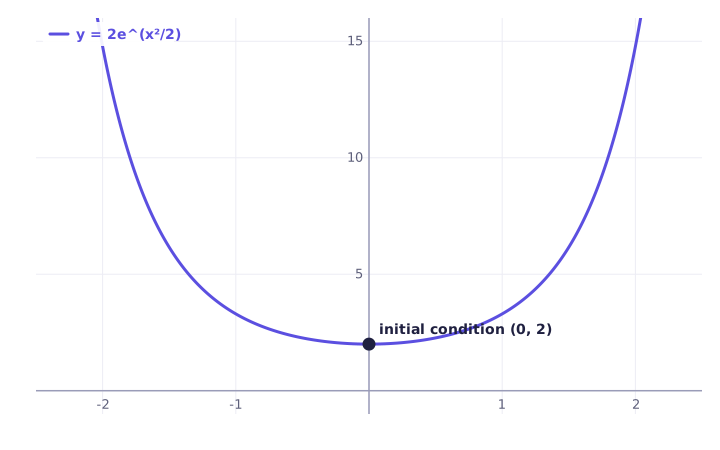
1. Separation of variables. Solve \frac{dy}{dx} = xy with y(0) = 2. Separate and integrate:
At (0, 2), C = \ln 2. Since y > 0, y = 2e^{x^2/2}.
2. Exponential decay. A 100 g sample has a half-life of 5 years. After 15 years, three half-lives have passed, so 100\left(\frac{1}{2}\right)^3 = 12.5 g remain. In the form y = 100e^{kt}, k = -\frac{\ln 2}{5}.
3. Reading a slope field. For \frac{dy}{dx} = x - y, the slope at (1, 0) is 1 and the slope at (2, 2) is 0. Every point on the line y = x has a horizontal segment.
4. BC: Euler's method. For \frac{dy}{dx} = x + y with y(0) = 1, use two steps of size 0.5 to estimate y(1):
| Point | Slope x + y | Next y |
|---|---|---|
| (0, 1) | 1 | 1 + 0.5(1) = 1.5 |
| (0.5, 1.5) | 2 | 1.5 + 0.5(2) = 2.5 |
So y(1) \approx 2.5. The exact solution is y = 2e^x - x - 1, giving y(1) = 2e - 2 \approx 3.44. The solution is concave up, so Euler's method underestimates.
5. BC: logistic model. For \frac{dP}{dt} = 0.2P\left(1 - \frac{P}{500}\right), the carrying capacity is 500 and the population grows fastest when P = 250.
How to study Unit 7
- Add C the moment you integrate. Adding it after you solve for y gives a wrong family of solutions and loses points.
- Use the initial condition right away. Plugging in before solving for y often makes the algebra easier.
- Practice sketching slope fields by hand. The free-response question usually asks you to draw segments at 6 to 9 points.
- Link back to Unit 5. Questions often ask whether a solution is concave up at a point. Find \frac{d^2y}{dx^2} by differentiating the equation implicitly.
- Work through problem sets. Try the differential equations practice problems, each with full solutions.
For the full course map, see the AP Calculus AB guide or the AP Calculus BC guide.
AP and Advanced Placement are registered trademarks of College Board, which is not affiliated with PracticeCalculus and does not endorse this guide. Unit names and weights come from College Board's course framework; check it for any changes.
Practice it now
Separable differential equations
Solve real problems on this topic with instant feedback, hints and a step-by-step walkthrough for every answer. Free, no sign-up needed to start.
Practice this lesson