AP Calc Unit 8 Review: Applications of Integration (AB and BC)
AP Calculus Unit 8 review for AB and BC: average value, motion, area between curves, cross sections, disc and washer volumes, and BC arc length.
AP Calculus units Updated 4 min read
At a glance
- AB exam weight
- 10–15%
- BC exam weight
- 5–10%
- Big ideas
- Average value, net change, area between curves, volumes
- BC only
- Arc length of a smooth planar curve
- Comes before
- Unit 9, parametric and polar (BC), or the AB exam review
- Practice here
- Calculus 1: Applications of integrals
AP Calculus Unit 8, Applications of Integration, is where integrals measure things. The integral of a velocity is a displacement. The integral of a height difference is an area. The integral of a cross-section area is a volume. The idea behind every topic is the same: slice the quantity into thin pieces, write one piece, and add them up with an integral.
| AP Calculus AB | AP Calculus BC | |
|---|---|---|
| Exam weight | 10–15% | 5–10% |
| Extra topics | none | arc length |
What Unit 8 covers
College Board splits the unit into these topics. Each row links to a lesson where you can practice it with new numbers every time.
| Topic | What you learn | Practice |
|---|---|---|
| Average value | \frac{1}{b - a}\int_a^b f(x)\,dx | Average value |
| Motion with integrals | Position, displacement and total distance from velocity | Net change |
| Accumulation in context | Amount at time t from a starting amount plus a rate | Net change |
| Area between curves | Integrating with respect to x or y, and with several intersections | Area between curves |
| Cross sections | Squares, rectangles, triangles and semicircles | Volumes with cross-sections |
| Disc method | Revolving around the axes and other lines | Volumes with disks |
| Washer method | Revolving a region with a hole | Volumes with washers |
| Arc length (BC) | \int_a^b \sqrt{1 + (f'(x))^2}\,dx | Arc length |
The key ideas
Net change is the integral of a rate. If x(t) is position and v(t) is velocity, then x(b) = x(a) + \int_a^b v(t)\,dt. Total distance uses |v(t)|, so split the integral wherever v changes sign.
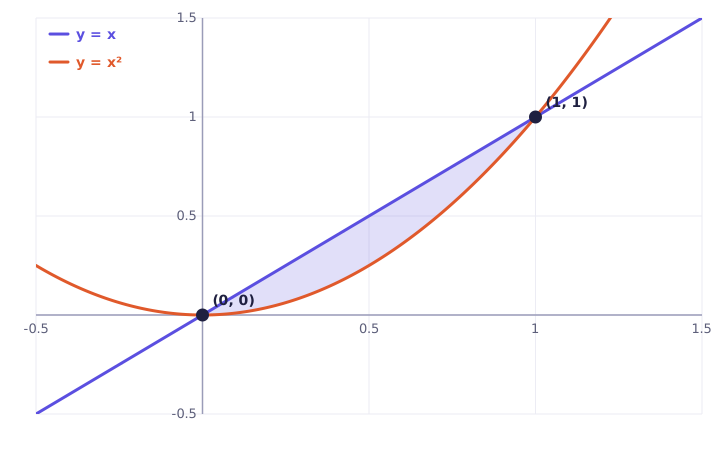
Area between curves is top minus bottom. Find where the curves meet, decide which one is on top, and integrate the difference. If the curves are easier to write as x = g(y), integrate right minus left with respect to y.
Volume is the integral of a cross-section area. For known cross sections, write the area of one slice A(x) and compute \int_a^b A(x)\,dx. For a disc, A(x) = \pi R^2. For a washer, A(x) = \pi\left(R^2 - r^2\right), where R and r are distances from the axis of rotation. The guides on area between curves and volumes of revolution go further.
Sample questions
1. Average value. The average value of f(x) = x^2 on [0, 3] is \frac{1}{3}\int_0^3 x^2\,dx = \frac{1}{3}\cdot 9 = 3.
2. Displacement and distance. For v(t) = t^2 - 4 on [0, 3], the displacement is \int_0^3 (t^2 - 4)\,dt = 9 - 12 = -3. The velocity changes sign at t = 2, so the total distance is
3. Area between curves. On [0, 1], y = x is above y = x^2, so the area is \int_0^1 (x - x^2)\,dx = \frac{1}{2} - \frac{1}{3} = \frac{1}{6}.
4. Washer method. Revolve the same region around the x-axis. The outer radius is x and the inner radius is x^2:
5. Square cross sections. If the same region is the base of a solid whose cross sections perpendicular to the x-axis are squares, each side is x - x^2:
6. BC: arc length. For y = \frac{2}{3}x^{3/2} on [0, 3], y' = \sqrt{x}, so
How to study Unit 8
- Sketch the region first. A quick picture shows which curve is on top and where the radii start.
- Measure radii from the axis of rotation. When revolving around y = -1, the radius is f(x) + 1, not f(x).
- Set up, then compute. Free-response questions often say "write, but do not evaluate, an integral expression." Practice clean setups with correct limits and \pi.
- Separate displacement from distance. Any time you see "total distance," check where the velocity is negative.
- Work through problem sets. Try the area between curves practice problems and volumes of revolution problems, each with full solutions.
For the full course map, see the AP Calculus AB guide or the AP Calculus BC guide.
AP and Advanced Placement are registered trademarks of College Board, which is not affiliated with PracticeCalculus and does not endorse this guide. Unit names and weights come from College Board's course framework; check it for any changes.
Practice it now
Area between curves
Solve real problems on this topic with instant feedback, hints and a step-by-step walkthrough for every answer. Free, no sign-up needed to start.
Practice this lesson