Derivative of cosh x: Formula, Proof and Examples
The derivative of cosh x is sinh x, with no minus sign. See the proof from exponentials, the hanging cable example, chain rule examples and a graph.
Hyperbolic derivatives Updated 2 min read
At a glance
- Derivative
- \sinh x
- Definition
- \cosh x = \dfrac{e^x + e^{-x}}{2}
- Chain rule form
- \dfrac{d}{dx}\cosh u = \sinh u\cdot u'
- Key identity
- \cosh^2 x - \sinh^2 x = 1
- Inverse derivative
- \dfrac{d}{dx}\operatorname{arcosh} x = \dfrac{1}{\sqrt{x^2 - 1}} for x > 1
On this page
The derivative of \cosh x is \sinh x. Watch the sign: unlike the circular cosine, there is no minus.
Proof from the definition
The hyperbolic cosine is the average of e^x and e^{-x}:
Differentiate each piece. The derivative of eˣ is e^x, and the derivative of e^(−x) is -e^{-x}:
Graph of cosh x and its derivative
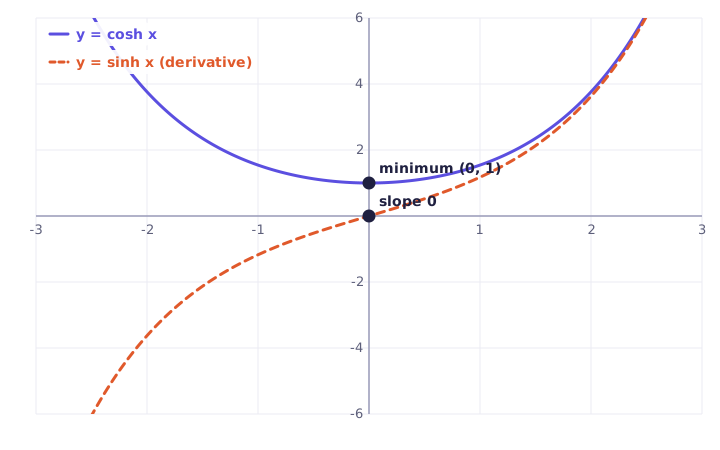
The derivative \sinh x is negative for x < 0 and positive for x > 0, so x = 0 is a minimum. The second derivative is \cosh x \ge 1 > 0, so the curve is concave up everywhere.
The hanging cable
A chain or cable hanging under its own weight takes the shape y = a\cosh\frac{x}{a}, called a catenary. Its slope at any point is
So the cable is flat at its lowest point and gets steeper toward the supports. The arc length formula also simplifies nicely, because 1 + \sinh^2 u = \cosh^2 u:
Chain rule version and examples
| Function | Derivative |
|---|---|
| \cosh(2x) | 2\sinh(2x) |
| \cosh(x^2) | 2x\sinh(x^2) |
| \cosh(\ln x) | \frac{\sinh(\ln x)}{x} = \frac{1}{2}\left(1 - \frac{1}{x^2}\right) |
| \cosh^2 x | 2\cosh x\sinh x = \sinh 2x |
| x\cosh x | \cosh x + x\sinh x |
In the third row, \sinh(\ln x) = \frac{x - 1/x}{2}, so dividing by x gives \frac{1}{2}\left(1 - \frac{1}{x^2}\right).
Worked example: checking the identity. Differentiate \cosh^2 x - \sinh^2 x:
A zero derivative means the expression is constant. At x = 0 it equals 1 - 0 = 1, which proves \cosh^2 x - \sinh^2 x = 1.
Derivative of arcosh x
For x > 1, the inverse hyperbolic cosine has derivative
Set \cosh y = x with y > 0, so \sinh y\,y' = 1 and \sinh y = \sqrt{\cosh^2 y - 1} = \sqrt{x^2 - 1}.
Common mistakes
- Writing -\sinh x. Copying the circular pattern is the most common error.
- Thinking \cosh x can be below 1. Its minimum is \cosh 0 = 1.
- Forgetting the inside derivative. \frac{d}{dx}\cosh(4x) = 4\sinh(4x).
See the derivative of sinh x, the derivative of tanh x and the hyperbolic functions page for graphs and identities.
Practice it now
Chain rule: e and ln
Solve real problems on this topic with instant feedback, hints and a step-by-step walkthrough for every answer. Free, no sign-up needed to start.
Practice this lesson