Arccosine arccos(x): Graph, Domain, Range, Derivative and Integral
The arccosine function arccos(x), the inverse of cosine: domain [−1, 1], range [0, π], graph, derivative −1/√(1−x²), integral and examples.
Inverse trigonometric functions Updated 3 min read
At a glance
- Domain
- [-1, 1]
- Range
- [0, \pi]
- Derivative
- -\frac{1}{\sqrt{1 - x^2}}
- Integral
- x\arccos x - \sqrt{1 - x^2} + C
- Meaning
- The angle in [0, \pi] whose cosine is x
- Identity
- \arccos x = \frac{\pi}{2} - \arcsin x
On this page
The arccosine function undoes cosine: \arccos x is the angle in [0, \pi] whose cosine is x. It is defined only for -1 \le x \le 1, and it is closely tied to arcsine: the two always add up to \frac{\pi}{2}.
Definition of arccos x
For example \arccos\left(-\frac{1}{2}\right) = \frac{2\pi}{3}, because \cos\frac{2\pi}{3} = -\frac{1}{2} and \frac{2\pi}{3} lies in [0, \pi]. The interval [0, \pi] is used because cosine is one-to-one there and hits every value in [-1, 1].
Graph of y = arccos x
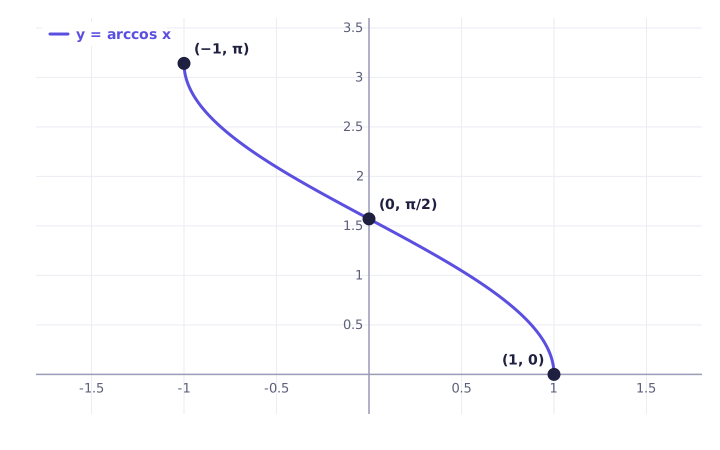
Unlike arcsine, arccosine is decreasing, and it is neither even nor odd. Its graph is symmetric about the point \left(0, \frac{\pi}{2}\right), which reflects the identity \arccos(-x) = \pi - \arccos x.
Key values of arccosine
| x | -1 | -\frac{\sqrt{3}}{2} | -\frac{1}{2} | 0 | \frac{1}{2} | \frac{\sqrt{2}}{2} | \frac{\sqrt{3}}{2} | 1 |
|---|---|---|---|---|---|---|---|---|
| \arccos x | \pi | \frac{5\pi}{6} | \frac{2\pi}{3} | \frac{\pi}{2} | \frac{\pi}{3} | \frac{\pi}{4} | \frac{\pi}{6} | 0 |
Properties of arccosine
- Domain [-1, 1], range [0, \pi].
- Decreasing on its whole domain.
- Cancellation. \cos(\arccos x) = x for x in [-1, 1]; \arccos(\cos x) = x only for x in [0, \pi].
- Complementary identity. \arcsin x + \arccos x = \frac{\pi}{2} for every x in [-1, 1].
- Reflection. \arccos(-x) = \pi - \arccos x.
Derivative of arccos x
Why. Let y = \arccos x, so \cos y = x. Differentiating implicitly, -\sin y\cdot y' = 1, so y' = -\frac{1}{\sin y}. On [0, \pi] we have \sin y \ge 0, so \sin y = \sqrt{1 - \cos^2 y} = \sqrt{1 - x^2}.
A quicker route: differentiate \arccos x = \frac{\pi}{2} - \arcsin x. The constant disappears and the sign flips.
Integral of arccos x
Use integration by parts with u = \arccos x and dv = dx, so du = -\frac{dx}{\sqrt{1-x^2}} and v = x:
Check: the derivative of -\sqrt{1-x^2} is \frac{x}{\sqrt{1-x^2}}, which cancels the -\frac{x}{\sqrt{1-x^2}} from the product rule on x\arccos x, leaving \arccos x.
In practice you rarely need an "arccos" antiderivative for -\frac{1}{\sqrt{1-x^2}}, since -\arcsin x + C works just as well. The two answers differ by the constant \frac{\pi}{2}.
Worked examples
Example 1: chain rule. Differentiate f(x) = \arccos(x^2):
Example 2: evaluate. \arccos\left(\cos\frac{5\pi}{3}\right). Since \cos\frac{5\pi}{3} = \frac{1}{2}, the answer is \arccos\frac{1}{2} = \frac{\pi}{3}, not \frac{5\pi}{3}.
Example 3: composition. Simplify \sin(\arccos x). With \theta = \arccos x in [0, \pi], \sin\theta \ge 0, so \sin(\arccos x) = \sqrt{1 - x^2}.
Example 4: a tangent line. At x = 0, \arccos 0 = \frac{\pi}{2} and the slope is -\frac{1}{\sqrt{1}} = -1. The tangent line is y = \frac{\pi}{2} - x.
Common mistakes
- Using the arcsine range. \arccos\left(-\frac{\sqrt{2}}{2}\right) = \frac{3\pi}{4}, which is in [0, \pi], not -\frac{\pi}{4}.
- Dropping the minus sign in the derivative. The arcsine derivative is positive; the arccosine derivative is negative.
- Treating \cos^{-1}x as \sec x. The reciprocal \frac{1}{\cos x} is the secant (see reciprocal trig functions).
- Assuming \arccos(\cos x) = x always. It only holds for x in [0, \pi].
How arccosine connects to other topics
Arccosine gives the angle between two vectors, \theta = \arccos\frac{\mathbf{u}\cdot\mathbf{v}}{\|\mathbf{u}\|\|\mathbf{v}\|}, which is why it shows up with the dot product. Its derivative mirrors arcsine, and the third inverse trig function you need for integration is arctangent.
Practice it now
Implicit differentiation
Solve real problems on this topic with instant feedback, hints and a step-by-step walkthrough for every answer. Free, no sign-up needed to start.
Practice this lesson