Hyperbolic Functions sinh, cosh, tanh: Graphs, Derivatives, Integrals
The hyperbolic functions sinh x, cosh x and tanh x: exponential definitions, graphs, identities, derivatives, integrals and worked examples.
Hyperbolic functions Updated 3 min read
At a glance
- Domain of sinh x
- (-\infty, \infty)
- Range of sinh x
- (-\infty, \infty)
- Derivative
- \cosh x
- Integral
- \cosh x + C
- Key identity
- \cosh^2 x - \sinh^2 x = 1
- Range of cosh x and tanh x
- [1, \infty) and (-1, 1)
On this page
The hyperbolic functions \sinh x, \cosh x and \tanh x are combinations of e^x and e^{-x} that behave remarkably like the trig functions. They share almost the same identities and derivative rules, but with a few sign changes, and they describe real shapes such as a hanging cable.
Definitions
Adding the first two gives \cosh x + \sinh x = e^x, so they split the natural exponential function into an even part (\cosh) and an odd part (\sinh). The reciprocals are defined just like their trig cousins: \operatorname{sech} x = \frac{1}{\cosh x}, \operatorname{csch} x = \frac{1}{\sinh x} and \coth x = \frac{1}{\tanh x}.
Graphs of sinh, cosh and tanh
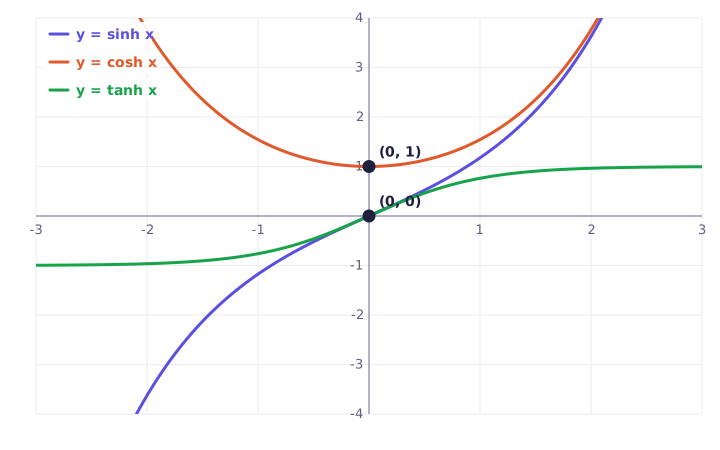
| Function | Domain | Range | Symmetry | Value at 0 |
|---|---|---|---|---|
| \sinh x | all reals | all reals | odd | 0 |
| \cosh x | all reals | [1, \infty) | even | 1 |
| \tanh x | all reals | (-1, 1) | odd | 0 |
\tanh x has horizontal asymptotes y = 1 and y = -1, since \tanh x \to 1 as x \to \infty and \tanh x \to -1 as x \to -\infty.
Hyperbolic identities
The central identity comes straight from the definitions:
Compare it with \cos^2 x + \sin^2 x = 1. Other useful identities:
- 1 - \tanh^2 x = \operatorname{sech}^2 x
- \sinh(2x) = 2\sinh x\cosh x
- \cosh(2x) = \cosh^2 x + \sinh^2 x
Derivatives of hyperbolic functions
| Function | Derivative |
|---|---|
| \sinh x | \cosh x |
| \cosh x | \sinh x |
| \tanh x | \operatorname{sech}^2 x |
Each follows from \frac{d}{dx}e^{-x} = -e^{-x}. For example,
For \tanh x, the quotient rule gives \frac{\cosh^2 x - \sinh^2 x}{\cosh^2 x} = \frac{1}{\cosh^2 x} = \operatorname{sech}^2 x.
Integrals of hyperbolic functions
| Function | Integral |
|---|---|
| \sinh x | \cosh x + C |
| \cosh x | \sinh x + C |
| \tanh x | \ln(\cosh x) + C |
| \operatorname{sech}^2 x | \tanh x + C |
The \tanh integral uses u = \cosh x: \int\frac{\sinh x}{\cosh x}\,dx = \ln|\cosh x| + C, and the absolute value can be dropped because \cosh x \ge 1.
Worked examples
Example 1: chain rule. \frac{d}{dx}\cosh(x^2) = 2x\sinh(x^2).
Example 2: evaluating. Find \cosh(\ln 2). Since e^{\ln 2} = 2 and e^{-\ln 2} = \frac{1}{2},
Example 3: a definite integral. \int_0^{1}\cosh x\,dx = \sinh 1 - \sinh 0 = \frac{e - e^{-1}}{2} \approx 1.175.
Example 4: u-substitution. \int\sinh(3x)\,dx = \frac{1}{3}\cosh(3x) + C.
Common mistakes
- Copying the trig minus sign. \frac{d}{dx}\cosh x = \sinh x, not -\sinh x.
- Using the trig identity. It is \cosh^2 x - \sinh^2 x = 1, with a minus sign.
- Expecting periodicity. Hyperbolic functions never repeat. \sinh and \cosh grow like \frac{e^x}{2} for large x.
- Confusing \sinh x with \sin x. They are different functions; \sinh 0 = 0 like \sin 0, but \sinh x is unbounded.
Where hyperbolic functions appear
A hanging cable takes the shape of a catenary, y = a\cosh\frac{x}{a}, and its arc length is easy to compute because 1 + \sinh^2 x = \cosh^2 x. The substitution x = \sinh t is an alternative to trig substitution for integrals with \sqrt{1 + x^2}. Hyperbolic functions also have tidy Taylor series: \sinh x = x + \frac{x^3}{3!} + \frac{x^5}{5!} + \cdots, the sine series with every sign positive. For background on the exponential derivatives behind all of this, see derivatives of exponential and logarithmic functions.
Practice it now
Chain rule: e and ln
Solve real problems on this topic with instant feedback, hints and a step-by-step walkthrough for every answer. Free, no sign-up needed to start.
Practice this lesson