Curve Sketching Practice Problems with Answers and Solutions
12 curve sketching practice problems with answers and full solutions: critical points, increasing and decreasing, extrema, concavity and asymptotes.
Applications of derivatives Updated 7 min read
At a glance
- Problems
- 12, with answers and full solutions
- Level
- Calculus 1 and AP Calculus AB, Unit 5
- You need
- The derivative rules and limits at infinity for asymptotes
- Main idea
- The sign of f' tells you where f rises or falls. The sign of f'' tells you which way it bends
- Practice with new numbers
- Increasing and decreasing lesson
On this page
These curve sketching practice problems walk through everything you need to sketch a graph from its derivatives: critical points, increasing and decreasing intervals, local extrema, concavity, inflection points and asymptotes. Try each one first. The answers come right after the list, then the full solutions.
What each derivative tells you:
| Sign | Meaning |
|---|---|
| f'(x) > 0 | f is increasing |
| f'(x) < 0 | f is decreasing |
| f''(x) > 0 | f is concave up (bends like a cup) |
| f''(x) < 0 | f is concave down (bends like a cap) |
For a full walkthrough, read the curve sketching guide.
Problems
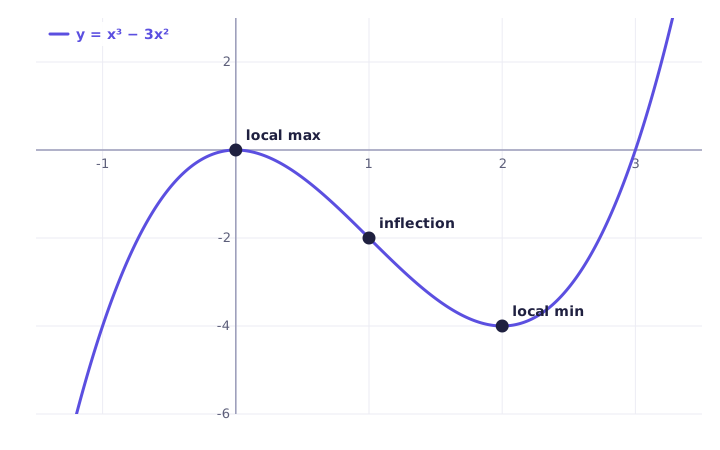
One function, step by step: f(x) = x^3 - 3x^2
- Find the critical points.
- Find where f is increasing and decreasing.
- Find the local maximum and minimum.
- Find the intervals of concavity and the inflection point.
Critical points that are not extrema
- Find the local extrema of f(x) = x^4 - 4x^3.
- Find the intervals of concavity and the inflection points of f(x) = x^4 - 4x^3.
Exponentials and rational functions
- For f(x) = xe^{-x}, find the local extrema, the inflection point and the horizontal asymptote.
- For f(x) = \dfrac{x}{x^2 + 1}, find the local extrema and the horizontal asymptote.
- For f(x) = \dfrac{x^2}{x^2 - 4}, find the asymptotes, the intervals of increase and decrease, the local extrema and the concavity.
Tests and special cases
- Use the second derivative test to classify the critical points of f(x) = 2x^3 + 3x^2 - 12x.
- A function has f'(x) = (x - 1)^2(x + 2). Where does f have local extrema?
- Find and classify the critical point of f(x) = x^{2/3}, and describe its concavity.
Answers
| Problem | Answer |
|---|---|
| 1 | x = 0 and x = 2 |
| 2 | Increasing on (-\infty, 0) and (2, \infty), decreasing on (0, 2) |
| 3 | Local max (0, 0), local min (2, -4) |
| 4 | Concave down on (-\infty, 1), up on (1, \infty), inflection point (1, -2) |
| 5 | Local min (3, -27) only. x = 0 is not an extremum |
| 6 | Up on (-\infty, 0), down on (0, 2), up on (2, \infty). Inflection points (0, 0) and (2, -16) |
| 7 | Local max \left(1, \frac{1}{e}\right), inflection point \left(2, \frac{2}{e^2}\right), asymptote y = 0 as x\to\infty |
| 8 | Local min \left(-1, -\frac{1}{2}\right), local max \left(1, \frac{1}{2}\right), asymptote y = 0 |
| 9 | See solution 9 |
| 10 | Local max (-2, 20), local min (1, -7) |
| 11 | Local min at x = -2 only |
| 12 | Local min at (0, 0) (a cusp), concave down on both sides |
Step-by-step solutions
1. Differentiate and set equal to zero:
2. Test one number in each interval:
| Interval | Test value | Sign of f' | f is |
|---|---|---|---|
| (-\infty, 0) | f'(-1) = 9 | + | increasing |
| (0, 2) | f'(1) = -3 | - | decreasing |
| (2, \infty) | f'(3) = 9 | + | increasing |
3. At x = 0, f' changes from + to -, so there is a local max: f(0) = 0. At x = 2, f' changes from - to +, so there is a local min: f(2) = 8 - 12 = -4.
4. The second derivative is f''(x) = 6x - 6, which is 0 at x = 1. It is negative for x < 1 and positive for x > 1, so the concavity changes. The inflection point is (1, f(1)) = (1, -2).
5. Differentiate and factor:
The critical points are x = 0 and x = 3. Since 4x^2 \ge 0, the sign of f' is the sign of x - 3: negative on both sides of 0 and positive after 3. So f decreases through x = 0 without turning, and x = 0 is not an extremum. At x = 3 the sign changes from - to +, giving a local min f(3) = 81 - 108 = -27.
6. The second derivative is
It is positive on (-\infty, 0), negative on (0, 2) and positive on (2, \infty). It changes sign at both zeros, so the inflection points are (0, 0) and (2, 16 - 32) = (2, -16).
7. Use the product rule:
Since e^{-x} > 0, f' has the sign of 1 - x: positive before 1 and negative after. So there is a local max at \left(1, \frac{1}{e}\right). Differentiate again:
This changes sign at x = 2, so the inflection point is \left(2, \frac{2}{e^2}\right). As x\to\infty, xe^{-x} = \frac{x}{e^x}\to 0, so y = 0 is a horizontal asymptote on the right.
8. Use the quotient rule:
The bottom is always positive, so the sign comes from 1 - x^2: negative for x < -1, positive on (-1, 1), negative for x > 1. That gives a local min f(-1) = -\frac{1}{2} and a local max f(1) = \frac{1}{2}. The degree of the bottom is higher, so y = 0 is the horizontal asymptote.
9. Asymptotes. The bottom x^2 - 4 is zero at x = \pm 2 and the top is not, so there are vertical asymptotes at x = -2 and x = 2. The degrees match, so the horizontal asymptote is y = 1.
Increase and decrease. Use the quotient rule:
The bottom is positive, so f' > 0 for x < 0 and f' < 0 for x > 0. f is increasing on (-\infty, -2) and (-2, 0), and decreasing on (0, 2) and (2, \infty). There is a local max at (0, 0).
Concavity. Differentiating again and simplifying gives
The top is always positive, so the sign comes from (x^2 - 4)^3. f is concave up on (-\infty, -2) and (2, \infty), and concave down on (-2, 2). The concavity changes only at the asymptotes, where f is undefined, so there are no inflection points.
10. Find the critical points:
The second derivative is f''(x) = 12x + 6.
- f''(-2) = -18 < 0: local max, f(-2) = -16 + 12 + 24 = 20.
- f''(1) = 18 > 0: local min, f(1) = 2 + 3 - 12 = -7.
11. The critical points are x = 1 and x = -2. The factor (x - 1)^2 is never negative, so the sign of f' comes from x + 2. It changes from - to + at x = -2, a local min. At x = 1 the sign stays + on both sides, so there is no extremum there.
12. The derivative is
It is never 0, but it is undefined at x = 0, where f is defined. So x = 0 is a critical point. f' < 0 for x < 0 and f' > 0 for x > 0, so (0, 0) is a local min. The slope goes to \pm\infty on either side, which makes a sharp point called a cusp. The second derivative is f''(x) = -\frac{2}{9}x^{-4/3}, which is negative for every x \ne 0, so the graph is concave down on both sides.
Common mistakes on these problems
- Calling every critical point an extremum. In problems 5 and 11, f' is zero but keeps its sign, so there is no max or min.
- Forgetting points where f' is undefined. Problem 12 has no solution to f'(x) = 0, but it still has a minimum.
- Counting an asymptote as an inflection point. In problem 9 the concavity changes at x = \pm 2, but f is not defined there.
- Giving only the x-value. A local max or min is a point. Give f(c) as well, as in problem 3.
Keep practicing
These 12 problems use fixed functions. For unlimited practice with new functions and instant feedback, try the critical points lesson, the increasing and decreasing lesson and the second derivative lesson. Then use the same tools on word problems with the optimization practice problems.
Practice it now
Concavity and the second derivative
Solve real problems on this topic with instant feedback, hints and a step-by-step walkthrough for every answer. Free, no sign-up needed to start.
Practice this lesson