Geometric Series Formula: Sum a/(1 − r), Convergence and Examples
The geometric series formula: a + ar + ar² + ... = a/(1 − r) when |r| < 1. Partial sums, the convergence condition and worked examples.
Series rules Updated 3 min read
At a glance
- First term
- a, the term you get when the exponent is 0
- Common ratio
- r, the factor that turns each term into the next
- Converges when
- \lvert r\rvert < 1
- Diverges when
- \lvert r\rvert \ge 1 (and a \ne 0)
- Partial sum
- S_N = a\,\dfrac{1 - r^N}{1 - r} for the first N terms, r \ne 1
On this page
A geometric series adds terms that each come from the one before by multiplying by the same number r. It is one of the few infinite series whose exact sum you can write down, which makes it the benchmark that every convergence test is compared against.
The geometric series formula
With first term a and common ratio r:
If \lvert r\rvert \ge 1 and a \ne 0, the series diverges.
The sum of the first N terms is finite for every r \ne 1:
Why the formula works
Multiply S_N by r and subtract. Almost every term cancels:
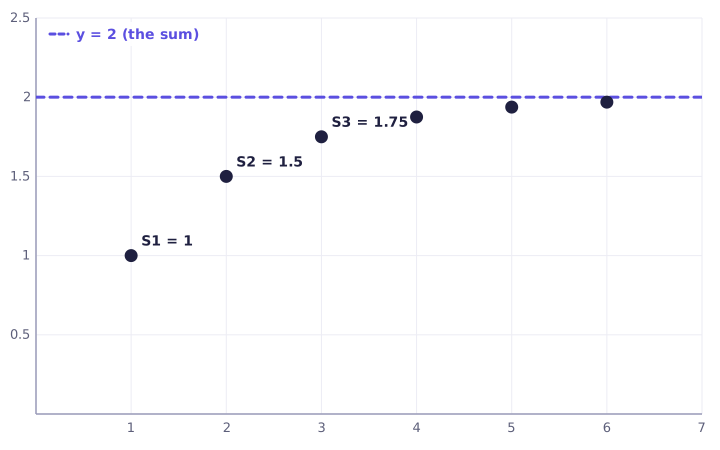
When \lvert r\rvert < 1, r^N \to 0 as N \to \infty, so S_N \to \frac{a}{1-r}. When \lvert r\rvert \ge 1, r^N does not go to zero and the partial sums have no finite limit.
How to use it
- Find a: the first term of the series as written. Plug in the starting index.
- Find r: divide any term by the previous one.
- Check \lvert r\rvert < 1. If not, stop: the series diverges.
- Compute \frac{a}{1-r}.
Worked examples
Example 1: a classic. 1 + \frac{1}{2} + \frac{1}{4} + \cdots has a = 1, r = \frac{1}{2}:
Example 2: the index does not start at 0. In \sum_{n=1}^{\infty} 3\left(\frac{2}{3}\right)^n the first term is 3\cdot\frac{2}{3} = 2, not 3:
Example 3: a negative ratio. \sum_{n=0}^{\infty} \left(-\frac{1}{3}\right)^n has a = 1, r = -\frac{1}{3}:
Example 4: a repeating decimal. 0.272727\ldots = \frac{27}{100} + \frac{27}{10000} + \cdots has a = \frac{27}{100} and r = \frac{1}{100}:
Example 5: divergence. \sum_{n=0}^{\infty} \left(\frac{5}{4}\right)^n has r = \frac{5}{4} > 1, so it diverges. The terms grow instead of shrinking.
Finite vs infinite sums
The finite formula works for every ratio except r = 1, so even a series with r = 3 has a perfectly good sum of the first ten terms: \sum_{n=0}^{9} 3^n = \frac{1 - 3^{10}}{1 - 3} = 29524. Only the infinite sum needs \lvert r\rvert < 1. When r = 1 every term equals a, so the first N terms add to Na, and the infinite series diverges.
Common mistakes
- Using the coefficient instead of the first term. When the sum starts at n = 1 or later, compute the first term directly.
- Ignoring the condition. \frac{a}{1-r} with r = 2 gives -a, a meaningless number. Always check \lvert r\rvert < 1 first.
- Mistaking other series for geometric. \sum \frac{1}{n^2} and \sum \frac{1}{2n} have no constant ratio, so the formula does not apply.
- Dropping a sign in r. For an alternating geometric series, r is negative, and 1 - r becomes 1 + \lvert r\rvert.
Where it leads
Geometric series are the model for the ratio test, which asks whether a series eventually behaves like a geometric one with \lvert r\rvert < 1. They also give the first power series, \frac{1}{1-x} = \sum x^n for \lvert x\rvert < 1, the starting point for power series. For more examples, read the full guide to geometric series.
Practice it now
Geometric series
Solve real problems on this topic with instant feedback, hints and a step-by-step walkthrough for every answer. Free, no sign-up needed to start.
Practice this lesson