Fundamental Theorem of Calculus Part 1: Derivative of an Integral
FTC part 1: if f is continuous, the derivative of the integral from a to x of f(t) dt is f(x). Statement, graph, chain rule version and worked examples.
Integral calculus theorems Updated 3 min read
At a glance
- Hypotheses
- f is continuous on [a, b], and F(x) = \int_a^x f(t)\,dt for x in [a, b]
- Conclusion
- F is continuous on [a, b], differentiable on (a, b), and F'(x) = f(x)
- In words
- The rate at which accumulated area grows is the height of the curve
- Chain rule version
- \frac{d}{dx}\int_a^{g(x)} f(t)\,dt = f(g(x))\,g'(x)
- Big consequence
- Every continuous function has an antiderivative
- Course
- Calculus 1
On this page
The fundamental theorem of calculus, part 1 (FTC 1) says that if you build a function by accumulating area under a continuous curve, the derivative of that function is the curve itself. It is the first half of the link between derivatives and integrals.
Statement of FTC part 1
Let f be continuous on [a, b], and define the accumulation function
Then F is continuous on [a, b], differentiable on (a, b), and
In Leibniz notation, \frac{d}{dx}\int_a^x f(t)\,dt = f(x). The variable t is a dummy variable of integration, and x is the upper limit.
What FTC 1 means
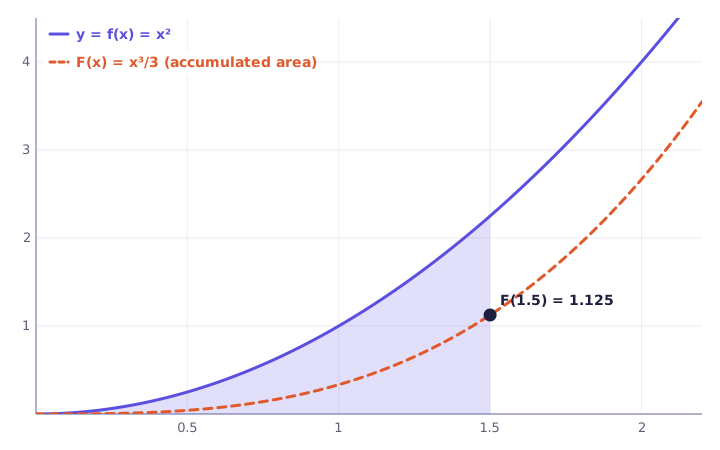
F(x) is the signed area under y = f(t) from a to x. Nudge x a little to the right by h, and the new area is a thin strip of width h and height about f(x). So
and the approximation becomes exact as h \to 0. The rate at which area accumulates equals the height of the curve.
Why continuity matters
Let f(t) = 0 for t < 0 and f(t) = 1 for t \ge 0, and let F(x) = \int_{-1}^x f(t)\,dt. The accumulated area is
which has a corner at x = 0. So F'(0) does not exist, and certainly does not equal f(0) = 1. The integral still makes sense, but at the jump the conclusion F' = f fails. Away from the jump, where f is continuous, F' = f still holds.
Worked examples
Example 1: the basic form.
No integration needed, and none possible in elementary terms. Replace t with x and you are done.
Example 2: upper limit is a function of x (chain rule). Find \frac{d}{dx}\int_0^{x^2}\cos t\,dt.
Step 1. Let u = x^2. Then the integral is G(u) = \int_0^u \cos t\,dt, and by FTC 1, G'(u) = \cos u.
Step 2. By the chain rule, \frac{d}{dx}G(x^2) = \cos(x^2)\cdot 2x.
Check: the integral equals \sin(x^2), whose derivative is 2x\cos(x^2).
Example 3: both limits depend on x. Find \frac{d}{dx}\int_x^{2x} e^{t^2}\,dt.
Step 1. Split at a constant: \int_x^{2x} = \int_0^{2x} - \int_0^{x}.
Step 2. Differentiate each piece with FTC 1 and the chain rule:
Example 4: a lower limit with x. Flip the limits first: \frac{d}{dx}\int_x^5 \sin(t^2)\,dt = \frac{d}{dx}\left(-\int_5^x \sin(t^2)\,dt\right) = -\sin(x^2).
Common mistakes
- Forgetting the chain rule factor. \frac{d}{dx}\int_0^{x^2}\cos t\,dt is 2x\cos(x^2), not \cos(x^2).
- Plugging in the lower limit too. For \int_a^x f(t)\,dt with constant a, the answer is just f(x). The constant lower limit only shifts F by a constant.
- Forgetting the sign when x is in the lower limit. Swapping the limits introduces a minus sign.
- Integrating first when it is impossible. Integrands like e^{t^2} have no elementary antiderivative, but FTC 1 still differentiates the integral instantly.
Why FTC 1 matters
FTC 1 proves that every continuous function has an antiderivative, namely \int_a^x f(t)\,dt. That fact is what makes FTC part 2 work, turning definite integrals into simple subtraction. It also defines important functions such as \ln x = \int_1^x \frac{1}{t}\,dt. For the full story of both parts, read the fundamental theorem of calculus guide, and see Riemann sums for the definition of the integral it relies on.
Practice it now
Derivatives of integrals
Solve real problems on this topic with instant feedback, hints and a step-by-step walkthrough for every answer. Free, no sign-up needed to start.
Practice this lesson