Constant Rule for Derivatives: Why the Derivative of c Is 0
The constant rule says the derivative of any constant is 0. The formula, a one-line proof, examples with π and e, and the mistakes to avoid.
Derivative rules Updated 3 min read
At a glance
- Applies to
- Any expression that does not depend on x, such as 7, \pi, e^2 or \ln 5
- In words
- A constant never changes, so its rate of change is zero
- Graph meaning
- The graph of y = c is a horizontal line, which has slope 0 everywhere
- Integral version
- \int 0\,dx = C, which is why antiderivatives end with +\,C
- Related rules
- Power rule, constant multiple rule, sum rule
On this page
The constant rule says that the derivative of a constant is zero. A constant never changes, so its rate of change is 0 everywhere. It is the simplest derivative rule, and it quietly appears in almost every derivative you compute.
The constant rule formula
For any constant c:
"Constant" means anything that does not depend on the variable you are differentiating with respect to. That includes ordinary numbers, but also expressions like \pi^2, e^3, \sqrt{7}, \sin 1 and \ln 5.
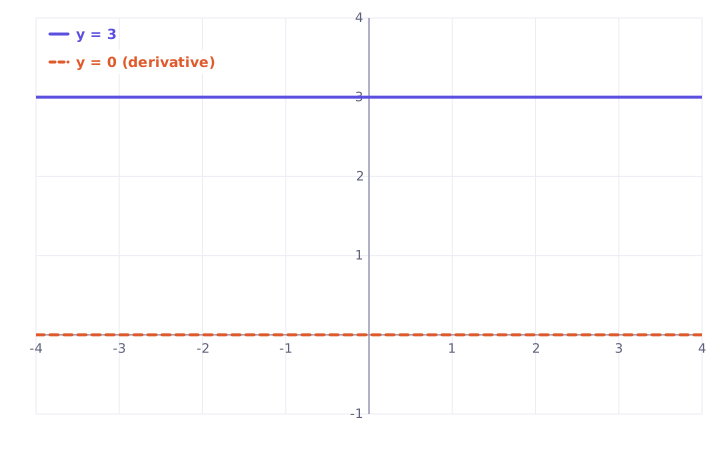
Examples
| Function | Why it is constant | Derivative |
|---|---|---|
| 7 | A number | 0 |
| -12.5 | A number | 0 |
| \pi | A number, about 3.14 | 0 |
| e^3 | No x anywhere | 0 |
| \ln 5 | No x anywhere | 0 |
| \sin\frac{\pi}{6} | Equals \frac{1}{2} | 0 |
Example: a constant term in a polynomial. With the sum rule, each term is differentiated separately and the constant term drops out:
Example: a parameter. If a and b are constants, then
The a^2 looks like a power, but it does not depend on x, so it is a constant.
Why the constant rule works
Use the limit definition of the derivative with f(x) = c:
You can also see it as a special case of the power rule: c = c\,x^0, and \frac{d}{dx}\,c\,x^0 = c \cdot 0 \cdot x^{-1} = 0 (for x \ne 0).
Constants added vs constants multiplied
This is where the constant rule meets the constant multiple rule:
| Expression | Derivative | Reason |
|---|---|---|
| x^3 + 5 | 3x^2 | An added constant vanishes |
| 5x^3 | 15x^2 | A multiplied constant stays |
| 5 | 0 | Constant rule |
| 5x | 5 | Constant multiple of x |
Shifting a graph up or down by adding a constant does not change its slope anywhere, which is exactly why added constants disappear. Stretching a graph by a factor multiplies every slope by that factor, which is why multiplied constants stay.
The constant rule in reverse
Because every constant has derivative 0, many functions share the same derivative: x^2, x^2 + 1 and x^2 - 8 all differentiate to 2x. So when you integrate, you must add an arbitrary constant:
See antiderivatives for more on why +\,C is required.
Common mistakes
- Treating constant expressions as variables. \frac{d}{dx}\,e^2 = 0, not 2e or e^2. The exponent is a number, not x.
- Zeroing out a constant multiple. \frac{d}{dx}\,4x = 4, not 0. Only a constant on its own, or added, becomes 0.
- Confusing which variable is changing. \frac{d}{dx}\,t^2 = 0 when t is a constant, but \frac{d}{dt}\,t^2 = 2t. Always check the variable in the denominator of \frac{d}{d\square}.
The constant rule is usually combined with the power rule and the sum rule. See the full guide to the power rule for practice with all three together.
Practice it now
Sums and constants
Solve real problems on this topic with instant feedback, hints and a step-by-step walkthrough for every answer. Free, no sign-up needed to start.
Practice this lesson