AP Calc Unit 1 Review: Limits and Continuity (AB and BC)
AP Calculus Unit 1 review for AB and BC: limits from graphs, tables and algebra, the Squeeze Theorem, continuity, asymptotes and the IVT, with practice.
AP Calculus units Updated 4 min read
At a glance
- AB exam weight
- 10–15%
- BC exam weight
- 5–10%
- Big ideas
- Limits, continuity, asymptotes, the Intermediate Value Theorem
- BC only
- None, AB and BC cover the same Unit 1 topics
- Comes before
- Unit 2, the definition of the derivative
- Practice here
- Calculus 1: Limits
AP Calculus Unit 1, Limits and Continuity, is the foundation of the whole course. A limit asks what value a function is heading toward as x gets close to a number. Every later idea, from the derivative to the integral to series, is defined with a limit, so a solid Unit 1 makes everything after it easier.
| AP Calculus AB | AP Calculus BC | |
|---|---|---|
| Exam weight | 10–15% | 5–10% |
| Extra topics | none | none |
What Unit 1 covers
College Board splits the unit into these topics. Each row links to a lesson where you can practice it with new numbers every time.
| Topic | What you learn | Practice |
|---|---|---|
| Limits and notation | What \lim_{x \to c} f(x) = L means, and one-sided limits | What is a limit? |
| Limits from graphs and tables | Reading a limit when the formula is not given | What is a limit? |
| Limits with algebra | Direct substitution and limit laws | Direct substitution |
| Algebraic manipulation | Factoring and rationalizing to fix \frac{0}{0} | Factoring 0/0 |
| Squeeze Theorem | Trapping a function between two others | Squeeze Theorem |
| Types of discontinuities | Removable, jump and infinite discontinuities | Continuity |
| Continuity | At a point, on an interval, and removing discontinuities | Continuity |
| Infinite limits | Vertical asymptotes and one-sided behavior | One-sided and infinite limits |
| Limits at infinity | Horizontal asymptotes and end behavior | Limits at infinity |
| Intermediate Value Theorem | Proving a value or root exists | Intermediate Value Theorem |
The key ideas
A limit is about nearby values. The function f(x) = \frac{x^2 - 9}{x - 3} is undefined at x = 3, but for every other x it equals x + 3. So as x approaches 3, f(x) approaches 6. The graph is a line with a hole.
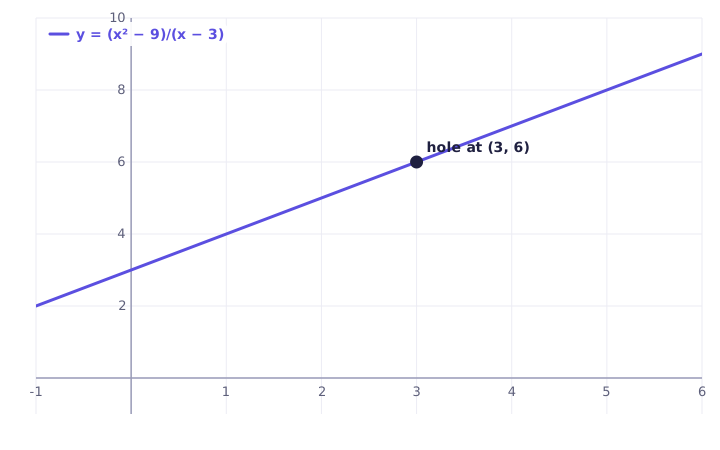
A limit exists only when both sides agree. If the left-hand limit and the right-hand limit are different, the two-sided limit does not exist. This is the most common reason a limit fails on the exam.
Continuity has three conditions. f is continuous at x = c when f(c) is defined, \lim_{x \to c} f(x) exists, and the two are equal. On free-response questions, state all three. A removable discontinuity (a hole) can be fixed by redefining one point. Jump and infinite discontinuities cannot.
Asymptotes are limits. A vertical asymptote at x = a means f(x) \to \pm\infty as x \to a. A horizontal asymptote y = L means f(x) \to L as x \to \pm\infty. For rational functions, compare the degrees of the top and bottom.
The IVT needs continuity. If f is continuous on [a, b] and k is between f(a) and f(b), then f(c) = k for some c in (a, b). Read the full statement on the Intermediate Value Theorem page, and see the Squeeze Theorem and the limit laws.
Sample questions
1. A \frac{0}{0} limit (calculator not allowed). Direct substitution gives \frac{0}{0}, so factor:
2. A limit at infinity. The top and bottom both have degree 2, so the limit is the ratio of the leading coefficients:
3. Making a function continuous. Let f(x) = kx + 1 for x < 2 and f(x) = x^2 for x \ge 2. The left limit at 2 is 2k + 1 and the right limit is 4. They match when 2k + 1 = 4, so k = \frac{3}{2}.
4. The Intermediate Value Theorem. Show f(x) = x^3 + x - 1 has a root in (0, 1). The function is a polynomial, so it is continuous on [0, 1]. Since f(0) = -1 < 0 and f(1) = 1 > 0, the IVT guarantees some c in (0, 1) with f(c) = 0.
How to study Unit 1
- Try direct substitution first. If it gives a number, you are done. Only reach for algebra when you get \frac{0}{0}.
- Practice reading limits from graphs. Look at where the curve is heading from each side, not at the filled dot.
- Write continuity justifications in full. Name the function value, the limit, and that they are equal. Graders look for all three.
- Say "continuous" every time you use the IVT. Leaving out the continuity condition costs a point on free response.
- Work through problem sets. Try the evaluating limits practice problems, limits at infinity problems and continuity problems, each with full solutions. The guide on how to evaluate limits puts all the methods in one place.
For the full course map, see the AP Calculus AB guide or the AP Calculus BC guide.
AP and Advanced Placement are registered trademarks of College Board, which is not affiliated with PracticeCalculus and does not endorse this guide. Unit names and weights come from College Board's course framework; check it for any changes.
Practice it now
What is a limit?
Solve real problems on this topic with instant feedback, hints and a step-by-step walkthrough for every answer. Free, no sign-up needed to start.
Practice this lesson