dy/dx: What Derivative Notation Means (Leibniz, f'(x), d/dx)
What dy/dx means, when it acts like a fraction, and how it compares to f'(x), y', d/dx and the Newton dot. Second derivatives, worked examples and mistakes.
Derivative rules Updated 6 min read
At a glance
- Read as
- "Dee y dee x", the derivative of y with respect to x
- Means
- The slope of the tangent line, or the rate of change of y per unit of x
- Same as
- f'(x), y', \frac{d}{dx}f(x) and Df(x)
- Second derivative
- \frac{d^2y}{dx^2} = f''(x)
- At a point
- \left.\frac{dy}{dx}\right|_{x=a} = f'(a)
- Named after
- Gottfried Wilhelm Leibniz, who introduced it around 1675
Try it yourself
On this page
The notation \frac{dy}{dx}, read "dee y dee x", means the derivative of y with respect to x: how fast y changes as x changes. It was introduced by Gottfried Leibniz, which is why it is called Leibniz notation. When y = f(x), it means exactly the same thing as f'(x). The two are just different ways of writing one idea.
What dy/dx means
Start with an ordinary slope. If x changes by a small amount \Delta x, then y changes by some amount \Delta y, and the average rate of change is \frac{\Delta y}{\Delta x}. The derivative is the value this ratio approaches as the change in x shrinks to zero:
Leibniz pictured dy and dx as infinitely small changes, so \frac{dy}{dx} is the ratio of a tiny change in y to the tiny change in x that caused it. On a graph it is the slope of the tangent line. In an application it is a rate: if s is distance in meters and t is time in seconds, then \frac{ds}{dt} is velocity in meters per second. The units come straight from the notation: units of y per unit of x.
The letters change with the problem. \frac{dV}{dr} is the derivative of V with respect to r, and \frac{dP}{dt} is how fast P changes over time. The variable on the bottom is always the one you differentiate with respect to.
Is dy/dx a fraction?
Strictly, no. \frac{dy}{dx} is a single symbol defined by a limit, and you cannot cancel the d's. But it often behaves like a fraction, which is the main reason the notation is so popular:
- Chain rule. If y depends on u and u depends on x, then \frac{dy}{dx} = \frac{dy}{du} \cdot \frac{du}{dx}. It looks as if the du cancels, and the result is true. See the chain rule.
- Inverse functions. \frac{dx}{dy} = \frac{1}{dy/dx} wherever \frac{dy}{dx} \ne 0. See the inverse function rule.
- Differentials. Writing dy = f'(x)\,dx gives the linear approximation \Delta y \approx f'(x)\,\Delta x. The same move separates variables in differential equations and changes variables in u-substitution.
The fraction picture does break. \frac{d^2y}{dx^2} is not \left(\frac{dy}{dx}\right)^2, and with partial derivatives "cancelling" gives the wrong answer: for three variables linked by one equation, \frac{\partial x}{\partial y}\cdot\frac{\partial y}{\partial z}\cdot\frac{\partial z}{\partial x} = -1, not 1. Use the fraction idea as a memory aid and fall back on the rules when in doubt.
Other ways to write the derivative
All of these mean the same thing for y = f(x):
| Notation | Read as | Named after | Best for |
|---|---|---|---|
| \frac{dy}{dx} | "dee y dee x" | Leibniz | Chain rule, implicit differentiation, rates |
| f'(x) | "f prime of x" | Lagrange | Naming a function and plugging in values |
| y' | "y prime" | Lagrange | Quick work when the variable is clear |
| \frac{d}{dx}f(x) | "d by dx of f of x" | Leibniz | Differentiating an expression in place |
| Df(x) | "D f of x" | Euler | Treating differentiation as an operator |
| \dot{y} | "y dot" | Newton | Derivatives with respect to time in physics |
Newton's dot always means a derivative with respect to time t, so \dot{y} = \frac{dy}{dt}, not \frac{dy}{dx}.
Prime notation is short but hides the variable. Leibniz notation is longer but tells you exactly what changes with respect to what, which matters as soon as more than one variable is involved.
Reading d/dx as an operator
The symbol \frac{d}{dx} on its own is an instruction: take the derivative, with respect to x, of whatever follows. So \frac{dy}{dx} is shorthand for \frac{d}{dx}\,y, and you can apply it directly to an expression:
Because it is an operator, it splits over sums and lets constants out, as in the sum and difference rule and the constant multiple rule. The variable on the bottom matters. If x and t are independent, \frac{d}{dx}\,x^2 t = 2xt treats t as a constant, while \frac{d}{dt}\,x^2 t = x^2 treats x as a constant.
Second and higher derivatives
Differentiate twice and you get the second derivative:
The 2 sits on the d at the top because the operator \frac{d}{dx} is applied twice. At the bottom, dx^2 means (dx)^2, not d(x^2). Third derivatives follow the same pattern, \frac{d^3y}{dx^3} = f'''(x), and from the fourth on people usually write f^{(4)}(x). In Newton's notation, \ddot{y} is the second derivative with respect to time, such as an acceleration.
For y = x^3: \frac{dy}{dx} = 3x^2 and \frac{d^2y}{dx^2} = 6x.
Evaluating dy/dx at a point
\frac{dy}{dx} is usually a function of x. To get the slope at one point, differentiate first and then substitute. A vertical bar means "evaluated at":
For y = x^3, \left.\frac{dy}{dx}\right|_{x=2} = 3(2)^2 = 12, so the tangent line at (2, 8) has slope 12.
Worked examples
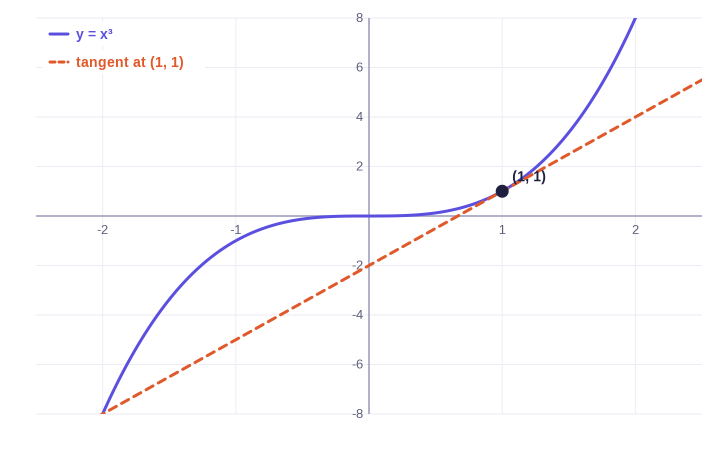
Example 1: a power. For y = x^3, the power rule gives
At x = 1 the slope is 3, so the tangent line through (1, 1) is y = 3x - 2.
Example 2: the chain rule in Leibniz form. For y = \sin(2x), let u = 2x, so y = \sin u:
The notation keeps track of the inner function for you. See the derivative of sin 2x for more.
Example 3: implicit differentiation. For the circle x^2 + y^2 = 25, differentiate both sides with respect to x. The y^2 term needs the chain rule, which is where \frac{dy}{dx} appears:
At (3, 4) the slope is -\frac{3}{4}. See implicit differentiation for the full method.
Example 4: a rate with other letters. A ball's height is h = 20t - 5t^2 meters after t seconds. Then
is its velocity in meters per second. At t = 1 it is rising at 10 m/s, and \frac{d^2h}{dt^2} = -10 is its acceleration in meters per second squared.
Example 5: differentials. For y = x^3 at x = 2 with dx = 0.01, the differential is dy = 3x^2\,dx = 12(0.01) = 0.12. The exact change is 2.01^3 - 8 = 0.120601, so the estimate is very close.
Common mistakes
- Cancelling the d's. \frac{dy}{dx} is not \frac{y}{x}. For y = x^3, \frac{dy}{dx} = 3x^2 while \frac{y}{x} = x^2.
- Substituting before differentiating. For y = x^3 at x = 2, plugging in first gives \frac{d}{dx}(8) = 0, which is wrong. Differentiate, then substitute, to get 12.
- Reading \frac{d^2y}{dx^2} as a square. It means differentiate twice, not \left(\frac{dy}{dx}\right)^2. For y = x^3 these are 6x and 9x^4.
- Mixing up the variable. \dot{y} and \frac{dy}{dt} are with respect to time, while \frac{dy}{dx} is with respect to x. If y depends on x and x depends on t, then \frac{dy}{dt} = \frac{dy}{dx}\cdot\frac{dx}{dt}.
- Forgetting \frac{dy}{dx} on y terms. In implicit differentiation, \frac{d}{dx}\,y^2 = 2y\,\frac{dy}{dx}, not 2y.
To see where the notation comes from, read the guide to the limit definition of the derivative. Then practice the power rule and the chain rule, where Leibniz notation does most of the work.
Practice it now
Notation and meaning
Solve real problems on this topic with instant feedback, hints and a step-by-step walkthrough for every answer. Free, no sign-up needed to start.
Practice this lesson