Derivative of 2ˣ and aˣ: Formula, Proof and Examples
The derivative of 2ˣ is 2ˣ ln 2, and of aˣ is aˣ ln a. See the proof by rewriting aˣ as e^(x ln a), chain rule examples and a graph.
Exponential and log derivatives Updated 2 min read
At a glance
- Derivative of 2ˣ
- 2^x\ln 2 \approx 0.693\cdot 2^x
- General base
- \dfrac{d}{dx}a^x = a^x\ln a for a > 0
- Chain rule form
- \dfrac{d}{dx}a^u = a^u\ln a\cdot u'
- Key rewrite
- a^x = e^{x\ln a}
- Integral version
- \int 2^x\,dx = \dfrac{2^x}{\ln 2} + C
On this page
The derivative of 2^x is 2^x\ln 2. The same pattern works for every positive base:
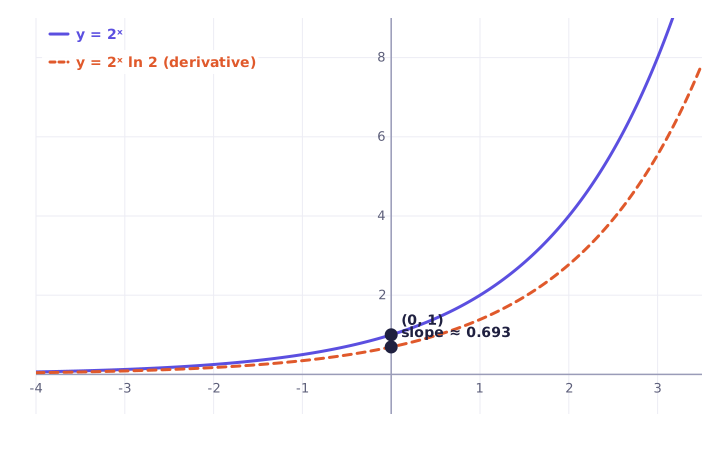
Since \ln 2 \approx 0.693, the slope of 2^x is always about 69\% of its height.
Graph of 2ˣ and its derivative
Proof: rewrite with base e
Any positive base can be written as a power of e, because a = e^{\ln a}:
Now \ln a is just a constant, so the chain rule with the derivative of eˣ gives
For a = 2 this is 2^x\ln 2. For a = e it is e^x\ln e = e^x, which is why e is the natural base: it is the only base with no extra factor.
The size of the factor ln a
| Base a | \ln a | Derivative of a^x |
|---|---|---|
| 2 | \approx 0.693 | 2^x\ln 2 |
| e | 1 | e^x |
| 3 | \approx 1.099 | 3^x\ln 3 |
| 10 | \approx 2.303 | 10^x\ln 10 |
| \frac{1}{2} | \approx -0.693 | -\left(\frac{1}{2}\right)^x\ln 2 |
For 0 < a < 1, \ln a is negative, so a^x is decreasing. That matches the graph of exponential decay.
Chain rule version and examples
Example 1. \frac{d}{dx}2^{3x} = 2^{3x}\ln 2\cdot 3 = 3\ln 2\cdot 2^{3x}.
Example 2. \frac{d}{dx}3^{x^2} = 3^{x^2}\ln 3\cdot 2x = 2x\ln 3\cdot 3^{x^2}.
Example 3. \frac{d}{dx}2^{-x} = -2^{-x}\ln 2.
Example 4: product rule. For f(x) = x\cdot 2^x, the product rule gives
Example 5: growth rate. A population P(t) = 500\cdot 2^t doubles every unit of time. Its growth rate at t = 3 is P'(3) = 500\cdot 8\ln 2 \approx 2773 per unit time.
2ˣ versus x²
| Function | Base | Exponent | Rule | Derivative |
|---|---|---|---|---|
| x^2 | variable | constant | power rule | 2x |
| 2^x | constant | variable | exponential rule | 2^x\ln 2 |
| x^x | variable | variable | logarithmic differentiation | x^x(\ln x + 1) |
When both base and exponent vary, neither rule applies on its own. See the derivative of xˣ.
Common mistakes
- Using the power rule: x\cdot 2^{x-1}. Wrong rule for a variable exponent.
- Leaving out \ln 2. That would be correct only for base e.
- Writing \log 2 instead of \ln 2. The factor is the natural log.
The reverse, \int 2^x\,dx = \frac{2^x}{\ln 2} + C, is on the integral of 2ˣ page. The inverse function, \log_2 x, is covered on the derivative of log x page. See also exponential functions.
Practice it now
Exponentials and logarithms
Solve real problems on this topic with instant feedback, hints and a step-by-step walkthrough for every answer. Free, no sign-up needed to start.
Practice this lesson