Derivative of a Constant: Formula, Proof and Examples
The derivative of a constant is 0. See why with the limit definition, plus tricky cases like π², e³, ln 5 and constants multiplied by functions.
Powers, roots and polynomials Updated 2 min read
At a glance
- Derivative
- 0 for every constant c
- Graph
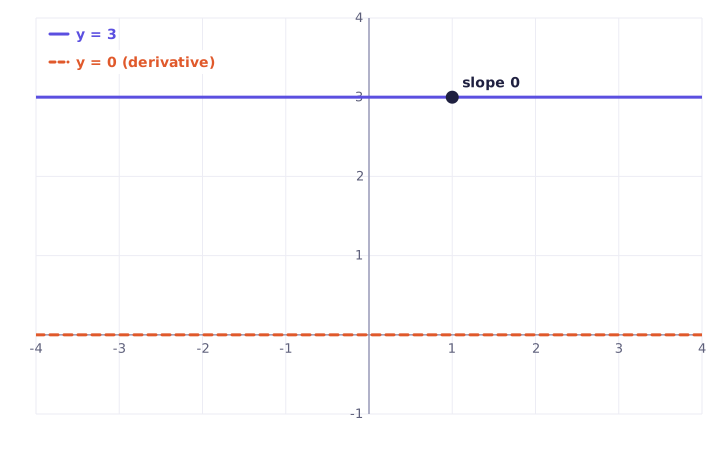
- A horizontal line, which has slope 0
- Added constant
- \dfrac{d}{dx}\big(f(x) + c\big) = f'(x)
- Constant multiple
- \dfrac{d}{dx}\big(c\,f(x)\big) = c\,f'(x)
- Integral version
- \int c\,dx = cx + C
On this page
The derivative of a constant is 0. If f(x) = c for some fixed number c, then f'(x) = 0 for every x.
Graph of a constant and its derivative
Proof from the limit definition
For f(x) = c, both f(x + h) and f(x) equal c:
The numerator is exactly 0 for every h \ne 0, so the limit is 0. This is the constant rule.
You can also see it with the power rule: c = c\,x^0, and \frac{d}{dx}\,x^0 = 0 \cdot x^{-1} = 0.
Spotting constants in disguise
The tricky part is not the rule, it is recognizing a constant. Anything without the variable is a constant, no matter how it looks.
| Expression | Constant? | Derivative with respect to x |
|---|---|---|
| 7 | yes | 0 |
| \pi^2 | yes | 0 |
| e^3 | yes | 0 |
| \ln 5 | yes | 0 |
| \sin\frac{\pi}{6} | yes, it equals \frac{1}{2} | 0 |
| a^2 + b (letters other than x) | yes, if they do not depend on x | 0 |
| e^x | no | e^x |
Added constants vs multiplied constants
An added constant vanishes:
A multiplied constant stays, by the constant multiple rule:
The reason is geometric. Adding 10 shifts the graph up, which does not change any slope. Multiplying by 10 stretches the graph, which makes every slope 10 times steeper.
Worked examples
Example 1. \frac{d}{dx}\left(4x^3 - 2x + \pi\right) = 12x^2 - 2.
Example 2. \frac{d}{dx}\left(e^2 x\right) = e^2. Here e^2 multiplies x, so it stays, and the derivative of x is 1.
Example 3. \frac{d}{dx}\left(\ln 3 + \ln x\right) = \frac{1}{x}. The \ln 3 is a constant. See the derivative of ln x.
Example 4: other variables. In \frac{d}{dx}(x^2 y^3), if y does not depend on x, treat y^3 as a constant multiple: the answer is 2xy^3. This idea becomes partial derivatives in Calculus 3.
Common mistakes
- Differentiating e^2 as if it were e^x. \frac{d}{dx}e^2 = 0, not e^2 or 2e.
- Dropping a multiplied constant. \frac{d}{dx}(3x) = 3, not 0.
- Using the power rule on a constant base. \frac{d}{dx}\pi^3 is 0, not 3\pi^2.
Going the other way, every antiderivative carries a +C because constants differentiate to 0. See the integral of a constant.
Practice it now
Sums and constants
Solve real problems on this topic with instant feedback, hints and a step-by-step walkthrough for every answer. Free, no sign-up needed to start.
Practice this lesson