Derivative of x: Formula, Proof and Examples
The derivative of x is 1. See why with the limit definition and the power rule, plus derivatives of 5x, ax + b and x with respect to other variables.
Powers, roots and polynomials Updated 2 min read
At a glance
- Derivative
- 1 for every real x
- Multiple of x
- \dfrac{d}{dx}(ax) = a
- Linear function
- \dfrac{d}{dx}(ax + b) = a
- Power rule view
- x = x^1, so the derivative is 1 \cdot x^0 = 1
- Integral version
- \int x\,dx = \frac{x^2}{2} + C
On this page
The derivative of x is 1. The function y = x is a straight line with slope 1, and the derivative of a line is just its slope.
Graph of x and its derivative
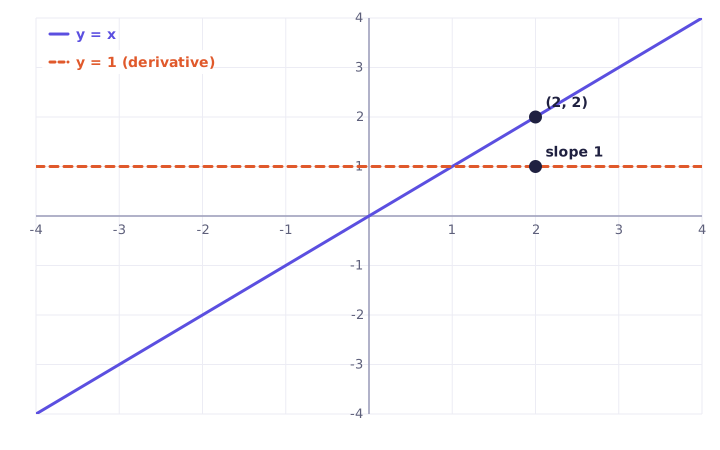
Because the slope never changes, the derivative is a constant. Pick any two points on the line: the rise always equals the run.
Proof from the limit definition
The limit definition of the derivative says
With f(x) = x:
The h cancels before you ever take the limit, so there is nothing tricky to resolve.
Proof from the power rule
Write x as x^1. The power rule says to bring the exponent down and lower it by one:
This uses x^0 = 1, which is fine for every x \ne 0, and the limit proof covers x = 0 too.
Multiples and linear functions
With the constant multiple rule and the constant rule, every linear function is easy:
| Function | Derivative |
|---|---|
| 5x | 5 |
| -x | -1 |
| \frac{x}{3} | \frac{1}{3} |
| 3x - 7 | 3 |
| \pi x + e | \pi |
The derivative of a line y = mx + b is always m, its slope. The intercept b only shifts the line up or down, so it does not affect how steep it is. See the derivative of a constant for why the b drops out.
Worked examples
Example 1: a sum. Differentiate f(x) = x^2 + 4x - 9:
The 4x term contributes 4 and the -9 contributes 0. The x^2 term uses the derivative of x².
Example 2: a product check. Write x^2 = x \cdot x and use the product rule:
This matches the power rule, which is a good sanity check.
Example 3: a different variable. In \frac{d}{dt}(xt), where x does not depend on t, treat x as a constant: the answer is x.
Common mistakes
- Answering 0. Only constants have derivative 0. The function x changes, so its derivative is 1.
- Writing x as the answer. The derivative of x is not x. That is true for e^x, not for x.
- Keeping the constant term. \frac{d}{dx}(3x + 7) = 3, not 3 + 7 or 10.
The reverse question, \int x\,dx = \frac{x^2}{2} + C, is on the integral of x page. For drills, try the power rule practice problems.
Practice it now
The power rule
Solve real problems on this topic with instant feedback, hints and a step-by-step walkthrough for every answer. Free, no sign-up needed to start.
Practice this lesson