Derivative of Cube Root of x: Formula, Proof and Examples
The derivative of the cube root of x is 1/(3∛(x²)). See the power rule and limit proofs, the vertical tangent at 0 and chain rule examples.
Powers, roots and polynomials Updated 2 min read
At a glance
- Derivative
- \dfrac{1}{3\sqrt[3]{x^2}} for x \ne 0
- As a power
- \dfrac{d}{dx}\,x^{1/3} = \tfrac{1}{3}x^{-2/3}
- Chain rule form
- \dfrac{d}{dx}\sqrt[3]{u} = \dfrac{u'}{3\sqrt[3]{u^2}}
- At x = 0
- Not differentiable, the tangent is vertical
- Domain
- All real numbers, unlike \sqrt{x}
On this page
The derivative of \sqrt[3]{x} is \dfrac{1}{3\sqrt[3]{x^2}}, for every x \ne 0. Write the cube root as the power x^{1/3} and the power rule does the rest.
Graph of ∛x and its derivative
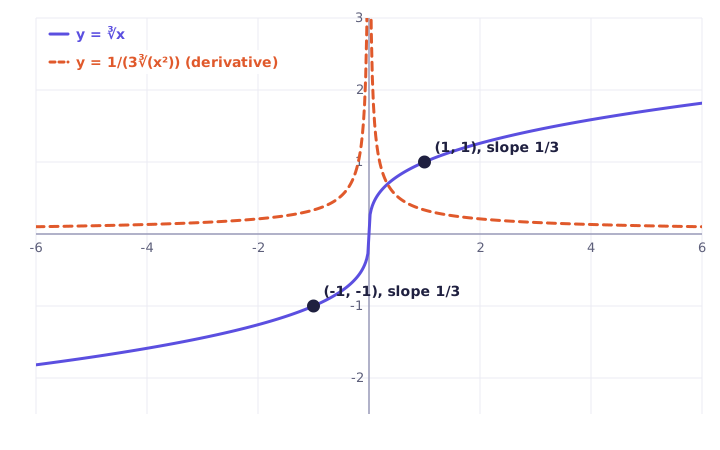
Notice that the derivative is the same at x = 1 and x = -1. Since x^2 is the same for x and -x, the derivative is an even function.
Proof with the power rule
Using the power rule with n = \frac{1}{3}:
A negative exponent moves the power to the bottom, and x^{2/3} = \sqrt[3]{x^2}.
Proof from the limit definition
Let a = \sqrt[3]{x + h} and b = \sqrt[3]{x}. Then a^3 - b^3 = h. The difference of cubes a^3 - b^3 = (a - b)(a^2 + ab + b^2) gives
As h \to 0, a \to b, so the limit is \frac{1}{3b^2} = \frac{1}{3\sqrt[3]{x^2}}. This needs b \ne 0, which is exactly why x = 0 fails.
Why the derivative fails at 0
At x = 0 the difference quotient is \frac{\sqrt[3]{h}}{h} = h^{-2/3}, which goes to +\infty from both sides. The curve is continuous but has a vertical tangent, a standard example of a function that is continuous but not differentiable.
Chain rule and other roots
For a cube root of an expression, the chain rule gives
Example 1. \frac{d}{dx}\sqrt[3]{5x - 1} = \frac{5}{3\sqrt[3]{(5x - 1)^2}}.
Example 2. \frac{d}{dx}\,6\sqrt[3]{x} = 6 \cdot \frac{1}{3}x^{-2/3} = 2x^{-2/3}.
Example 3. Any root works the same way: \frac{d}{dx}\sqrt[n]{x} = \frac{1}{n}x^{\frac{1}{n} - 1}. For n = 4 this is \frac{1}{4}x^{-3/4}.
Example 4: a tangent line. At x = 8, \sqrt[3]{8} = 2 and the slope is \frac{1}{3 \cdot 4} = \frac{1}{12}. So \sqrt[3]{9} \approx 2 + \frac{1}{12} \approx 2.083. The true value is about 2.080.
Common mistakes
- Writing x^{-1/3}. The new exponent is \frac{1}{3} - 1 = -\frac{2}{3}.
- Putting the 3 in the wrong place. The answer is \frac{1}{3}x^{-2/3}, not 3x^{-2/3}.
- Assuming negative x is off limits. Cube roots of negatives are real, so the derivative exists for every x except 0.
Compare with the derivative of √x, which is only defined for x > 0.
Practice it now
The power rule
Solve real problems on this topic with instant feedback, hints and a step-by-step walkthrough for every answer. Free, no sign-up needed to start.
Practice this lesson