AP Calc Unit 2 Review: Differentiation Basics (AB and BC)
AP Calculus Unit 2 review for AB and BC: the limit definition of the derivative, differentiability, power, product and quotient rules, trig derivatives.
AP Calculus units Updated 4 min read
At a glance
- AB exam weight
- 10–15%
- BC exam weight
- 5–10%
- Big ideas
- The derivative as a limit, differentiability, the basic derivative rules
- BC only
- None, AB and BC cover the same Unit 2 topics
- Comes before
- Unit 3, the chain rule, implicit and inverse functions
- Practice here
- Calculus 1: The derivative
AP Calculus Unit 2, Differentiation: Definition and Fundamental Properties, introduces the derivative. It starts with a question: how fast is something changing at one instant? The answer is a limit of average rates of change, and by the end of the unit you can find most derivatives with a few quick rules instead of a limit.
| AP Calculus AB | AP Calculus BC | |
|---|---|---|
| Exam weight | 10–15% | 5–10% |
| Extra topics | none | none |
What Unit 2 covers
College Board splits the unit into these topics. Each row links to a lesson where you can practice it with new numbers every time.
| Topic | What you learn | Practice |
|---|---|---|
| Average and instantaneous rates | Secant slopes, and what happens as the interval shrinks | Instantaneous rate of change |
| Defining the derivative | The limit definition and notations f'(x), \frac{dy}{dx} | The limit definition |
| Estimating derivatives | From graphs and tables of values | Average rate of change |
| Differentiability and continuity | Corners, cusps, vertical tangents and jumps | Differentiability |
| Power rule | \frac{d}{dx}x^n = nx^{n-1} | Power rule |
| Sum, difference, constant rules | Differentiating term by term | Sum and constant rules |
| \sin x, \cos x, e^x, \ln x | The first non-polynomial derivatives | Trig derivatives |
| Product rule | (fg)' = f'g + fg' | Product rule |
| Quotient rule | \left(\frac{f}{g}\right)' = \frac{f'g - fg'}{g^2} | Quotient rule |
| \tan x, \cot x, \sec x, \csc x | Derived with the quotient rule | Trig derivatives |
The key ideas
The derivative is the slope of the tangent line. The average rate of change of f on [x, x + h] is the slope of a secant line. As h \to 0, the secant line turns into the tangent line:
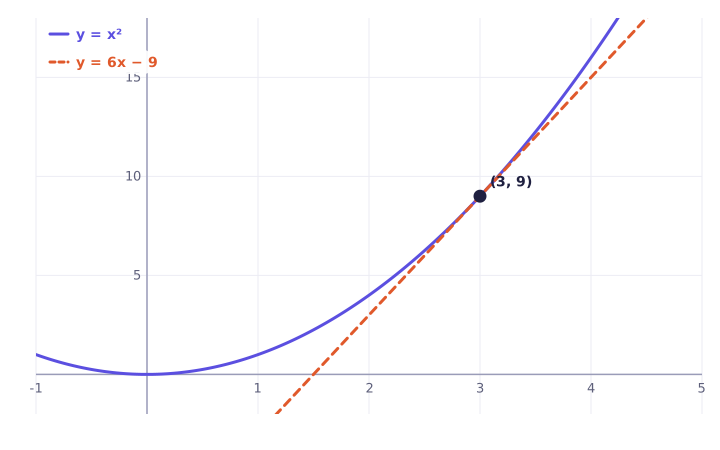
The derivative is also a rate. If s(t) is position, s'(t) is velocity. If V(t) is volume in liters and t is in minutes, V'(t) is in liters per minute. Units help you check any answer.
Differentiable means smooth. If f is differentiable at c, it is continuous at c. The converse fails: |x| is continuous at 0 but has a corner, so the left and right slopes (-1 and 1) do not match.
The rules replace the limit. Learn the power rule, the product rule and the quotient rule until they are automatic. Then memorize the six trig derivatives, plus \frac{d}{dx}e^x = e^x and \frac{d}{dx}\ln x = \frac{1}{x}.
Sample questions
1. Using the limit definition. For f(x) = x^2:
2. Estimating from a table. A function has f(1) = 5 and f(3) = 11. The best estimate of f'(2) is the average rate of change on [1, 3]:
3. Product rule. \frac{d}{dx}\left(x^2 \sin x\right) = 2x\sin x + x^2\cos x.
4. Quotient rule. \frac{d}{dx}\left(\frac{e^x}{x}\right) = \frac{x e^x - e^x}{x^2} = \frac{e^x(x - 1)}{x^2}.
5. Recognize a derivative. The limit \lim_{h \to 0} \frac{\ln(e + h) - 1}{h} is the derivative of \ln x at x = e, because \ln e = 1. The answer is \frac{1}{e}.
How to study Unit 2
- Spot hidden derivatives. When a limit has the shape \frac{f(a + h) - f(a)}{h}, name f and a, then differentiate. This shows up on almost every exam.
- Always include units. "The derivative is 3" loses the context point. "The temperature is rising at 3 degrees per minute at t = 2" earns it.
- Know the differentiability failures. Sketch a corner, a cusp, a vertical tangent and a jump until you can spot each on a graph.
- Drill the rules. Use the derivatives reference and the calculus formula sheet to check your work.
- Work through problem sets. Try the limit definition practice problems, power rule problems and product and quotient rule problems, each with full solutions.
For the full course map, see the AP Calculus AB guide or the AP Calculus BC guide.
AP and Advanced Placement are registered trademarks of College Board, which is not affiliated with PracticeCalculus and does not endorse this guide. Unit names and weights come from College Board's course framework; check it for any changes.
Practice it now
The limit definition
Solve real problems on this topic with instant feedback, hints and a step-by-step walkthrough for every answer. Free, no sign-up needed to start.
Practice this lesson