Double Integrals: Iterated Integrals, Regions and Polar Form
Evaluate double integrals step by step: iterated integrals, Fubini's theorem, curved regions, switching the order and polar coordinates.
By the PracticeCalculus team Published 7 min read
On this page
- What is a double integral?
- Iterated integrals and Fubini's theorem
- Double integrals over non-rectangular regions
- How to switch the order of integration
- Double integrals in polar coordinates
- Common mistakes with double integrals
- Quick reference: setting up double integrals
- Practice the setup, not just the integration
A single integral adds up a function along an interval. A double integral adds one up over a whole region in the plane, which lets you find volumes, masses and averages over 2D shapes. The surprise is that you never need a new technique to evaluate one: you just do two ordinary integrals in a row. The hard part is getting the limits right.
This guide walks through iterated integrals and Fubini's theorem, integrals over curved regions, switching the order of integration, and polar coordinates, with every step shown.
What is a double integral?
Chop a region R in the xy-plane into tiny rectangles of area \Delta A. Over each one, build a thin column of height f(x, y). The double integral is the limit of the total volume of those columns as the rectangles shrink:
It is the 2D version of a Riemann sum. When f \ge 0 it is the volume under z = f(x, y) and above R. When f = 1 it is simply the area of R.
Iterated integrals and Fubini's theorem
You almost never use the limit definition. Instead you evaluate an iterated integral, one variable at a time. Fubini's theorem says that for a continuous f on the rectangle R = [a, b] \times [c, d],
Read the iterated integral from the inside out. In \int_a^b \int_c^d f\,dy\,dx, integrate with respect to y first, treating x as a constant (just like a partial derivative in reverse). The result is a function of x alone. Then integrate that from a to b.
Worked example 1: a rectangle, both orders
Evaluate \iint_R (x + 2y)\,dA where R = [0, 2] \times [0, 3], meaning 0 \le x \le 2 and 0 \le y \le 3.
Step 1. Inner integral in y, holding x constant.
Step 2. Outer integral in x.
Step 3. Check with the other order. Inner in x: \int_0^2 (x + 2y)\,dx = 2 + 4y. Outer in y: \int_0^3 (2 + 4y)\,dy = 6 + 18 = 24. Same answer, as Fubini promises.
Tip: if the integrand factors as g(x)\,h(y) and the region is a rectangle, the double integral splits into a product: \left(\int_a^b g(x)\,dx\right)\left(\int_c^d h(y)\,dy\right).
Double integrals over non-rectangular regions
Most regions are bounded by curves. There are two standard ways to describe them.
Type I (vertical strips): a \le x \le b and g_1(x) \le y \le g_2(x). Integrate y first:
Type II (horizontal strips): c \le y \le d and h_1(y) \le x \le h_2(y). Integrate x first:
The golden rule: the outer limits are constants, and the inner limits may depend only on the outer variable.
How to set up the limits:
- Sketch the region and label every boundary curve.
- Choose the order. For dy\,dx, draw a vertical line through the region: it enters at the bottom curve g_1(x) and leaves at the top curve g_2(x).
- The outer limits are the smallest and largest x in the whole region.
Worked example 2: a region under a curve
Evaluate \iint_R xy\,dA, where R is bounded by y = \sqrt{x}, y = 0 and x = 4.
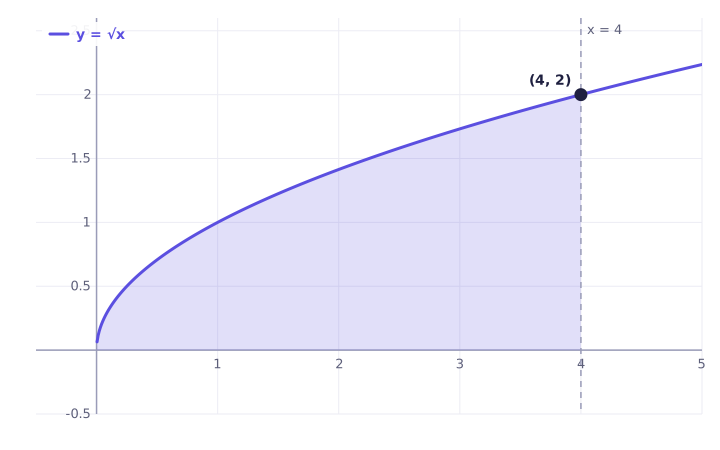
Step 1. Describe the region. A vertical line at x enters at y = 0 and leaves at y = \sqrt{x}, for x from 0 to 4.
Step 2. Inner integral in y.
Step 3. Outer integral in x.
How to switch the order of integration
Switching the order means describing the same region with horizontal strips instead of vertical ones (or vice versa). You cannot just swap the limits. You have to redraw.
Step 1. Recover the region from the current limits and sketch it.
Step 2. Find the constant range of the new outer variable.
Step 3. For a typical value of it, find where the new inner variable enters and leaves. Solve each boundary curve for the inner variable.
Redo example 2 in the order dx\,dy. The region runs from y = 0 to y = 2 (since \sqrt{4} = 2). A horizontal line at height y enters at the curve, where x = y^2, and leaves at x = 4:
Same answer, which is a great way to check your limits.
Worked example 3: switching to make it possible
Evaluate \displaystyle\int_0^1 \int_y^1 e^{x^2}\,dx\,dy.
The inner integral \int e^{x^2}\,dx has no elementary antiderivative, so in this order you are stuck. Switch.
Step 1. Read off the region. 0 \le y \le 1 and y \le x \le 1. That is the triangle below the line y = x, above y = 0, left of x = 1.
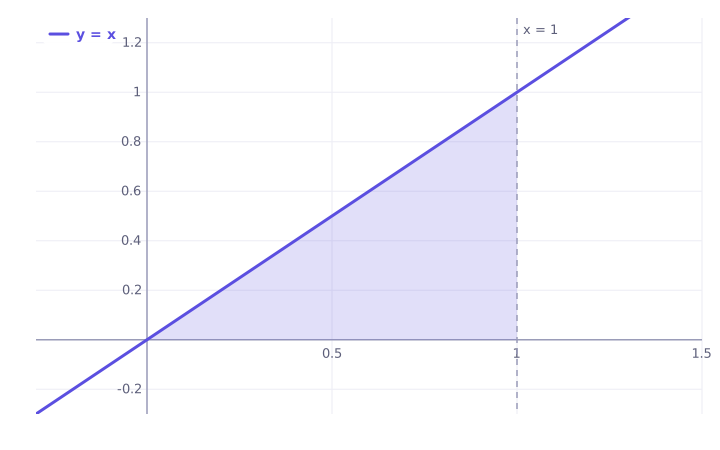
Step 2. Describe it with vertical strips. x runs from 0 to 1, and for each x, y runs from 0 up to the line y = x.
Step 3. Integrate in the new order.
Step 4. Finish with u-substitution. With u = x^2, du = 2x\,dx:
The inner y integral produced the factor x that made the substitution work. That is the classic reason to switch.
Double integrals in polar coordinates
When the region is a disk, a ring or a wedge, rectangular limits get messy. Switch to polar coordinates:
The extra r is there because a small polar patch has width dr and arc length r\,d\theta.
Worked example 4: volume under a paraboloid
Find the volume under z = 4 - x^2 - y^2 and above the xy-plane.
Step 1. Find the region. The surface meets z = 0 where x^2 + y^2 = 4, a disk of radius 2. In polar: 0 \le r \le 2, 0 \le \theta \le 2\pi.
Step 2. Convert the integrand. 4 - x^2 - y^2 = 4 - r^2.
Step 3. Set up with dA = r\,dr\,d\theta.
Step 4. Inner integral.
Step 5. Outer integral. \int_0^{2\pi} 4\,d\theta = 8\pi.
The volume is 8\pi. In rectangular coordinates this would need \sqrt{4 - x^2} limits and a much harder integral.
Common mistakes with double integrals
- Forgetting the r in polar. Without it, example 4 gives \int_0^{2\pi}\int_0^2 (4 - r^2)\,dr\,d\theta = \frac{32\pi}{3}, which is wrong.
- Variables in the outer limits. If an outer limit contains x or y, the setup is broken. Outer limits are always numbers.
- Swapping limits without redrawing. Changing \int_0^1\int_y^1 \,dx\,dy to \int_0^1\int_x^1 \,dy\,dx describes a different triangle.
- Mismatched dx\,dy order. The inner differential must match the inner limits.
- Upper and lower curves reversed. If g_1(x) is above g_2(x), you get a negative area. Check with a sketch.
Quick reference: setting up double integrals
| Region | Setup |
|---|---|
| Rectangle [a, b] \times [c, d] | \int_a^b \int_c^d f\,dy\,dx (either order) |
| Type I: g_1(x) \le y \le g_2(x) | \int_a^b \int_{g_1(x)}^{g_2(x)} f\,dy\,dx |
| Type II: h_1(y) \le x \le h_2(y) | \int_c^d \int_{h_1(y)}^{h_2(y)} f\,dx\,dy |
| Disk of radius a | \int_0^{2\pi} \int_0^a f\,r\,dr\,d\theta |
| Area of R | \iint_R 1\,dA |
| Average value of f on R | \frac{1}{\text{Area}(R)}\iint_R f\,dA |
Practice the setup, not just the integration
The integration in a double integral is usually Calculus 1 and 2 material. What takes practice is reading a region and writing the right limits in the right order. The interactive lesson below gives you regions and integrals to set up, checks your limits before you integrate, and shows exactly which boundary went wrong.
Practice it now
Double integrals over rectangles
Solve real problems on this topic with instant feedback, hints and a step-by-step walkthrough for every answer. Free, no sign-up needed to start.
Practice this lesson