Derivative of 1/x²: Formula, Proof and Examples
The derivative of 1/x² is -2/x³. See the power rule and quotient rule proofs, the chain rule for 1/u², a graph and examples like 1/(3x - 2)².
Powers, roots and polynomials Updated 2 min read
At a glance
- Derivative
- -\dfrac{2}{x^3} for x \ne 0
- As a power
- \dfrac{d}{dx}\,x^{-2} = -2x^{-3}
- Chain rule form
- \dfrac{d}{dx}\,\dfrac{1}{u^2} = -\dfrac{2u'}{u^3}
- Second derivative
- \dfrac{6}{x^4}
- Integral version
- \int \frac{1}{x^2}\,dx = -\frac{1}{x} + C
On this page
The derivative of \dfrac{1}{x^2} is -\dfrac{2}{x^3}. Move the power to the top as x^{-2}, and the power rule finishes the job in one step.
Graph of 1/x² and its derivative
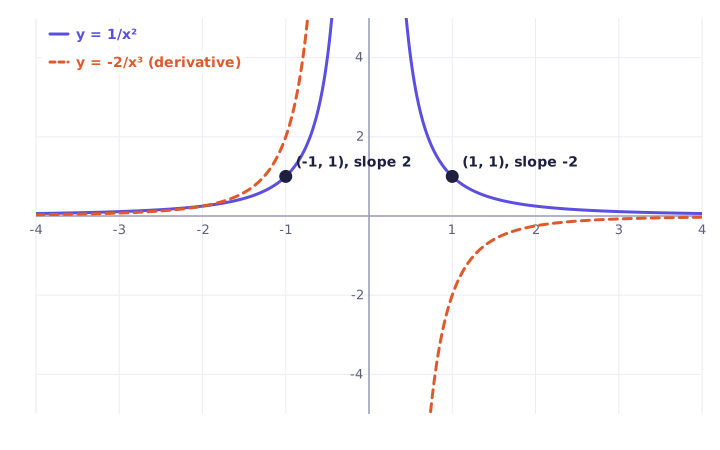
The graph of \frac{1}{x^2} is symmetric about the y-axis, so its slopes at x and -x are opposites. That is why the derivative is an odd function.
Proof with the power rule
This is the power rule with n = -2. The only care needed is the subtraction: -2 - 1 = -3.
Proof with the quotient rule
With top 1 and bottom x^2, the quotient rule gives
Same answer, more work. Rewriting as a power is the faster habit.
Proof from the limit definition
As h \to 0 this becomes \frac{-2x}{x^4} = -\frac{2}{x^3}.
The chain rule version: derivative of 1/u²
Example 1. \frac{d}{dx}\,\frac{1}{(3x - 2)^2} = -\frac{2 \cdot 3}{(3x - 2)^3} = -\frac{6}{(3x - 2)^3}.
Example 2. \frac{d}{dx}\,\frac{1}{(x^2 + 4)^2} = -\frac{2 \cdot 2x}{(x^2 + 4)^3} = -\frac{4x}{(x^2 + 4)^3}.
Example 3. \frac{d}{dx}\,\frac{1}{\cos^2 x} = -\frac{2(-\sin x)}{\cos^3 x} = \frac{2\sin x}{\cos^3 x}. Since \frac{1}{\cos^2 x} = \sec^2 x, this matches the derivative of sec²x, 2\sec^2 x\tan x.
More worked examples
Example 4: a physics shape. Gravity and light intensity follow F = \frac{k}{r^2}. The rate of change with distance is \frac{dF}{dr} = -\frac{2k}{r^3}. Doubling the distance cuts the force to a quarter and the rate of change to an eighth.
Example 5: second derivative. \frac{d}{dx}\left(-2x^{-3}\right) = 6x^{-4} = \frac{6}{x^4}. It is positive everywhere, so both branches are concave up.
How to remember it
Think of \frac{1}{x^2} as a power that happens to sit in the denominator. Move it up as x^{-2}, apply the power rule like any other power, then move the result back down if you want a fraction. The same three steps work for \frac{1}{x^3}, \frac{1}{x^{10}} or \frac{1}{\sqrt{x}}. A quick sign check helps too: for positive x the curve is falling, so the derivative has to be negative there, and -\frac{2}{x^3} is.
Common mistakes
- Writing -2x^{-1}. Going down one from -2 lands at -3.
- Flipping the derivative of the bottom. \frac{1}{2x} is not the derivative of \frac{1}{x^2}.
- Losing the minus sign. The exponent -2 comes down as a negative coefficient.
Going backward, \int \frac{1}{x^2}\,dx = -\frac{1}{x} + C is on the integral of 1/x² page. Compare with the derivative of 1/x.
Practice it now
The power rule
Solve real problems on this topic with instant feedback, hints and a step-by-step walkthrough for every answer. Free, no sign-up needed to start.
Practice this lesson