Derivative of cos²x: Formula, Proof and Examples
The derivative of cos²x is -2 sin x cos x, which equals -sin 2x. See the chain rule proof, an identity check and examples like cos²(4x).
Trigonometric derivatives Updated 2 min read
At a glance
- Derivative
- -2\sin x\cos x
- Simplified
- -\sin 2x
- Chain rule form
- \dfrac{d}{dx}\cos^2 u = -2\cos u\sin u\cdot u'
- Not the same as
- \cos(x^2), whose derivative is -2x\sin(x^2)
- Integral of cos²x
- \int\cos^2 x\,dx = \frac{x}{2} + \frac{\sin 2x}{4} + C
On this page
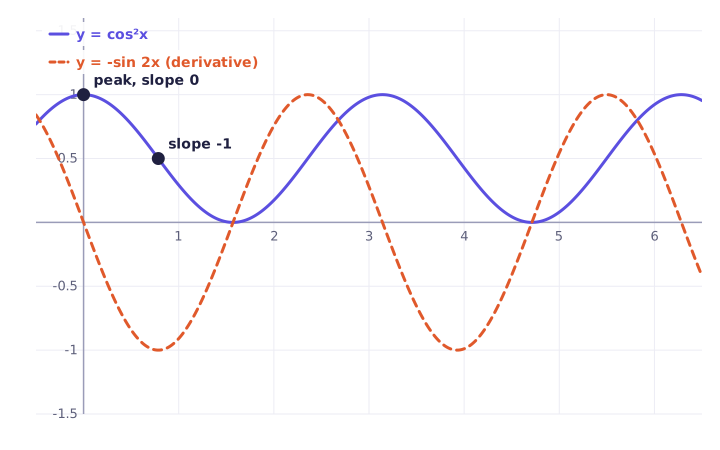
The derivative of \cos^2 x is -2\sin x\cos x, which is the same as -\sin 2x.
Graph of cos²x and its derivative
Proof with the chain rule
\cos^2 x means (\cos x)^2. The outside is the square and the inside is \cos x. With the chain rule and the derivative of cos x:
Since 2\sin x\cos x = \sin 2x, this is -\sin 2x.
A check with a power-reducing identity
Use \cos^2 x = \frac{1 + \cos 2x}{2}:
A check with sin²x
Because \cos^2 x = 1 - \sin^2 x, its derivative must be 0 - \sin 2x, the negative of the derivative of sin²x. The two graphs are mirror images across y = \frac{1}{2}, so their slopes are always opposite.
Chain rule variants
| Function | Derivative | Simplified |
|---|---|---|
| \cos^2(4x) | -8\cos 4x\sin 4x | -4\sin 8x |
| \cos^2(x^2) | -4x\cos(x^2)\sin(x^2) | -2x\sin(2x^2) |
| \cos^2(\pi x) | -2\pi\cos(\pi x)\sin(\pi x) | -\pi\sin(2\pi x) |
Worked examples
Example 1: a value. At x = \frac{\pi}{6}, the slope is -\sin\frac{\pi}{3} = -\frac{\sqrt{3}}{2} \approx -0.866.
Example 2: a higher power. \frac{d}{dx}\cos^3 x = 3\cos^2 x\cdot(-\sin x) = -3\cos^2 x\sin x.
Example 3: a product. \frac{d}{dx}\left(x\cos^2 x\right) = \cos^2 x - x\sin 2x.
Example 4: where is it flat? -\sin 2x = 0 when x = \frac{k\pi}{2}. At even multiples of \frac{\pi}{2}, \cos^2 x = 1 (peaks). At odd multiples, \cos^2 x = 0 (valleys).
Where you will meet it
The function \cos^2 x shows up in physics and engineering whenever something is squared after a cosine wave. The power of an alternating current is proportional to \cos^2(\omega t), and the intensity of polarized light through a filter follows \cos^2\theta. In each case the derivative tells you how fast that quantity changes. Because the answer simplifies to -\sin 2x, the rate of change is itself a simple wave, twice as fast as the original cosine. Writing the answer in that short form also makes it easier to find where the slope is zero, positive or negative.
Common mistakes
- Losing the minus sign. The inner derivative -\sin x carries it.
- Answering 2\cos x or -\sin^2 x. Neither applies the chain rule correctly.
- Confusing \cos^2 x with \cos(x^2). \frac{d}{dx}\cos(x^2) = -2x\sin(x^2).
The integral of \cos^2 x uses the same identity, see the integral of cos²x.
Practice it now
Chain rule: trig
Solve real problems on this topic with instant feedback, hints and a step-by-step walkthrough for every answer. Free, no sign-up needed to start.
Practice this lesson