Derivative of e^(2x): Formula, Steps and Examples
The derivative of e^(2x) is 2e^(2x). See the chain rule steps, a second proof using (eˣ)², higher derivatives, a graph and worked examples.
Exponential and log derivatives Updated 2 min read
At a glance
- Derivative
- 2e^{2x}
- Second derivative
- 4e^{2x}
- nth derivative
- 2^n e^{2x}
- General form
- \dfrac{d}{dx}e^{kx} = ke^{kx}
- Integral version
- \int e^{2x}\,dx = \frac{1}{2}e^{2x} + C
On this page
The derivative of e^{2x} is 2e^{2x}. The exponential stays exactly the same, and the derivative of the exponent, 2, comes out in front.
Step by step with the chain rule
Write e^{2x} as an outer function e^u with inside u = 2x. The chain rule says
- The outer derivative: the derivative of eˣ is itself, so e^u stays as e^{2x}.
- The inside derivative: \frac{d}{dx}(2x) = 2.
- Multiply: e^{2x}\cdot 2 = 2e^{2x}.
The same steps give the general rule \frac{d}{dx}e^{kx} = ke^{kx}. For example, \frac{d}{dx}e^{5x} = 5e^{5x} and \frac{d}{dx}e^{x/3} = \frac{1}{3}e^{x/3}.
A second proof without the chain rule
Since e^{2x} = (e^x)^2 = e^x\cdot e^x, the product rule works too:
Both methods agree, which is a nice check.
Graph of e^(2x) and its derivative
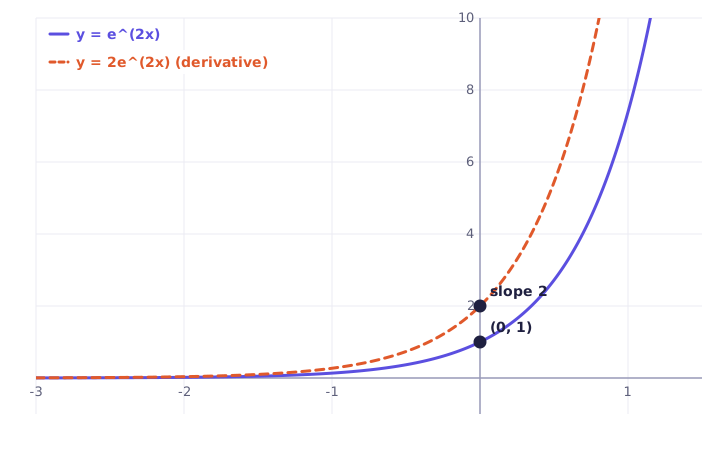
The tangent line at x = 0 has slope 2 and passes through (0, 1), so it is y = 2x + 1.
Higher derivatives
Each time you differentiate, another factor of 2 comes out:
| Derivative | Result |
|---|---|
| f'(x) | 2e^{2x} |
| f''(x) | 4e^{2x} |
| f'''(x) | 8e^{2x} |
| f^{(n)}(x) | 2^n e^{2x} |
This pattern is why y = e^{2x} solves the differential equation y'' = 4y. It also explains the first derivative on its own: y' = 2y says the function grows at a rate equal to twice its current size, which is the rule behind exponential growth with rate constant 2.
Worked examples
Example 1: product rule. For f(x) = xe^{2x},
Since e^{2x} > 0, the only critical point is where 1 + 2x = 0, at x = -\frac{1}{2}.
Example 2: a shifted exponent. For g(x) = e^{2x + 1}, the inside derivative is still 2:
Example 3: a constant multiple. For h(x) = 5e^{2x} - e^{-2x},
The second term flips sign because \frac{d}{dx}(-2x) = -2.
Common mistakes
- Forgetting the 2. \frac{d}{dx}e^{2x} = e^{2x} is the most common slip. Always multiply by the inside derivative.
- Bringing the exponent down like a power. 2x\,e^{2x - 1} is wrong; the power rule does not apply.
- Writing 2e^{x}. The exponent does not change. It stays 2x.
- Mixing up the derivative and the integral. The derivative multiplies by 2; the integral divides by 2.
For the reverse direction, see the integral of e^(2x). For more practice, try derivatives of exponential and logarithmic functions.
Practice it now
Chain rule: e and ln
Solve real problems on this topic with instant feedback, hints and a step-by-step walkthrough for every answer. Free, no sign-up needed to start.
Practice this lesson