Reciprocal Function f(x) = 1/x: Graph, Derivative, Integral and Limits
The reciprocal function 1/x: its hyperbola graph and asymptotes, the derivative -1/x², why its integral is ln|x| + C, and its one-sided limits.
Algebraic functions Updated 3 min read
At a glance
- Domain
- x \ne 0
- Range
- y \ne 0
- Derivative
- -\frac{1}{x^2}
- Integral
- \ln|x| + C
- Asymptotes
- x = 0 and y = 0
- Symmetry
- Odd: f(-x) = -f(x)
On this page
The reciprocal function f(x) = \frac{1}{x} sends each number to one over itself. It is the simplest rational function, the power function with exponent -1, and the standard example of infinite limits, asymptotes and the natural logarithm's derivative.
Formula
Graph of 1/x
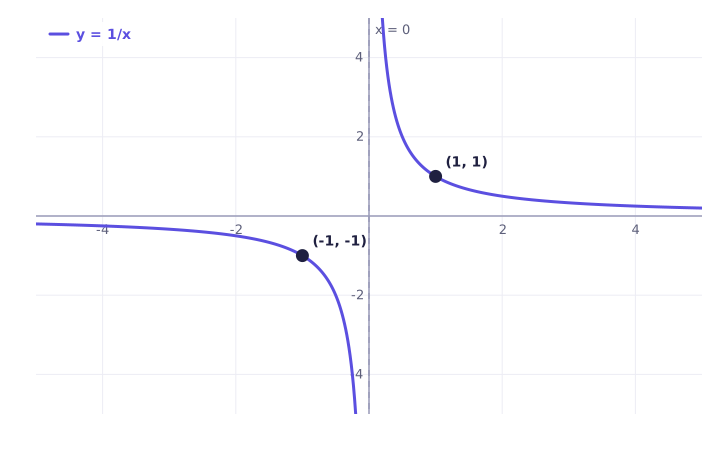
The graph is a hyperbola with two branches, one in the first quadrant and one in the third.
Key properties
- Domain and range. All reals except 0, for both.
- Odd function. \frac{1}{-x} = -\frac{1}{x}, so the graph is symmetric about the origin.
- Asymptotes. Vertical asymptote x = 0, horizontal asymptote y = 0.
- Its own inverse. Solving y = \frac{1}{x} for x gives x = \frac{1}{y}, so f^{-1} = f and the graph is symmetric about y = x.
- Discontinuous only at 0, which is not in the domain. It is continuous on its domain.
Limits of 1/x
Because the one-sided limits at 0 disagree, \lim_{x \to 0}\frac{1}{x} does not exist. The limit at infinity is the basic building block for limits at infinity of every rational function.
Derivative of 1/x
This follows from the power rule with n = -1. The derivative is negative everywhere it is defined, so the function decreases on each branch, and the tangent lines get steeper near 0 and flatter far away. The second derivative is \frac{2}{x^3}: concave up for x > 0, concave down for x < 0.
Integral of 1/x
The reverse power rule would give \frac{x^0}{0}, which is undefined, so \frac{1}{x} is the one power that integrates to a natural logarithm. The absolute value covers negative x: for x < 0, \frac{d}{dx}\ln(-x) = \frac{-1}{-x} = \frac{1}{x}.
A definite integral cannot cross x = 0: \int_{-1}^{1}\frac{1}{x}\,dx is an improper integral that diverges.
Worked examples
Example 1: tangent line. At x = 2, f(2) = \frac{1}{2} and f'(2) = -\frac{1}{4}, so the tangent line is y = \frac{1}{2} - \frac{1}{4}(x - 2) = -\frac{1}{4}x + 1.
Example 2: definite integral. \int_1^e \frac{1}{x}\,dx = \ln e - \ln 1 = 1.
Example 3: a shifted reciprocal. \frac{d}{dx}\frac{3}{x - 1} = -\frac{3}{(x - 1)^2} and \int \frac{3}{x - 1}\,dx = 3\ln|x - 1| + C.
Common mistakes
- Writing \int \frac{1}{x}\,dx = \frac{x^0}{0} or \ln x without the absolute value.
- Getting the derivative sign wrong. \frac{d}{dx}\frac{1}{x} is -\frac{1}{x^2}, not \frac{1}{x^2}.
- Confusing \frac{1}{x} with x^{-1} as an inverse function. \frac{1}{f(x)} is a reciprocal, while f^{-1}(x) usually means an inverse. For \frac{1}{x} they happen to agree, which is unusual.
- Integrating across the asymptote as if the function were continuous there.
How it connects
The area under \frac{1}{t} from 1 to x is exactly \ln x, which is one way to define the natural logarithm. The power functions page covers the family x^n that \frac{1}{x} belongs to, and the harmonic series \sum \frac{1}{n} is its discrete cousin.
Practice it now
One-sided and infinite limits
Solve real problems on this topic with instant feedback, hints and a step-by-step walkthrough for every answer. Free, no sign-up needed to start.
Practice this lesson