Direct Substitution for Limits: When It Works and What to Do Next
Direct substitution evaluates a limit by plugging in the value. Learn when it works, how to read the result and what to do with 0/0 or a/0.
Limit laws Updated 3 min read
At a glance
- Applies to
- Any function that is continuous at x = a
- Works for
- Polynomials everywhere, rational functions where the denominator is nonzero, and \sin, \cos, e^x, \ln x, \sqrt{x} on their domains
- If you get a number
- That number is the limit
- If you get 0/0
- Indeterminate: simplify, then substitute again
- If you get a/0 with a ≠ 0
- The limit is infinite or does not exist
On this page
Direct substitution is the first move for any limit: replace x with the value it approaches and compute. If the function is continuous there, the value you get is the limit. If you get \frac{0}{0} or a number over zero, the result tells you which technique to use next.
The direct substitution property
If f is continuous at x = a, then
This is really the definition of continuity read backwards. It covers most functions you meet: polynomials, rational functions (where the denominator is not zero), roots, exponentials, logarithms and trig functions on their domains, and any sums, products, quotients and compositions of these. The limit laws are what guarantee it.
How to read the result
| You get | What it means | Next step |
|---|---|---|
| A real number L | The limit is L | Done |
| \frac{0}{0} | Indeterminate form | Factor, rationalize or use L'Hôpital's rule |
| \frac{a}{0} with a \ne 0 | Vertical asymptote | Check the sign from each side: \pm\infty or does not exist |
| Undefined for another reason (like \sqrt{-1}) | a is outside the domain | Look at one-sided limits or the domain |
Worked examples
Example 1: a number comes out. Polynomials and trig functions are continuous, so substitute:
Example 2: a rational function. The denominator at x = 3 is 2 \ne 0:
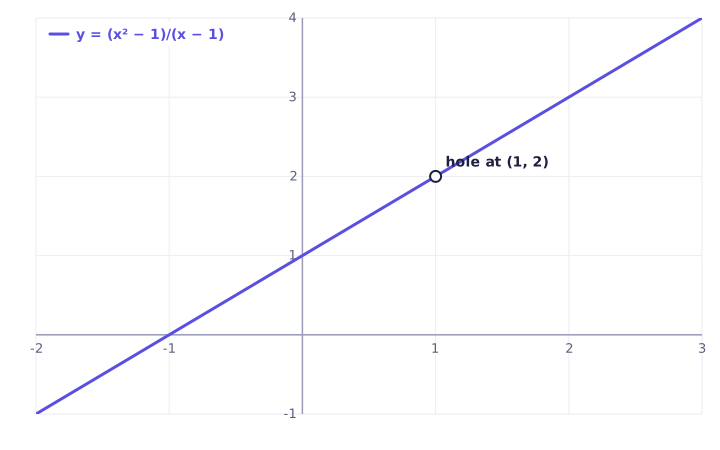
Example 3: \frac{0}{0}. Substituting x = 2 into \frac{x^2 - 4}{x - 2} gives \frac{0}{0}. Factor, cancel, and substitute into the simpler expression:
Example 4: \frac{0}{0} with a root. For \lim_{x \to 0} \frac{\sqrt{x + 9} - 3}{x}, substitution gives \frac{0}{0}. Multiply by the conjugate:
Now substitute: \frac{1}{3 + 3} = \frac{1}{6}.
Example 5: a nonzero number over zero. For \lim_{x \to 2} \frac{1}{x - 2}, substitution gives \frac{1}{0}. From the right the quotient goes to +\infty and from the left to -\infty, so the two-sided limit does not exist.
Why canceling is allowed
A limit as x \to a depends only on values of x near a, never on x = a itself. The functions \frac{x^2-4}{x-2} and x + 2 are equal for every x \ne 2, so they have the same limit at 2. Canceling changes the function only at the one point the limit ignores.
Common mistakes
- Calling \frac{0}{0} zero, one, or "does not exist". It is none of those automatically. It means "keep working".
- Substituting into a function that is not continuous at a. For a piecewise function, the value f(a) can differ from the limit. Check each side.
- Stopping at \frac{a}{0}. Decide the sign from each side to say whether the answer is \infty, -\infty or does not exist.
- Forgetting to substitute after simplifying. The whole point of factoring is to reach an expression you can substitute into.
When algebra gets messy, L'Hôpital's rule handles \frac{0}{0} with derivatives. For a full set of techniques, see how to evaluate limits.
Practice it now
Direct substitution
Solve real problems on this topic with instant feedback, hints and a step-by-step walkthrough for every answer. Free, no sign-up needed to start.
Practice this lesson